Ethnic Cleansing in Ohio, Thanks to the Supreme Court
Timothy Snyder Substack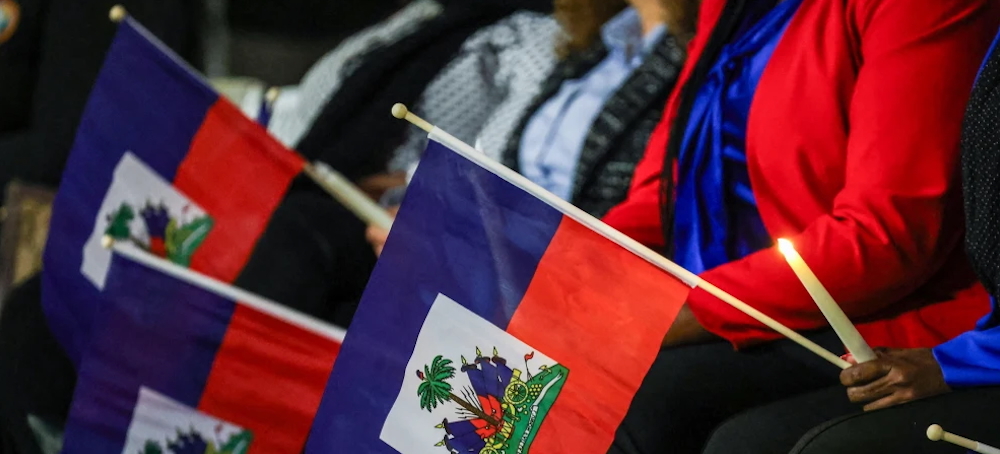 The Supreme Court decision could affect as many as 350,000 Haitians who have TPS. (photo: Giorgio Viera/AFP/Getty Images)
ALSO SEE: Thinking About, Timothy Snyder on Substack
Back in February, when I first wrote on this subject, the city was on the brink of a federal ethnic cleansing, grounded in a hate campaign organized by the vice-president and American Nazis, in the context of the racially hateful language of the president. The deportation was halted by a district court in February on the correct ground that the decision to deport them was based on race. Ethnic cleansing has now been endorsed by the Supreme Court.
Before the district court and the the Supreme Court, Haitian plaintiffs claimed, with much evidence, that race was one of the motivating factors of the decision of the executive branch to terminate the protected status that allowed them to remain in the United States. The Supreme Court majority just chose, in a ruling that was openly counter-factual, to imagine that what was patently racist might not have been, and that the transparent motivations of the president and his administration “could have” have been different from what they were.
Self-lying by the powerful is often element of an ethnic cleansing campaign.
The Supreme Court majority rightly insisted that a decision about equal protection depends upon “context.” Context means two two things: the lexical context, the words that were actually said by relevant actors around a matter in question; and the the historical context, the events during which or about which words were uttered. Both point towards the racial motivation of the executive branch. Both were ignored by the majority.
The Haitian plaintiffs drew attention to the following statements of the president (cited by a minority in a dissent). Haitians are “eating the dogs… They’re eating the cats. They’re eating—they’re eating the pets of the people that live (in Springfield, Ohio).” Haitians are also eating, the president claimed, “other things too that they’re not supposed to be.” Haitians in the United States, he said, “probably have AIDS.” Haiti is a “shithole country,” which is “filthy, dirty, (and) disgusting.” Haitian immigration is “like a death wish for our country.” Haitians are “poisoning the blood” of America.
This lexical context should have been more than enough to show that race was one of the motivating factors.
The historical context, which the Supreme Court also set aside, reveals a very specific campaign against the Haitians of Springfield, Ohio, initiated by JD Vance, American Nazis, and Donald Trump.
During the last presidential campaign, JD Vance, then the vice-presidential nominee, put the Haitians of Springfield at the center of national attention. Temporary Protected Status had been granted to non-citizen Haitians in the US after an earthquake in Haiti killed more than 200,000 people; it was extended after the Haitian president was assassinated. This allowed ten thousand or more Haitians to gather in Springfield, a small city between Dayton and Columbus, and to work. Vance heard about Haitians in Springfield, from a city manager who wanted federal assistance for housing. He turned a reasonable request into a racial crusade. In his own phrase, he made up a story.
In a speech of 10 July 2024, Vance claimed that “Springfield, Ohio has been overwhelmed” by Haitian immigrants. Although there was certainly friction over schools and housing, there was no basis for such a judgement. Vance is from Ohio; it would not have been hard for him to figure out that Springfield was doing better economically than in any moment in his lifetime. In the months to follow, he would return again and again to the theme, publishing a number of inflammatory claims about Haitians in Springfield, not a single one of which was true. As we will see, Vance’s goal was not so much to get individual lies on the record; it was rather to create a self-sustaining story, in which a real place and its real people could become the raw material for an alternative Nazi reality -- I use the word advisedly. Vance had help in expanding his theme, and crucial helpers were Nazis. All of this history is in the public record; the fact that the Supreme Court ignored it does not make it go away.
In American terms, Haitians are Black; and the American group Blood Tribe are white-supremacist blood-obsessed Nazis. After Vance’s speech, Blood Tribe took its cue. Blood Tribe had marched in other cities in the previous two years, wearing masks, distinctive uniforms, and carrying banners with swastikas. These marches were unmistakably Nazi. Vance’s speech drew the attention of Blood Tribe to Springfield, Ohio. On 10 August 2024, members of Blood Tribe carried out their usual performance in the city’s downtown, two of them carrying banners with swastikas and another two brandishing automatic rifles. Mayor Rob Rue called the march “an attempt to disrupt our community by an outside hate group.” Blood Tribe responded on social media: “We hear that you have a real problem with Haitian ‘refugees.’”
And from whom did they “hear” this? JD Vance. It is worth noting that Mayor Rue (a Republican) as well as Ohio governor Mike Dewine (also a Republican) denied that Haitians were a problem, characterizing them as hard workers who had improved the local economy. But Vance was not interested in the the local reality; he was trying to change it by deliberately introducing fiction. His lies brought more lies, and those lies brought hatred.
Later in August 2024, a local Springfield (self-described) social media influencer named Anthony Harris attended a meeting of the Springfield City Commission. He claimed that Haitians were “flipping cars in the middle of the street,” which was not the case. He then introduced a colorful new element to Vance’s image of a Springfield “overwhelmed” with refugees. He claimed that Haitians went to Springfield parks, seized ducks by the necks, cut off their heads, and then devoured the headless fowl. This was untrue, but it of course invoked an image of a barbarous other. Vance’s lie led to more lies, which he would himself then spread.
Five Blood Tribe members also attended that same 27 August City Commission meeting. One of the Nazis, Drake Berentz, stood up to say that “I come to bring a word of warning. Stop what you are doing before it’s too late. Crime and savagery will only increase with every Haitian that you bring in.” Haitians had been living in Springfield for years. The only novelty was that Vance had drawn attention to them. After the City Commission meeting, Blood Tribe took to the internet to spread the lie that “Haitians eat the ducks out of city parks.”
This business of purported animal abuse would become very important. A month later a version of the story would be spread to tens of millions of people by a former (and future) president of the United States, Donald Trump, who would use a tale of barbarism as a justification for a “large deportation.” It began with Vance, it spread through Nazis, it reached Trump, and eventually it defined policy.
The question of who is human and who is not can be defined by animals. In a predominantly rural society, the claim that people are beasts is a suggestion that they can be slaughtered. In an urban or suburban setting, in which animals are companions, the idea that others mistreat animals can be the signal that they are not like us, barbarians, not fully human. Among the many other accelerating repressions, Jews in Nazi Germany were not allowed to keep pets at home. In the US, the slur of eating pets has traditionally been applied to Asians. The idea that Black people eat the wrong things in the wrong way is a staple of American racism.
In early September 2024, a Springfield woman posted on Facebook about a lost cat. She had heard from someone — who had heard from someone else —who had heard from yet someone else — that a cat had been abducted and eaten by Haitians. The fourth-hand story had no basis. But once online, it could be used, and it was. The fascist-friendly Twitter account @EndWokeness posted that “ducks and pets are disappearing,” with a screenshot of the cat post and a photo of a man holding a Canada goose. The photo was taken in another city, and the man in the image complained that his image was being used in a campaign of lies. The baseless notion that Haitians were mistreating or killing animals, spread to make them seem like barbarians, was then quickly shared by prominent far-right figures such as Charlie Kirk and Elon Musk.
When Vance then posted about Haitians on 9 September 2024, two months after his first speech, a circle was closed. He had drawn attention to Springfield, including the attention of Nazis. This led to the portrayal Haitians as criminals and barbarians, first by Nazis whom he drew to Springfield and then by far-right influencers on the internet. Vance now repeated the specific claims, to which he himself had given the general impulse, as evidence that his initial slander had been true. “Reports now show,” he wrote, “that people have had their pets abducted and eaten by people who should not be in this country.”
There were no such reports; there was only the campaign of obviously racial aggression that Vance himself had initiated. Cat-eating now became a favorite topic among national elected Republican officials. Often this took a joking tone, with cat memes. This levity is a tactic of the on-line far right: even as we demean other people and deny their humanity, it is all somehow just a joke. But of course the consequences are real: an advocate of the Haitian community was harassed after Vance’s post.
This was just the beginning. The alternative reality that Vance and Nazis co-created was bleeding into the real world. The next day was the presidential debate between Donald Trump, then the Republican nominee, and Kamala Harris, the Democratic nominee.
On the stage in Philadelphia on 10 September 2024, before a national televised audience of sixty-seven million people, Trump led with racial abuse of Haitians in Springfield: “In Springfield, they’re eating the dogs, the people that came in, they’re eating the cats. They’re eating, they’re eating the pets of the people that live there, and this is what is happening in our country and it’s a shame.” One of the moderators pointed out that there was no evidence for any such claim. Trump then said that he had seen “people on television” complaining that their dogs had been eaten. There were no such television reports.
After the debate, Vance revealed that he was deliberately lying: saying one thing that was not true (the pets) in the service of spreading even bigger lies (some general catastrophe). He essentially granted to an interviewer that the story about cats and dogs was not true, but “whatever the case may be,” it was legitimate to spread a lie because it drew attention to the general “carnage” in Springfield, of which of course there was none. Small lies are acceptable, for Vance, when they help build up a big lie. Vance’s stance might be summarized thus: “Where there is the smoke that I made up, then there must also be the fire that I also made up.” In other settings, Vance was more specific than “carnage,” claiming increased rates of disease and crime. All of these claims were also baseless and false.
A spurious alternative reality, built from Nazi marches, internet memes, and Vance’s and Trump’s lies was consciously created and spread. The day after the presidential debate, the leader of the Nazi group Blood Tribe understandably declared victory, expressing his pride that Blood Tribe had “pushed Springfield into the public consciousness.” What the Nazis and Vance and Trump said about Haitians at this time is part of the lexical context that the Supreme Court majority invoked only to ignore. It is also part of the historical context of which their ruling is now part. In ignoring all of this history, the majority has pushed history in a certain way: towards ethnic cleansing
In the moment, in autumn 2024, Ohio politicians did make an effort to protect the truth. Governor Mike DeWine spoke up to contain the lies that Vance and others had spread. DeWine acknowledged the very real challenges created by rapid immigration to schools and housing, and described state-level measures designed to address them. He described the Haitian immigrants as a “positive influence.” He elaborated: “People who want to work, people who value their kids, who value education, you know, these are positive influences on our community in Springfield, and any comment about that otherwise, I think, is hurtful and is not helpful to the city of Springfield and the people of Springfield.” Mike DeWine, who was born in Springfield, knew what he was talking about. But he was reaching thousands of people. Social media had reached millions, Trump tens of millions. The damage had been done. The historical event that the Supreme Court’s majority chose to ignore entirely was underway.
Vance’s Nazi-propelled propaganda had won. And a propaganda victory of this sort, involving degrading claims about crime, barbarism, and disease, can lead directly to threats and violence. Two days after the presidential debate, Blood Tribe doxed Springfield residents, while several public buildings in Springfield had to be closed due to bomb threats, at least one of which involved hate speech about Haitians. The day after that, on 13 September 2024, three Springfield schools had to be closed after bomb threats. Amidst the chaos that he himself had sown, Vance blamed the immigrants and Kamala Harris.
Having created the problem, Trump and Vance had a “solution,” That same day, Trump claimed that immigrants had “destroyed” Springfield, and promised that, were he to become president, he would order an ethnic purge of the city: “I can say this, we will do large deportations from Springfield, Ohio — large deportations. We’re going to get these people out.” Trump’s words were as magnetic as Vance’s: on 28 September, the Nazis of Blood Tribe returned to Springfield, this time waving a swastika flag in front of the mayor’s house. Trump announced in September 2024 what would in fact become his policy, and in the historical moment it was absolutely clear that it was based upon a racist fantasy and racist emotion. The Supreme Court’s majority ignored this obvious and known set of facts.
And, of course, these kinds of facts, observable in the United States in 2024, themselves fall into a larger historical context, that of the rhetorical preparation for ethnic cleansing. The Trump-Vance lie that the city had been “destroyed,” the notion of “carnage,” the dehumanization of immigrants— all of this creates the impression that their promised ethnic cleansing action would be a response to something, rather than a simple choice to exercise state violence against an invented racial enemy. These reversals are very important. It is important to consider this carefully.
First, Vance reported that the Nazi propaganda campaign that he had himself inspired amounted to factual evidence. Mental chaos has been created where there was none before. And then that mental chaos becomes the justification for physical chaos: Trump’s “large deportations,” ICE raids now enabled by the Supreme Court that would, in fact, wreck an improving local economy.
And once that physical chaos has been created, it will be blamed on the immigrants who are no longer there. Most of this has already played out. A key threshold, which the Supreme Court has now allowed the president to cross, is the application of the state violence. At that point, so to speak, the lie is supposed to become “true.”
Hitler gave very specific propaganda guidance in Mein Kampf: a Nazi leader should tell a lie so big that his people cannot accept that they could be deceived on such a scale. And that is one logic, for those predisposed to believe a cat-eating-scale liar like Vance and to accept that the violence was justified. Others, those who do not trust Vance, might still find it hard to believe that their own government, however untrustworthy, is really about to carry out an ethnic cleansing operation just because Nazis march and the vice-president messages. That is, however, the origin story of this policy; and by ignoring it, the Supreme Court takes part in what comes next.
But if we lose time in incredulity at the horror of Vance and Trump’s preparations and the faux naïveté and po-faced politics of the Supreme Court, we risk becoming complicit. Once a big lie has led to violence, violence in which we are implicated because it is our government, it becomes harder to deny the initial lies — we do not want to think that we are complicit in an act of state terror that was based on absolutely nothing except Vance’s lies and Nazi marches. And so some kind of resistance now, even if it is not completely effective, is not only politically but ethically very important.
One answer to a big lie, to a Nazi alternative reality, are the small truths. When I visited Ohio in October 2024, after the presidential debate, and then again in October 2025, I was told that the narrative imposed by Vance and Trump on Springfield was irritating and wrong. To be sure, Springfield had problems, like most cities in my home state. But when I stopped there last October, my impressions were in line with what the Ohio governor has been saying. The city, which I have known since childhood, is clearly on the upswing.
When I was growing up in the area, Springfield was much rougher than it is now. When I was finishing middle school, in 1983, Newsweek devoted an entire issue to Springfield, a gentle case study of the decline of the American dream. When I was in high school, the city (still) had two high schools, and so two football teams, which meant that I visited several times (to watch). It was a tricky town. Things got worse in the 1990s, as the main local employer, International Harvester cut back production, and industry in nearby Dayton also retreated. Between 1999 and 2014, median income in Springfield fell by more than in any other metropolitan area in the country. By 2012, Springfield self-rated as the unhappiest city in the land, and in 2016 it was presented in national media as the nadir the rust belt trajectory. But the city presented itself as a good place to do business, and in 2017 a big Japanese auto parts maker moved in. And suddenly there were more jobs than people seeking them. Soon the Haitians, who could legally work, starting coming.
By the 2020s, the city has visibly improved. The downtown, which had gone almost dark, is much more bright and functional: the Museum of Art and the Heritage Center Museum are still inviting, and there are good restaurants in the center — in part thanks to Haitians. Looking out into the sunshine of a perfect fall day from the pavilion of a Mexican place, it seemed grotesque to imagine that restaurants and other sites of employment could be raided by federal agents, that the city could be laid to waste on the lying logic that it had already been laid to waste. There was nothing here, nothing among the small truths of Springfield, that could justify such an action.
But even as I was visiting Springfield in autumn 2025, Vance’s mendacity was doing its political work under the new Trump administration. The fiery racial lies were becoming cold bureaucratic power. A few weeks later, in late November, the federal government took the actions necessary to establish the institutional preconditions for an ethnic cleansing of Springfield. In late November 2025, the Department of Homeland Security issued an unpersuasive finding of improved conditions in Haiti. It did so without the consultations required by law.
This was the step needed to deprive Haitians of the official Temporary Protected Status that allows them to live and work legally in the United States. Read attentively, the text reveals that conditions in Haiti remain disastrous. At most, there is some weak gesturing towards the future possibility of some improvement — which, in normal times, would be obviously insufficient to deprive Haitians of their status. There is no sense of such improvement in State Department documents, such as the current travel advisory strongly discouraging Americans from visiting Haiti.
The concluding claim of the finding is that the presence of Haitians “is contrary to the US national interest.” This assertion, which is presented as dispositive of all other issues, goes unexplained and undefended. What national interest, exactly? How? The only answer is a vague reference to Trump’s beliefs. In the context of the previous events, the meaning is clear enough. The beliefs that Trump had expressed, following Vance, were all about race. The president and the vice-president had repeated that Haitians eat domestic animals, cause diseases, commit violent crimes, and wreck cities. These very specific dicta about Haitians originated with JD Vance and American Nazis. Given the lack of any other explanation, it would seem reasonable to conclude that the motive of the policy is the racial hatred expressed by the president and the vice-president. This was the determination of a district court that cited some of these facts; it was overturned by a Supreme Court majority last week that cited none of them.
This expression of state of mind is one reason why, should a major ICE operation go forward in Springfield, it would have to be seen as the ethnic cleansing of an American city. To be sure, the appearance of racial difference drives ICE raids all over the country. But in the case of the Haitians of Springfield, Ohio, we have a particularly clear trail from public racism to practical policy. This is what lawyers and historians concerned with genocide try to ascertain: was there the “intent to destroy, in whole or in part, a national, ethnical, racial or religious group”? It is not easy to settle questions of intent, or of genocide generally; but the expression of racial fantasy about “carnage,” “destruction,” and barbarism by the vice-president and the president weighs on one side of the scale.
Will there now be such an operation? Earlier this year, before the district court ruling, local authorities indicated that one would begin on 4 February and last for thirty days. Today the general expectation is the same.
Up until now, the major ICE raids have taken place in states and cities with reliable Democratic majorities. In Springfield, Ohio, the politics would be different. Republicans dominate a wildly gerrymandered Ohio state legislature. Ohio’s two Republican United States senators are unlikely to contradict the president on his signature issue. Mayor Rue and Governor DeWine unsurprisingly say that the law is the law; even these local and state-level Republicans, for whom the issue is close at hand, cannot be expected to use a language of opposition. That said, their expressions of concern have been unmistakable; and, in DeWine’s case, thoughtful and detailed. Dewine is far more informed about both Springfield and Haiti than any of the federal authorities.
DeWine has disputed the two justifications given by the Department of Homeland Security for the federal action: that Haiti is safe and that Haitians in Springfield somehow compromise “national security.” He said earlier that the decision to remove their Temporary Protected Status was “wrong.” His description of Haiti is, sadly, quite accurate: “it’s extremely violent, the economy’s in shambles, the government does not function, the police are virtually worthless.” He contradicts the Department of Homeland Security finding: “it doesn’t qualify as the situation changing for the better in Haiti.” DeWine is an informed observer, not only of Springfield, but also of Haiti. He and his wife Fran DeWine helped to fund a school in Haiti, named in honor of their deceased daughter, Becky. This charitable effort became unsustainable in 2024.
The direction of federal deportation policy really rests on claims about Springfield. Here DeWine’s statement was equally clear: “Springfield and Clark County are coming back, they’ve been doing a very very good job. It’s an upward movement. Part of that upward movement comes about because, frankly, of Haitians who are working and contributing to the economy and buying things and opening restaurants and doing all the things that working people (do). These people are working, and they’re hard workers, so I think from a public policy point of view, it is a mistake, it is not in the best interest of Ohio, for these individuals who are workers and working to lose that status.” The Ohio governor still says, after the Supreme Court ruling, that the president’s policy is wrong in its claim that Haiti is safe and harmful to the people of Ohio.
DeWine’s description of workers helps us to imagine the realization, in an actual city, of the inhuman, nonsensical language of the Supreme Court’s ruling. There are at least ten thousand men, women, and children who will be subject to arrest and deportation in Springfield alone. These are those men and women at work, “who one day will be able to work, and the next day will not be able to work,” as the governor put it -- the Supreme Court ruling means that people who try to work will be seized in their workplaces, and if not seized in their home.
Those are adults; we also have to imagine the children. Roughly twenty percent of the children in Springfield Public Schools do not have documentation that would establish their citizenship. All of these boys and girls, about fifteen hundred children, are vulnerable. As in other cities, they can be taken from schools and away from their parents, or return home to find their parents gone. The Ohio Education Association, the largest teachers’ union in the state, “strongly opposes” any presence of ICE agents in schools, which “undermines trust, disrupts learning, and creates trauma for children and families.”
Although the Supreme Court majority tries to persuade us that it is simply applying the law as it must, its nonsensical prose is on the side of chaos, not of order. Sad though it is to contemplate, trauma is a goal of ethnic cleansing. The stages that we have seen in Ohio are all too familiar: the fiction of the subhuman enemy; the false details that are used to introduce the stereotypes; the organized use of the propaganda of racial hatred in media; the capture of government by people involved in all this; and then finally the Court’s endorsement of the application of violence to thousands of human bodies. At every stage we have been offered the reasons that we should find this normal: on the one side, the fiery talk about subhumans; on the other, the Court’s Kafkaesque boilerplate suggesting that all is normal and inevitable and that no one need take personal responsibility for what is simply happening and must happen.
The work to normalize racist and Nazi language looks exactly like the Court’s ruling; the overwrought performative neutrality of the Court is not only dishonest in itself, but constructive in its outrageous mendacity of an atmosphere of unreality that favors violence. The Court, in other words, in not only permitting the executive to undertake violent actions; by doing so on the basis of transparently obvious falsehoods, it is actively creating the conditions in which such violence can be rationalized and escalated.
The violence, once it comes, changes normality: first of all, for the people who are rounded up and held in the concentration camps we call “detention centers,” preparatory to being sent either somewhere they do not want to go, or dying in custody. And this leaves trauma among the survivors in the most obvious, incontestable sense.
But everyone who observes also partakes in the trauma. The kids who remain in Springfield schools after their friends disappear will need to tell themselves something. Their parents will need to think of what to tell them. Everyone around has to ask how it came to this. The trauma becomes a political resource. The perpetrators of an ethnic cleansing use the emotion to reshape how we see our neighbors — and ourselves. Most people, I expect, would be appalled by an ethnic cleansing in Springfield. The ethnic cleanser, though, rules with the help of those who are not, those who comply, agree, take part. And in this way ethnic cleansing itself is a step away from democracy and towards minority rule by a police state served by those willing to wear the mask.
Those who dispense the trauma are aware of what they are doing. In this whole Springfield story, it is the statements of Blood Tribe and the the vice-president that reveal the most self-awareness. They are guiding a process that they recognize, understand, and approve: the generation of an alternative reality with a clear definition of the detestable other, and then the mobilization of state power to eliminate that imagined enemy. If this process is completed, as there is every sign that it will be, they will have succeeded: and they too will be altered. Blood Tribe, and groups like them, will have seen how they can move the national conversation and the federal government.
If there is a Springfield pogrom, JD Vance will have his first namesake policy. Although he has been outspoken during the first year of the Trump administration, and has gotten himself in the way of various endeavors, there is, as of yet, no clear instance of a policy of which he is the author and the executor. The ethnic cleansing of Springfield would be the first. “JD Genocide,” or perhaps “Genocide Vance” -- if all this happens, the sobriquets will write themselves.
And what history will the rest of us write for ourselves? When we are confronted with street terror, concentration camps, and mass deportations, as now in the United States, the thought of historical precedents arises — and is usually suppressed. “It can’t happen here,” we think, so this must not be “it.” When we take the focus down from the national to the local, to the story of Springfield, this is a bit harder to maintain. The “it” is right there in front of our faces.
We confront here no historical analogy, but actual twenty-first century American Nazis who took their cues from the man who is now vice-president, acted in the public sphere, shaped the public conversation, and are now getting the policy outcome that they desired from a Supreme Court that whitewashes the history in which they played a central part. As the mayor noted after Blood Tribe marched in Springfield, the aim was to “disrupt the community” — and now, thanks to the Supreme Court, that disruption can take on a catastrophic scale.
Having followed the genealogy of events in Springfield, we might find ourselves more open to broader interpretations of what is happening around us, at a national level. After all, the social media feeds of the Department of Homeland Security are ever less distinguishable from those of Blood Tribe, and of course incomparably more influential. The motives given for the deportation operations as a whole, the notion of “criminal aliens” and the like, are essentially those of Springfield writ large. Springfield, far from being the exception, might help us to see the general rule. When I see masked ICE agents I can’t help remembering the masks of Blood Tribe -- and asking myself if there might be some overlap in personnel...
For me, as a historian of atrocity who was raised in Ohio, it is uncanny to consider this evidence. Usually I am reading the sources years or decades after the fact, not along with the events themselves. Usually I visit sites of memory, not cities at risk, which is what Springfield is right now. I wish that what I know about other times and places was not quite so applicable. But insofar as is historical patterns are of any use, it is in naming what might well happen before it does happen -- which, perhaps, makes the horror less likely.
An ICE surge in Ohio is not inevitable. Trump does not have to order his promised “large deportation.” In April the House of Representatives passed legislation extending protected status for Haitians. But the Senate would have to agree and the president would have to choose not to exercise his veto.
In the five months between the district court ruling and the Supreme Court ruling, Trump has become even more unpopular. It is possible that he wiIl avoid a single dramatic cleansing action and instead try to get rid of Haitians in smaller groups, or by taking actions that make their lives here intolerable. Whatever policy he chooses, it can be resisted, recorded, given its place in history by those with the courage to be present and to speak about what they see. There will be other Courts, and other Americans, who will care about this history, and how we choose to make it and see it. The seeing, just the seeing, is of huge importance, for all of us. When we see, we can feel and we can act. We can empathize, communicate, shelter, protest, help.
PS For a sense of how how you might help, please follow the links in the final paragraph.
PPS In this essay I cite local reporting from the Dayton Daily News, the Ohio Capital Journal, and the Springfield News-Sun. Please consider following the links to subscribe.
PPPS In this essay I do not raise another issue about the majority ruling: it ignores the statute in question, or rather on the basis of some adventurous wordplay claims that the law does not say what it clearly says. The Secretary of Homeland Security, then Kristi Noem, was statutorily required to consult about the safety of Haiti before issuing a determination that Haitians could be denied their protected status. She did not do so. But the majority found that this was acceptable, because (for example) “consulting” can mean just the intention to consult and not an actual exchange of information. As ever the Court majority’s “literalism” proves to be specious, or indeed Orwellian: Congress can write any statute it wants, and then the Court can decide that the executive branch need not follow it, because of some improvised semantic fantasy that reads as though it arose from a late-night competition of Supreme Court clerks to see who could come up with the most embarrassing formulation to put in the mouths of their justices.
PPPPS This is an updated and expanded version of a post that I originally published in early February 2026, right before the district court ruling. I am updating in June 2026, after the Supreme Court ruling (TS 29 June 2026).