Donald Trump’s Ad-Lib Strategy on Iran
Robin Wright The New Yorker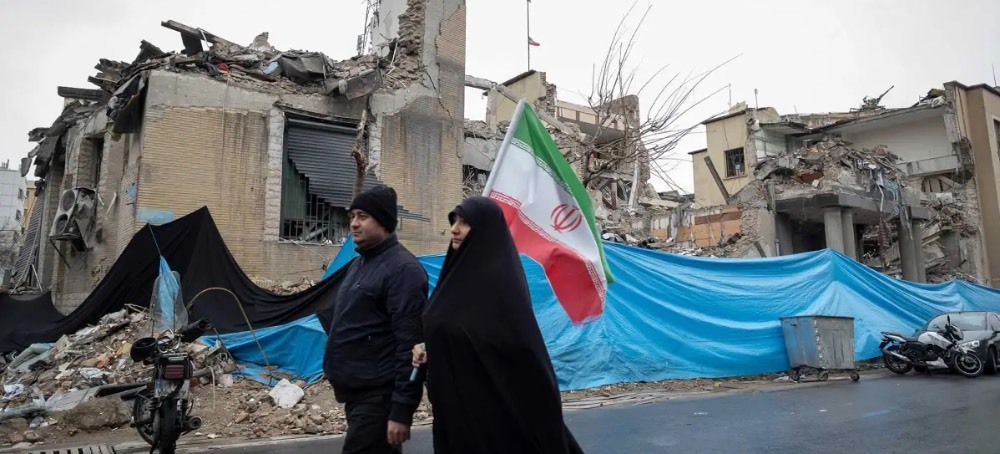 The President promised to end what had been a quarter century of forever wars in the Middle East. Now the U.S. is mired in an intractable conflict of his own making. (photo: Andrew Harnik/Getty)
The President promised to end what had been a quarter century of forever wars in the Middle East. Now the U.S. is mired in an intractable conflict of his own making.
As America’s war in the Middle East gets more complicated, Trump appears to be ad-libbing policy. According to Richard Haass, a senior official in both Bush Administrations and the former president of the Council on Foreign Relations, Trump has tried three strategies so far: regime change, relentless bombardment, and then diplomacy. The U.S. has “come up short each and every time,” Haass wrote in his Substack column this week. “The question is whether Trump has a Plan D. But who’s counting?”
In Washington, there is a growing sense of despair among foreign-policy experts and former policymakers about the direction of the war—and whether an end to it is even achievable, at least anytime soon, short of diplomatic surrender by either side. On Tuesday, Alan Eyre, a former diplomat and an Iran expert now at the Middle East Institute, posted, on X, “Trump doesn’t have a strategy to end this war: strategically, he is flailing.”
The President’s statements have gyrated wildly. Just a month ago, Trump and his Iranian counterpart, Mahmoud Pezeshkian, signed a fourteen-point memorandum of understanding that declared “the immediate and permanent termination of military operations on all fronts, including in Lebanon.” Washington and Tehran vowed “from now on not to initiate any war or any military operation against each other, and to refrain from the threat or use of force against each other.”
At the time, Trump boasted that the arrangement “achieves everything we set out to accomplish.” He touted the Iranian mediators as “very rational people. They were nice to deal with. They were strong people, smart people.” He added, “They’re not radicalized.” This was from the same man who implied, on the first day of the war, that the U.S.-Israeli operation sought to topple the regime. “The hour of your freedom is at hand,” he had promised the Iranian people, as their Supreme Leader, Ayatollah Ali Khamenei, was assassinated. “When we are finished, take over your government. It will be yours to take.” By mid-June, he was telling reporters at the G-7 summit in France, “I never cared about regime change.”
While the diplomatic efforts were under way, Vice-President J. D. Vance, who negotiated with senior Iranian officials in Pakistan and Switzerland, told Jake Tapper, of CNN, “The coolest thing about the progress we’ve made over the last few weeks is that you see people within the Iranian system, senior leadership, even I.R.G.C. officials, say, ‘You know what, we may have some animosity, we may have some mistrust, but we recognize the way that we’ve done business with the United States for forty-seven years is a mistake.’ ”
Now, as Trump’s fly-by-the-seat-of-your-pants policy on Iran implodes, he has taken to disparaging Iranian interlocutors as “scum,” “cuckoo,” “sick,” “vicious, violent people,” and “a bunch of lying guys.” He has stooped to the level of the belligerent Iranians who have shouted “Death to America” for nearly half a century.
“It is impossible to overstate how quickly and comprehensively the U.S. has undermined deterrence and squandered its leverage over Iran,” Philip Gordon, who served in the Obama and Biden Administrations, noted this week. Last summer, the U.S. and Israel struck Iran’s nuclear sites in a limited military operation, targeting facilities in Natanz, Fordow, and Isfahan. The extent of the damage was debated, but the balance of power remained fundamentally unchanged. “It was only Trump’s decision to roll the dice on regime change that led a cornered regime to start attacking its neighbors and close the Strait, grabbing a stranglehold on the world economy,” Gordon, who is now at the Brookings Institution, wrote. “That genie can never be put back in the bottle.”
David Axelrod, a former adviser to President Barack Obama and a founder of the bipartisan Institute of Politics at the University of Chicago, lamented, on X, “There are days when I feel as an American like a passenger in a plane being piloted by a 6-yr-old. You’re strapped in your seat, as the plane dives and weaves crazily, and all you can do is hope and pray that it lands safely.”
The core issue now is control of the Strait of Hormuz, which wasn’t even part of the original justification for war. For existential reasons of geography and security, Tehran now wants to exert authority over the narrow waterway, through which a fifth of the world’s oil and gas supplies transit. Washington favors freedom of navigation but, most of all, doesn’t want Iran to have any say over the strait. Both countries have threatened to impose steep tolls. “The breakdown of the MOU reflects its remarkably shoddy, imprecise drafting,” Robert Malley, an architect of the nuclear deal with Iran, in 2015, by the Obama Administration, wrote on X. “One could drive a truck—or an aircraft carrier—through paragraph 5 on Hormuz, with Washington … Tehran each pointing to different clauses to assert diametrically opposed interpretations.”
On Tuesday, Trump met with his national-security team to talk through next steps. Anonymous Administration sources began to leak to the press this week that the President was considering expanding military strikes to target bridges, water-purification facilities, and power plants if Iran did not return to the negotiating table. The threat sounded familiar. In late March, almost a month into the war, Axios had reported that the Pentagon was preparing for a “final blow” that could include more ambitious offensives, such as seizing Kharg Island, Iran’s primary hub for oil exports. At the time, the White House press secretary, Karoline Leavitt, warned that the President “doesn’t bluff, and he is ready to unleash hell. Iran shouldn’t miscalculate again.” Neither bluster nor bombs will “work any better this time,” Gordon said, at a conference organized by the International Crisis Group, on Thursday. “The Iranian regime has shown it doesn’t care about the welfare of its people, and, as I said before, is more ready to endure pain than the United States is.”
John Limbert, a diplomat who was held hostage at the U.S. Embassy in Tehran during the 1979 revolution, has pointed out that Trump is not the first foreign leader “driven by hubris and ignorance” to launch an ill-advised military campaign on Iran. Four Roman military leaders did, too. “Crassus met his doom because he ignored his ally, obsessed over the triumphs of his rivals, and imagined that his becoming rich by real estate speculation made him a military genius,” Limbert wrote, for Responsible Statecraft. “Marc Antony ignored geography and underestimated his enemy. Valerian both underestimated the enemy and overestimated Roman military strength. Julian was misled when a Persian exile prince, who had lived abroad for decades and spoke fluent Greek, claimed that Persia would welcome him as a liberator.” Their fates, Limbert cautioned, “should offer lessons for our times.”
Trump keeps claiming that Tehran is desperate for the war to end. “They want to settle so badly,” he said this week. “They don’t like what we’re doing.” That may be true. Iran is losing hundreds of millions of dollars a day in oil revenues, the White House claims. Inflation is in the triple digits. U.S. and Israeli air strikes have killed top military and political leaders and severely damaged Iran’s ground, naval, and air-force facilities.
But the cost to American taxpayers and consumers—for the military campaign, and in damage to U.S. bases from Iranian attacks—already far exceeds a hundred and thirty billion dollars, per the Times. The rest of the world, still reliant on energy supplies from the Gulf states, is paying an additional, incalculably high price. The diminishment of American credibility, another cost, will probably be with us for decades to come.
On Wednesday, Mohammad Bagher Ghalibaf, who is both Iran’s speaker of parliament and the country’s chief negotiator, left the door open to diplomacy. “We must create coördination between the military and diplomatic tracks, and we must fear neither war nor negotiations,” he said, in an address on state television. Notably, he added, “Negotiations at this stage do not amount to capitulation.”
Lately, the hostilities have become ominously personal. Iran’s new Supreme Leader, Mojtaba Khamenei, and Trump are threatening to kill each other. During the week-long funeral processions for Khamenei’s father, mourners carried huge red banners that said “Kill Trump,” in English and in Farsi. “Revenge is the demand of our nation,” Mojtaba said. “And it must certainly be carried out.” It sounded like a fatwa, similar to the edict made by the Revolution’s first leader, Ayatollah Ruhollah Khomeini, calling on followers to kill Salman Rushdie, the author of “The Satanic Verses.” In Revolution Square, in Tehran, a huge new billboard, which wraps around two sides of a block, depicts Trump laid out in a black coffin, his blond hair tousled and his red tie draped down the side of a bulging belly.
Only a month ago, a White House statement argued that the deal between the U.S. and Iran insured that America would not be engaged in another forever war. If only. The U.S. has now spent the first quarter of the twenty-first century befuddled and bedevilled by conflicts in the Middle East. A war against the Taliban and Al Qaeda in Afghanistan, launched after the 9/11 attacks, in 2001, became America’s longest—and ended with the Taliban back in power, in 2021. Since 2003, the U.S. has fought two wars in Iraq—one against the regime of Saddam Hussein, and a second against ISIS extremists, generated by the imprisonment and alienation of Iraqis during the first deployment. The last two thousand American troops, the White House announced this week, are scheduled to withdraw in September—twenty-three years later.