DOJ Charges 15 in Minnesota With Conspiracy to Block ICE, Claims Antifa Ties
Molly Hennessy-Fiske The Washington Post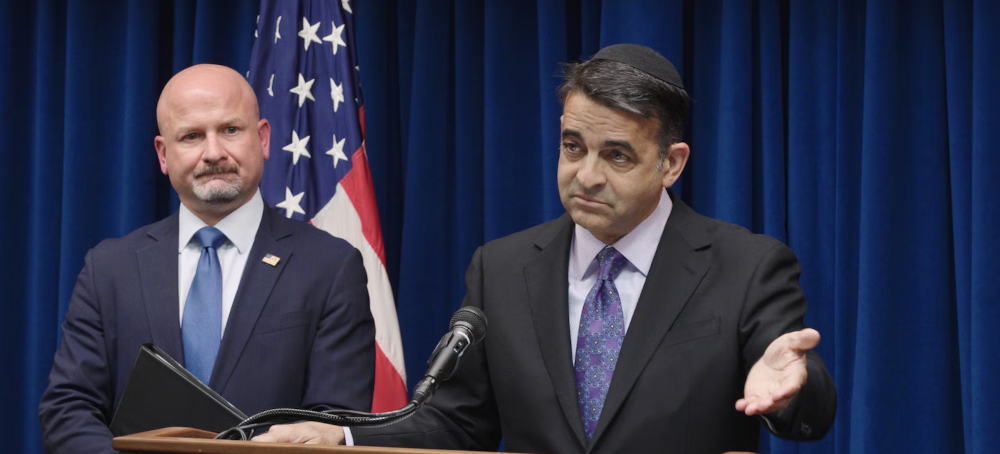 U.S. Attorney Daniel Rosen, right, and Homeland Security Investigations Special Agent in Charge Michael McCarthy announce charges Tuesday against 15 people for allegedly conspiring to interfere and injure federal immigration agents during Operation Metro Surge in Minneapolis early this year. (photo: Mark Vancleave/AP)
ALSO SEE: Released by ICE, She Sat at a Bus Stop for Days and Died of Exposure
Federal prosecutors alleged that the 15 people were “conspiring to impede or injure federal officers” during the Trump administration’s immigration enforcement operation in Minneapolis earlier this year.
Fifteen members of Minneapolis groups, which prosecutors said are composed of far-left antifa activists, were charged with conspiracy to impede or injure a federal officer, according to a federal indictment unsealed Tuesday. Five of the 15 faced additional charges, including solicitation to commit a crime of violence, interstate threats, interstate stalking, assault on a federal officer and destruction of government property.
Daniel N. Rosen, U.S. attorney for the District of Minnesota, said at a Tuesday briefing that the charges “reflect a broad federal effort to address organized, lawless behavior which seeks to disrupt the execution of federal law, endanger law enforcement and, importantly, endanger the very communities that these defendants falsely claim to be protecting.”
Department of Homeland Security agents have arrested a dozen of those charged, Rosen said. One is already in custody on other federal charges, and two were at large on Tuesday, he said. It is not immediately clear whether the defendants have attorneys.
Short for “anti-fascists,” antifa is a loosely knit movement of far-left activists — often anti-capitalist or anti-state — who oppose fascism and right-wing ideologies and have become a target of the Trump administration.
President Donald Trump instructed federal law enforcement in an executive order last fall to take “investigatory and prosecutorial actions” against those who financially support antifa, labeling it a “domestic terrorist organization” although that designation isn’t part of existing U.S. law.
The people charged Tuesday in Minneapolis were members of Direct Action Minnesota and subgroups such as the Black Cat Workers Collective, Rosen said. They are a “Minneapolis-based Antifa affinity group committed to militant class struggle, community self-defense, and revolution,” the indictment states.
The allegations stem from activity during the Trump administration’s immigration operations in the city earlier this year, when Rosen said the accused “deployed what they call hard and soft blockades” against federal law enforcement and local authorities.
Rosen accused them of shutting down operations at the Whipple Federal Building, where immigration officials and other law enforcement brought both immigrants and protesters detained during the operation.
“The conspiracy was not to interfere with their voice but to do it by force,” Rosen said. “That’s a crime.”
Many in the Twin Cities responded to the immigration enforcement operation by organizing networks of volunteer “rapid response” and “ICE watch” patrols, which they considered protected by their constitutional right to assemble and protest.
Homeland Security Investigations Special Agent in Charge Michael McCarthy said during the news conference that “peaceful protest is a protected right and a cornerstone of our democracy. We respect and defend that right” but added: “There is a line that cannot be crossed. … Unfortunately some groups have crossed that line.”
He said the charges followed a months-long investigation into how the defendants had done “extensive planning, material support and coordinated attack against federal personnel and facilities.” He said federal agents conducted surveillance, reviewed camera footage and analyzed “large volumes of information to identify those responsible.”
Asked during Tuesday’s briefing how many federal agents were injured as a result of the defendants’ alleged actions, Rosen said the charges stem from their plans.
“We have a group of people who quite deliberately got together and planned violence, used violence,” he said, alleging they threw ice blocks and damaged vehicles. “Whether or not they actually at the end of the day caused bodily harm is not the measure of whether or not they committed a serious crime.”
Many of the cases brought against three dozen other Minnesota-based protesters during the federal immigration operation have been downgraded or dismissed, but Rosen defended the latest charges.
“You watch how this case plays out, you watch how the evidence plays out and the evidence will prove it all out,” he said.
Asked about charges against officers involved in the fatal shootings of Renée Good and Alex Pretti, protesters fatally shot in Minneapolis in January, Rosen said the investigations are ongoing. Last month, local prosecutors arrested an ICE agent facing multiple second-degree felony assault charges and one count of falsely reporting a crime after a Venezuelan immigrant was shot in the leg.
The shooting happened shortly after the Trump administration launched its immigration crackdown in response to reports of fraud within Minnesota’s Somali community. The enforcement operation brought thousands of federal agents — many masked and heavily armed — to the Twin Cities and surrounding areas. Agents often traveled in unmarked vehicles, waited outside schools, pulled drivers over and demanded they produce proof of citizenship.
Federal prosecutors said the operation led to about 4,000 arrests. But it also quickly spawned a network of local volunteers, organized through encrypted apps and text threads, who tailed agents and used whistles and car horns to alert those nearby. Border czar Tom Homan said this month “if you put a hand on an ICE officer, you spit on an officer, you threaten an officer, you damage a vehicle, zero tolerance.”
“You get arrested and you’re going to be federally prosecuted,” he said on Fox News.
On Tuesday, Minneapolis City Council member Jason Chavez posted on social media after the Justice Department announced the new charges that he feared investigators were targeting legal observers.
“Alerting our neighbors about ICE activity is not a crime,” Chavez posted on Instagram. “Observing is not a crime, and loving your immigrant neighbors is not a crime. To every person who was observing the illegal actions committed by ICE and who supported our immigrant community, please know we have your back.”
The indictment cites the defendants’ texts and messages on the encrypted Signal app.
Carl Tobias, a law professor at the University of Richmond, has been following the Minneapolis case and what federal judges in Minnesota have been doing since the immigration operation.
“I don’t think it’s a compelling case,” he said of the indictment, which he’s read, dismissing it as “pretty thin.”
Tobias also noted the case threatens First Amendment protections of free speech.
“You shouldn’t do violence but you are entitled to make known your views and protest,” he said, noting the defendants also had a constitutional right to arm themselves, regardless of their ideology.
But since Trump designated antifa a terrorist group, others have been similarly charged and convicted based on such evidence.
Nine people in an alleged armed North Texas “antifa cell” were convicted earlier this year of conspiring to attack an ICE detention center. Prosecutors defined antifa in court filings as “a militant enterprise made up of networks of individuals and small groups, primarily ascribing to a revolutionary anarchist or autonomous Marxist ideology, which explicitly calls for the overthrow of the United States government, law enforcement authorities and the system of law.”
The nine are scheduled for sentencing later this month before the same federal judge in Fort Worth, most facing potential life sentences.