Deadly Shootings by ICE Officers Renew Scrutiny of Recruitment and Training
Amna Nawaz and Amalia Huot-Marchand PBS News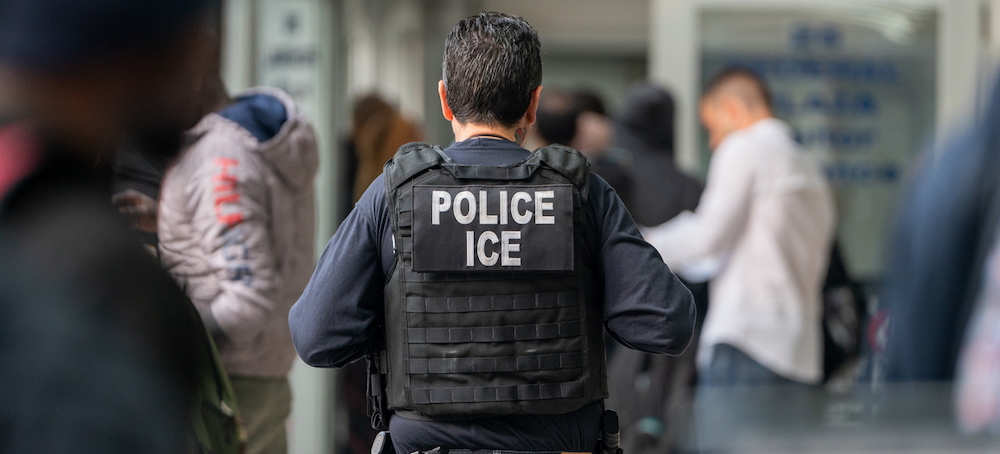 An ICE agent. (photo: David Dee Delgado/Getty Images)
Two deadly shootings involving ICE officers reignited protests and renewed questions about tactics, training and recruitment at the agency. None of the agents involved were wearing body cameras, and neither of the victims was the intended target of the operation. Amna Nawaz discussed more with John Sandweg, who served as acting director of ICE under President Obama.
Two fatal shootings this month involving Immigration and Customs Enforcement officers have reignited protests and renewed questions about tactics, training and recruitment at the agency.
Both incidents took place during traffic stops, one in Maine and the other in Texas. None of the agents involved were wearing body cameras, and neither of the victims were the intended targets of the operation.
For more, we're joined now by John Sandweg. He's an attorney, and he served as acting director of ICE under President Barack Obama from 2013 to 2014.
John, welcome back. Thanks for being with us.
John Sandweg, Former Acting ICE Director:
Yes, thanks for having me.
Amna Nawaz:
So two men were killed in these latest stops. In Houston, Texas, it was 52-year-old Lorenzo Salgado Araujo, originally from Mexico. In Biddeford, Maine, it was 26-year-old Johan Sebastian Duran Guerrero, originally from Colombia.
In both cases, DHS has says the men attempted to flee and they weaponized their vehicles. From what we know, do the facts say to you that deadly force was justified here?
John Sandweg:
Amna, it's really difficult to tell based on the limited information we have available to us thus far.
But I think if you take a step back and you look at this trend, right, where we have at least 17 shootings involving ICE agents, not including other DA's officers, five of which have been fatal, it's clear to me we have a problem. And I think it's pretty easy, if you spent any time at ICE, understanding the source of the problem.
And that is how this administration is deploying these ICE agents and how we're using now vehicular stops as part of the tools that the ICE agents are using to effectuate these arrests.
I'll just say quickly, Amna, historically, traffic stops have never been a major part of ICE's operations. They don't need to be a major part of ICE's operations given that ICE can arrest the individual as they're getting in their car or after their car. And from a training perspective, because they weren't such a critical part of what ICE does, they've never been a major focus of training, like you'd see with other law enforcement agencies.
So, look, at the end of the day, I think that -- as you know, the secretary of DHS had recommended a pause. I think that made a lot of sense. We have a larger problem here. Regardless of whether any one of these shootings was individually justified, the trend itself is what's disturbing.
Amna Nawaz:
Well, the secretary recommended a pause, and the president intervened to say that those vehicular stops have to continue. So it doesn't seem like there will be a pause.
But I want to ask you about the body cameras in this as well, because none of the officers seem to be wearing them in these instances. We know ICE is flush with cash after some major funding bills, including $20 million dollars for body cameras specifically.
Why wouldn't those have been ruled out by now?
John Sandweg:
It's hard for me to say, right?
The administration, at least vocally, is saying that they're in favor of the body cameras. It certainly can't be, as you point out, money, right? I mean, the agency has tens of billions of dollars in the Big Beautiful Bill, tens more billions in this kind of two-year appropriation money that was recently given to them. So it's not a financial issue.
The only thing I could say is, it's a prioritization issue. And, Amna, if you go back at the history of the agency, I mean, it's probably fair to ask why weren't ICE agents wearing these already even before the Trump administration.
I think a lot of that, though, goes back to what I was talking about earlier, how ICE agents were being deployed. Historically, the vast majority of immigration arrests ICE makes are of individuals who are already in somebody else's custody.
And when you're taking -- or you're picking up someone at a local jail or you're going down to the Border Patrol station and picking them up at the border, it doesn't raise those same concerns that you have when you're deploying ICE agents to do these at-large arrests inside the communities, right? There, they're engaging with the public in a way where we need that body camera.
But, look, I know there have been excuses offered here about the shutdowns or this or that. Honestly, at the end of the day, it's just a prioritization issue. It just wasn't a priority. And I hope that now, in light of these incidents, it will be.
Amna Nawaz:
As you mentioned, we don't know a lot yet. So there are still many questions left unanswered.
But we do know a little bit about one of the officers reportedly involved in the Maine shooting, a man named David Brouillette. His ex-wife and several family members told the Associated Press he had a history of violence, that they believe he never should have had a badge or a gun.
His ex-wife, Ashley, actually told the AP that he called her, he acknowledged that he killed Duran Guerrero. And here's actually part of what she said about the encounter.
Ashley Brouillette, Ex-Wife of David Brouillette: I believe that this man was murdered. I believe that David -- David's mental health played a part in what happened. I think what happened was, he was standing there during that operation, had a PTSD moment and hit fight-or-flight mode. And, unfortunately, a man lost his life due to it.
Amna Nawaz:
Now, John, I want to be clear we don't know about this man's particular hiring circumstances, but there are questions about the vetting and the training of ICE agents in this hiring surge.
I want to play for you one more bit of sound, because our White House correspondent, Liz Landers, asked Tom Homan about that vetting process earlier today. Take a listen.
Liz Landers:
So you're satisfied with the training right now of ICE agents? Nothing needs to be improved?
Tom Homan, White House Border Czar:
There's always room for -- that's a loaded question. There's always room for improvement. Things change all the time. FBI updates their training. DEA updates their training. Every police department updates their training. But ICE used to -- look, I -- you can never be overtrained. I wish there was more training.
Amna Nawaz:
John, you ran this agency. Does all of this lead you to have concerns about the vetting and the training of the ICE agents?
John Sandweg:
Oh, absolutely.
I have real concerns here. This particular instant raises concerns about the vetting. As you indicated earlier, I don't know all the details of his background. And I'm not saying that there aren't circumstances by which someone like this could be hired, provided everything current -- their current state suggests they have the suitability to be a federal agent.
But it's incredibly rare for someone with that kind of background to be hired as a federal agent. And it raises real questions that, in this crazy push we're seeing to double the size of ICE, to recruit people, to cut short their training and get them deployed as quickly as possible, that we're dropping the ball in the vetting operation.
And really what concerns me is, if you look at what -- historically, ICE only hires a couple of hundred agents a year. And so the vetting offices were built to handle that volume.
And now we say to them, hey, you're going to hire 2,000, 3,000 people in a year, we want them vetted and onboarded as quickly as possible so we can get them on the streets as quickly as possible, it certainly makes you think, boy, there's a real chance here that, as they're building this thing on the fly, they're going to drop the ball on the vetting.
And, unfortunately, again, without knowing for sure whether this is a case of a dropped ball, the vetting was messed up here or something else going on, it absolutely raises concerns for me about, wow, are we failing to do a proper suitability check on these potential candidates, giving them -- minimizing their training, then putting them on the streets without knowing exactly who they are or what's in their background?
Amna Nawaz:
Hey, John, before I let you go, I want to ask you briefly about a bit of reporting from The New York Times, who looked at the hundreds of assault charges that the Trump administration has filed against people and protesters who come out to kind of record and protest some of the ICE crackdown.
They found, of the more than 400 cases that have been resolved so far, the administration lost nearly half. Defendants were acquitted or the cases unraveled. What does all of that say to you?
John Sandweg:
I think what it says to me, though, is, again, we have had this kind of -- you know, it makes me worry about the quality of the vetting before charging decisions were being made, right? We had this -- with this time period that I will give Secretary Mullin credit for, it seems to have dissipated, where you had ICE agents put in this position to aggressively confront these protesters.
I will say that, based on the shift in tactics thus far, that those incidents have gone down. But you saw a Justice Department that was quick to charge everyone and anyone, including in obviously in many of these cases, not necessarily all of them, many of these cases where there was flimsy evidence as to whether or not there was the intent to actually assault an officer or actually contact was made.
Look, I recognize that this situation, right, ICE -- ICE agents have an incredibly difficult job, and I do have a lot of sympathy for them. But this idea of kind of charging everything, even where the evidence doesn't support a federal criminal charge, doesn't do them any favors.
Amna Nawaz:
John Sandweg, always great to talk to you. Thank you so much for your time and perspective.
John Sandweg:
Thank you.