Blanche Insists He’s Not Trump’s ‘Yes-Man’ as Attorney General Vote Looms
Jeremy Roebuck, Perry Stein and Theodoric Meyer The Washington Post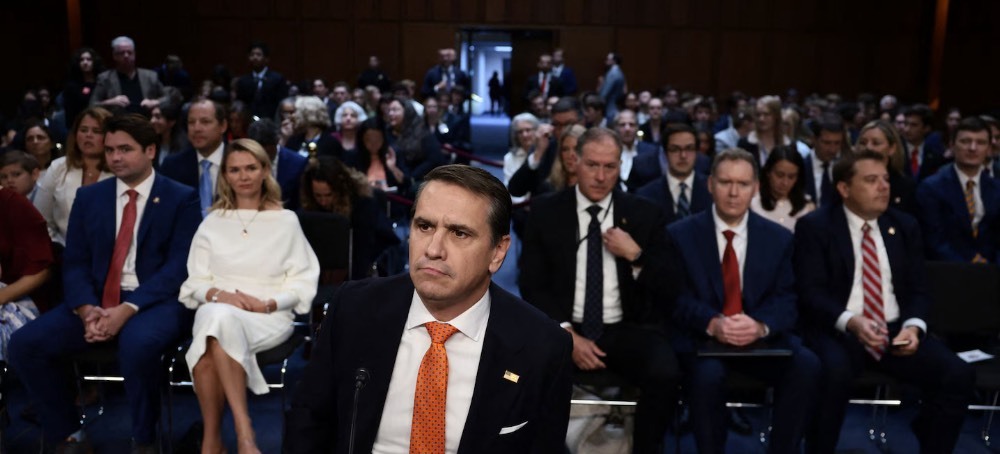 With Democrats united against acting attorney general Todd Blanche, even one Republican committee vote against him would be enough to sink the nomination. (photo: Evelyn Hockstein/Reuters)
At a contentious Senate confirmation hearing, the acting AG defended his role in the release of the Epstein files and Trump’s settlement with the IRS.
But whether he succeeded in convincing the members of the Senate Judiciary Committee after a contentious five-hour confirmation hearing remained uncertain. At least one key Republican — Sen. John Cornyn (Texas) — told reporters afterward that he had not yet decided whether he would support advancing Blanche’s nomination to become attorney general for a full Senate vote.
With Democrats united against Blanche, even one Republican committee vote against him would be enough to sink the nomination.
“I think he’s an impressive guy,” Cornyn said after the hearing. But attorneys general, Cornyn added, “have to walk a very narrow path between being the chief law enforcement officer of the country and then being the president’s guy.”
The senator joined colleagues in peppering Blanche during the hearing with sharp questions over his role overseeing a controversial deal to resolve the lawsuit Trump filed against the IRS over the leak of his tax returns. The agreement included broad tax protections for the president and his family and a now scuttled proposal to establish a nearly $1.8 billion payout fund for those who claim they were targeted by politicized prosecutions.
Cornyn, who lost a primary reelection bid earlier this year and has more forcefully questioned the Trump administration since then, described both those provisions as “unusual.” He told reporters after the hearing that it seemed Blanche “certainly leaned in to help the president beyond what was necessary to resolve the case.”
Blanche, who has held the title of acting attorney general since the April firing of his predecessor, Pam Bondi, vowed in his opening remarks Wednesday to regain senators’ trust. He said he was proud of his past work as Trump’s criminal defense lawyer during the four indictments he faced during his years out of office.
But he stressed it was only a small portion of his résumé, which also included years working as a federal prosecutor in Manhattan. He highlighted his record since returning to the Justice Department last year, as the No. 2 official under Bondi, of combating violent crime, prosecuting fraudsters and bringing gang leaders and human traffickers to account.
“I am a career prosecutor, I started out as an intern down the street at the Department of Justice as a paralegal,” Blanche said. “The fact that I represented President Trump for a period of time under two years does not define my career, nor does it define me.”
Still, Blanche at one point during Wednesday’s hearing appeared to stumble over that distinction when asked whether he considered Trump a friend.
“I am his lawyer,” the acting attorney general said, before quickly correcting himself. “I was his lawyer.”
Democrats quickly seized on that remark to press their case that Blanche had never truly given up his old job.
They have maintained that in his brief but tumultuous tenure over the Justice Department, Blanche has overseen a hollowing out of the department’s ranks and defended Trump’s efforts to erode its traditional independence from the White House.
They argued Wednesday that he has used the department’s resources to enrich Trump, chase his baseless claims that the 2020 election was stolen, and pursue political vendettas against the president’s foes.
“This nation deserves an attorney general who loves the Constitution more than he loves any single president. An attorney general who is focused on keeping Americans safe and combating corruption — not satisfying the president’s personal grievances and filling his bank accounts,” said Sen. Dick Durbin of Illinois, the top Democrat on the committee.
Throughout the hearing, Blanche met even the most barbed attacks from Democrats with a largely calm and measured tone. Unlike Bondi, who routinely arrived to congressional hearings with pre-scripted insults for political opponents, Blanche showed only brief flashes of impatience with needling from his interrogators.
Sen. Adam Schiff (D-California) — one of the Trump Justice Department’s most vocal critics — demanded at one point that Blanche explain how he’d gone from a respected federal prosecutor, to Trump’s lawyer, and now “someone willing to sacrifice everything you once believed in for that title, that position of attorney general.”
“What happened to you Todd Blanche?” the senator demanded.
“I’m still here,” Blanche shot back. “I am the exact same person I was when I was a federal prosecutor.”
At another point, Blanche explained, “President Trump trusts me to give him counsel. Counsel does not mean I’m a yes man.”
It was one of a few moments during Wednesday’s hearing where Blanche attempted to carve out some distance between himself and the president.
For instance, the acting attorney general said he did not believe federal judges should be impeached simply for ruling against the president’s agenda. Trump has repeatedly called for such action against jurists who have ruled against him.
When asked about Trump’s blanket pardon for those convicted of playing a role in the Jan. 6, 2021 attack on the U.S. Capitol, Blanche said it was the president’s right to pardon anyone he wanted but stopped short of endorsing it.
“I wasn’t celebrating it,” Blanche said, describing Trump’s decision as “very generous.” He later said that all defendants who attacked police officers on Jan. 6 “should have been prosecuted and were.”
Democrats seized on Blanche’s oversight of the congressionally mandated public release of millions of pages of files related to the investigation of convicted sex offender Jeffrey Epstein.
Lawmakers from both parties criticized the department for sloppy redactions that exposed the names of Epstein victims, while accusing officials of over-redacting in other instances, potentially obscuring names of people who may have been complicit in Epstein’s crimes.
Blanche acknowledged Wednesday that “mistakes were made” but he maintained that only about 1 percent of the records had redactions that needed to be fixed.
“This administration, when it comes to Jeffrey Epstein, has been more transparent than any past administration, than Biden was or anybody else,” he said.
As he spoke, several of Epstein’s accusers were seated behind him in the Senate gallery. Yet under questioning from Durbin, Blanche resisted calls for him to personally meet with them, saying he was legally prohibited from doing so if they have attorneys. He offered a staffer to meet with them instead.
“When it comes to the victims of this horrible man, we will never, never not talk to victims,” Blanche said. “We will never not do everything we can to prosecute anybody that committed any crimes against these women.”
But it was the issue of the Justice Department’s recent deal with Trump to resolve the suit against the IRS that consistently drew the most heat. Several senators questioned a provision of the agreement that granted Trump, his family, and their business sweeping immunity from past tax claims — a potentially lucrative benefit for a president who has repeatedly complained about burdensome IRS audits.
Blanche responded to that criticism by saying that while a case involving a president was unusual, such agreements were common.
The deal’s separate provision to establish the nearly $1.8 billion payout fund — which Democrats have derided as a “slush fund” to funnel taxpayer money to Trump’s allies — also continued to provoke scrutiny.
Blanche walked back plans for the payout fund this spring after a rare revolt from Senate Republicans who were concerned some of the money might end up in the pockets of Jan. 6, 2021 Capitol rioters. Though he has repeatedly insisted the Justice Department no longer intends to move forward with the fund, he has resisted repeated calls from lawmakers and a judge to put that pledge into writing.
“It is a moot issue, meaning there is no weaponization fund,” Blanche reiterated Wednesday. “The weaponization fund is dead. It’s not moving forward.”
Cornyn, for one, appeared unsatisfied with that answer.
“Just to be clear, the president of the United States, who’s a plaintiff in this lawsuit, has not agreed in writing to delete the ‘Anti-Weaponization Fund’ and there’s no guarantee that he won’t raise it in the future?” Cornyn said. Blanche responded that Trump has no power over the fund, which would have to be initiated by the Justice Department.
The senator highlighted a ruling earlier this week from the judge who oversaw Trump’s IRS suit. She described the litigation — in which attorneys on both sides of the case ultimately reported to Trump — as an improper attempt to “manipulate the judicial process.”
“I very much disagree with the judge’s insinuations about me, and we’re going to do what we can to make that right,” Blanche said.
Those responses appeared to dispel the doubts of at least one Republican.
Sen. Thom Tillis (R-North Carolina), who is retiring after this term, previously expressed reservations about Blanche’s nomination and said any whiff of a suggestion that the acting attorney general supported Jan. 6 rioters would immediately prompt a “no” vote from him. He’s also raised concerns that the payout fund could be revived and that rioters could be among those receiving money.
But Tillis praised Blanche during his testimony Wednesday, saying he “did a great job today.”
The senator told reporters afterward that he was leaning toward voting to advance Blanche’s nomination. First though, Tillis added, he needed “absolute certainty” that the fund is dead and suggested his vote could hinge on whether Trump would endorse a bill in Congress codifying its demise.
The Judiciary Committee on Thursday is expected to hear from several witnesses both in support of and against Blanche before voting on his nomination later this month.
Republicans have said former attorney general John Ashcroft, who served under President George W. Bush, will be among those testifying in Blanche’s favor. Democrats plan to call an Epstein accuser and Liz Oyer, the Justice Department’s former pardon attorney who was fired by Blanche last year, to speak out against his nomination.
Should Blanche’s nomination clear the committee, the Senate’s Republican leadership has said it intends to hold a full vote on his nomination before the chamber departs for its August recess.