
Beware Chuck Schumer’s Mind Games
Ken Klippenstein Substack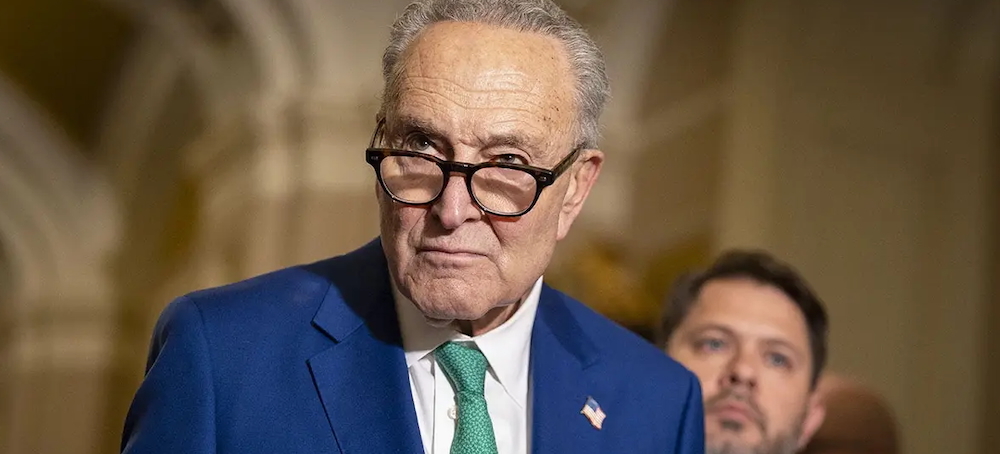 Senate Minority Leader Chuck Schumer, D-N.Y., speaks at a press conference with other members of the Senate Democratic caucus. (photo: Anadolu via Getty Images)
ALSO SEE: Ken Klippenstein on Substack
When Van Hollen announced his challenge, Schumer’s response was petulant. He didn’t explain why he was the better choice. He didn’t say what he’d do differently, even though different is exactly what voters across the country just voted for.
Instead, Schumer fell back on process. He has the votes, he insisted, so a contested election and a public debate are unnecessary. It’s like he doesn’t think he should have to apply for the job at all.
The Washington media, as uninterested in the world outside Washington as Schumer is, covered it as a backroom, Washington-centric story. Headlines blared Schumer’s claim that he already has the votes, framing the entire issue as a fait accompli requiring no further discussion. No comment about the old guard maintaining the levers of power, no explanation of how much it’s in Schumer’s interest to close off debate, no acknowledgment that it is a Washington playbook trying to shape people’s perception of what’s possible.
“I have the votes”
“I have the votes to continue serving as Democratic Leader,” Schumer said last week in response to Van Hollen’s challenge.
On Saturday, The Hill reported that “Schumer’s allies” expect he’ll win an “overwhelming majority” of votes to become leader.
“We’re done here,” declared Adam Jentleson, former chief of staff to Sen. John Fetterman (who has endorsed Schumer), in a social media post linking to The Hill’s story. “Time to move on and focus on delivering for Americans who put their faith in Democrats to deliver real, tangible improvements in their lives.”
Apparently “delivering for Americans” doesn’t include listening to them. A majority of Americans, including Democrats, have consistently disapproved of Schumer — even after the midterm blowout.
Even on the narrow question of who has the votes, it’s not clear at all that that’s Schumer. The problem with Schumer’s account is that, as of today, only 16 of the Democrats’ 55 senators have publicly endorsed him. Van Hollen, meanwhile, says Schumer is lying and that several senators Schumer claims as supporters have actually endorsed Van Hollen. Schumer, he says, is trying to manufacture a sense of inevitability to scare people out of supporting anyone else. (Sound like the Biden White House stiff-arming any challenger to the president?)
“The Schumer team’s put out a lot of misinformation,” Van Hollen told ABC’s This Week on Sunday. “They’re essentially trying to instill fear in people who may say that they’re going to support me as a new leader.”
Schumer is reaching for another Washington trick, too. He is trying to move the vote up to two weeks from now, to head off the leadership debate.
“Let’s not rush into a coronation,” Van Hollen says.
The Schumer Psy-Op
Manufactured inevitability is one of the oldest psychological tricks in the Washington playbook. The beauty of it is that instead of having to win an argument, they just declare it already over. And it isn’t aimed only at senators. It’s aimed at the rest of us, too: the voters, activists, anyone whose pressure might actually force changes, if only they thought it was possible.
Social scientists have a name for what happens next: “pluralistic ignorance.” In a 2022 study in Nature Communications, researchers found that 66 to 80 percent of Americans support major climate policies. But Americans guessed that only 37 to 43 percent of their fellow citizens did. Supporters outnumbered opponents roughly two to one, yet the public believed nearly the opposite.
Perception often becomes reality. People who think they’re in the minority tend to drift toward what they believe everyone else thinks, and they stop pushing. “They fall into a trap of: I support this but I think other people don’t,” the study’s lead author, Gregg Sparkman, said.
In Washington, declaring a race “over” before a single ballot is cast is a tool of political control. It serves two audiences at once. Inside the Capitol, leaked whip counts and “overwhelming majority” headlines signal to undecided senators and incoming freshmen that opposing the incumbent is futile and even career-limiting. Outside the Capitol, the message to voters is even simpler: there is nothing to see here, no debate worth having, and no reason for you to call your senator.
There’s another benefit of the Schumer psy-op. By treating Schumer’s re-election as a foregone conclusion, party insiders can avoid answering the substantive questions Van Hollen’s challenge forces onto the table — whether, for example, Democrats should reject AIPAC money, whether they will block funding for the war in Iran, and whether the new majority will confront corporate power or slip back into the same cautious habits that left Schumer with his abysmal approval rating in the first place.
You’re not alone
Another demonstration comes from an unlikely place: Saudi Arabia.
In a 2020 study in the American Economic Review, economists found that the vast majority of young married Saudi men privately supported women working outside the home. But they badly underestimated how many other men agreed, even their own neighbors.
So the researchers told a random group of the men the real numbers. Those men became more willing to help their wives look for jobs. Four months later, their wives were more likely to have applied and interviewed for work outside the home.
Nobody’s mind was changed. The men just learned they weren’t alone.
The most damning American example is segregation.
In a 1975 study in Public Opinion Quarterly, sociologist Hubert O’Gorman went back to national survey data from 1968. He found that most white Americans grossly exaggerated how many other whites still supported segregation. Their private views had moved on. They assumed their neighbors’ hadn’t. So they went along with a system most of them no longer believed in.
Schumer is exploiting the same psychological blind spot. You don’t have to change anyone’s mind. You only have to convince people that they’re alone.
The news media failed to predict the magnitude of public discontent with the generation in power. It doesn’t seem interested in discovering the real America now, or what people want. It prefers the binary of Democrat vs. Republican, without ever asking: Democrat what?
Instead it covers the “race” for the majority and, of course, 2028.
Go back to sleep, America. We’ll call you again in two years when we need your vote — er, input.

