‘Behind Every Story in This Book Is a Real Gazan Who Struggled to Stay Alive’
Nagham Zbeedat Haaretz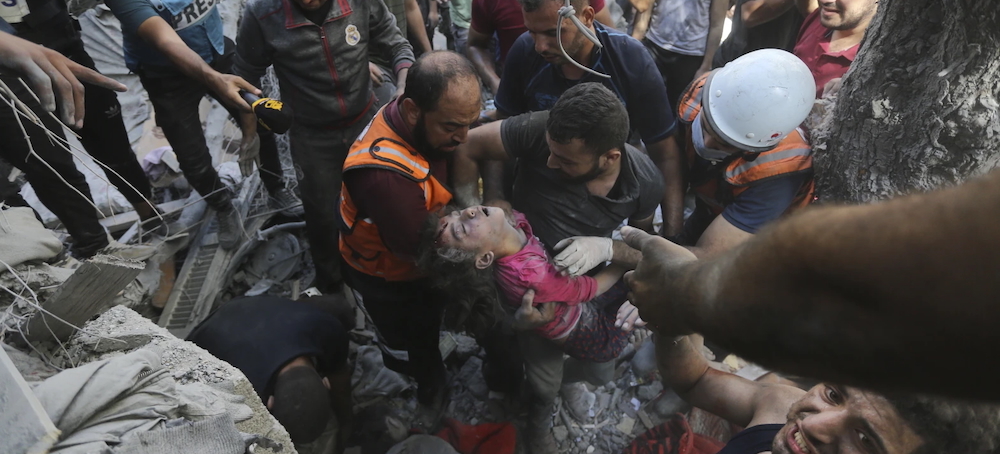 Palestinians rescue a child from under the rubble after Israeli airstrikes in Gaza City, Gaza Strip. (photo: Abed Khaled/AP)
Qusai Tariq Abu Tebah, a 24-year-old student from Khan Yunis, documented his family's survival through 12 displacements, the loss of two siblings and the destruction of his home. He tells Haaretz: 'I wanted the book to be the witness that does not die'
Much like chocolate cookies, cell phones and so-called "dual-use" medical supplies like operating tables, paperback books are not among the few items permitted by Israel to enter Gaza.
"It felt like having a child who had been exiled to a distant country," Abu Tebah says. "Strangers could hold it, touch it and get to know it, while I, the one who gave it life, am deprived of even looking at it."
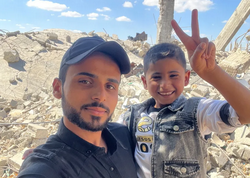
Qusai Tariq Abu Tebah and a child from his neighborhood, standing on the remains of Abu Tebah's family home in Khan Yunis.
Credit: Qusai Abu Tebah
He pauses before adding: "I own nothing of this achievement except a PDF file on a shattered phone screen."
Abu Tebah didn't plan to become a writer. When the war began in October 2023, he had just completed his first year studying cybersecurity engineering at University College of Applied Sciences in Gaza City – a degree he is now completing online.
Speaking to Haaretz from his family's tent in Khan Yunis, Abu Tebah says he only began writing in November 2023 after realizing that the events unfolding around him were vanishing almost as quickly as they emerged. He completed the manuscript in May 2025 – often by hand, or by typing on his smartphone, in tents and makeshift shelters – and six months later, ar-Wiqat al-Fikr, a Jordanian publishing house, released the first copies.
"Stories of survivors, the displaced, the dead and the martyrs – I saw them evaporating into the air as if they had never existed," he says. "Social media platforms and websites became a cold graveyard for stories. A post dies after a few hours, and the world's algorithms hide our cries."
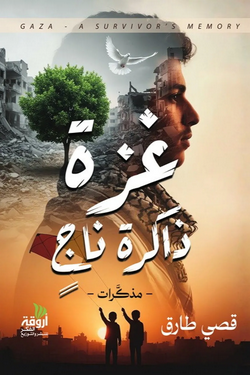
e cover of "Gaza: A Survivor's Memory."
Credit: Arwiqat al-Fikr Publishing House
"I wanted the book to become the witness that does not die," he continues. "Literature gives people back their names, their faces and their dreams. It takes them out of being perceived only as a statistic."
Describing nights spent in a tent with his family, he writes in the book: "The cold crept through the tiny holes in the tent, freezing our limbs and reminding us how far we were from safety. We gathered around a small lamp whose light barely illuminated our faces, but it was better than the pitch darkness."
Part-memoir and part-literary testimony, "Gaza – A Survivor's Memory" traces Abu Tebah's journey through war, 12 separate displacements around southern Gaza and grief – including the deaths of two of his brothers.
Abu Tebah says of the moment he decided to write the book, that it was "that fatal second when you stand at your doorstep and look back one last time at your room, your books, the details of your old life, while knowing deep inside that it may be the last time."
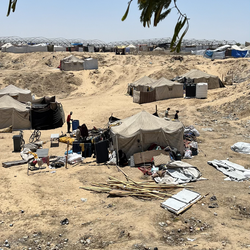
The tent that Abu Tebah and his family live in. In this photo, it was near the sea at Mawasi; today, they are in Khan Yunis.
Credit: Qusai Abu Tebah
"What happened to me happened to countless people in Gaza," he says. "Everyone lives the same pain. The book is not simply about war; it's about the people who lived through it."
Farah, a 22-year-old from Rafah who has been displaced to Khan Yunis, praises the book for its deeply authentic portrayal of surviving Israel's war in Gaza.
"It also provides future generations with a source for understanding what happened through our voices – those who lived the experience themselves," she tells Haaretz. "I believe the value of the book lies not only in recounting events, but also in its ability to preserve and faithfully convey our collective memory. It reminds readers that behind every news story or statistic are people who lived through these experiences in all their details."
Losing two brothers in less than two years
The moment that convinced Abu Tebah to document his experience in real time hit him as he prepared to flee his home in Khan Yunis, where he had grown up with his parents and five brothers.
He describes the moment as "That fatal second when you stand at your doorstep and look back one last time at your room, your books, the details of your old life, while knowing deep inside that it may be the last time."
He recalls writing about the rush to fit what he could into two bags that could not carry memories, the fear that accompanied displacement, and the uncertainty of not knowing where his family would sleep that night.
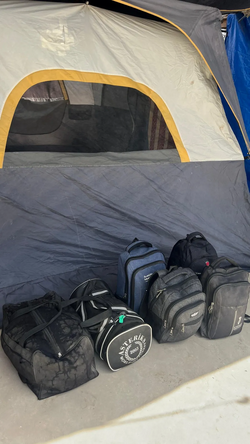
The family's packed bags, moments before they left a displacement camp in Rafah before the Israeli army entered.
Credit: Qusai Abu Tebah
Like the more than 1.9 million Palestinians displaced across Gaza – often multiple times – since October 2023, Abu Tebah left behind not only a home, but the life he had built inside it. He and his family were displaced a total of 12 times, moving around southern Gaza between Rafah, western Khan Yunis and the coastal Mawasi area.
Between November and early December 2023, his family was repeatedly forced to move as the Israeli army besieged the city and fighting intensified around their neighborhood in eastern Khan Yunis. On December 4, they left their home.
The next day, his older brother, Adel, was killed in an Israeli airstrike. The 21-year old had returned to their neighborhood to retrieve materials to set up a shelter. "That was the first grief," he says. "The first bitterness that made me begin writing."
In July 2025, Abu Tebah lost his younger brother, Mohammed. The 19-year-old was among the more than two-dozen Palestinians killed on July 12, as he attempted to gather aid for the family from a distribution site run by the now-defunct U.S.-backed Gaza Humanitarian Foundation.
Losing his brothers a year and a half apart ultimately bookended much of the writing process. Abu Tebah says he wrote wherever and whenever he could: on his phone, on scraps of paper and in the corners of overcrowded refugee camps. Most often, he wrote at night.
"I used to steal moments the way someone steals their final breaths," he says. "Writing was not a luxury. It was my only means of survival."
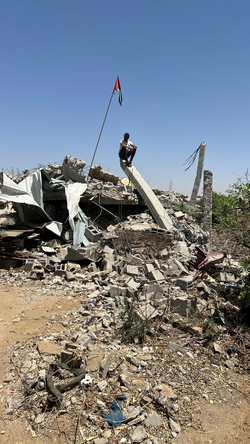
Qusai Abu Tebah sitting on the ruins of his family's house in eastern Khan Yunis.
Credit: Qusai Abu Tebah
He waited until the camps had fallen quiet and exhausted families had drifted to sleep. Under the dim light of his phone screen, he wrote down memories, observations and fragments of stories gathered from others he met throughout the day.
"I had no desk, no comfortable chair, no warm cup of coffee," he says. "I wrote while curled up on a worn-out mat on the floor of a tent."
His conviction behind that effort appears throughout the book. "I write because I believe words can reach places that walls and barriers cannot," he explains in the book. "That I am still capable of feeling, of loving, of dreaming. Writing gives me freedom amid confinement and makes me believe that, however cruel the world may seem, there is still a place for my voice."
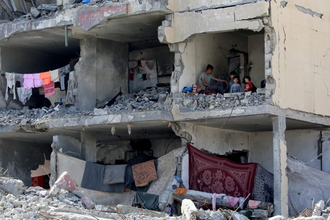
A Palestinian family sitting in a bombed-out building following an Israeli airstrike in Rafah in May 2024.
Credit: Eyad al-Baba/AFP
'We are not numbers'
On June 27, 2024, while living in a displacement camp near Rafah, Abu Tebah says he climbed a sand dune in search of an internet signal. While there, he noticed Israeli tanks advancing toward the area.
He rushed back to warn his family. "We had to leave immediately," he says. Within minutes, the family grabbed what little they could carry and fled. Each person took a single bag before leaving the camp behind.
The notebooks and scraps of paper on which he had written portions of the manuscript remained in the tent. When Abu Tebah returned the following day, he says the camp had been destroyed. "I found nothing," he says. He had to rebuild the manuscript from memory wherever he could.
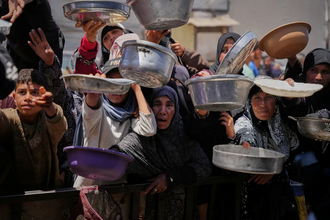
Women and children standing in line to receive hot food from a charity kitchen in Khan Yunis in May.
Credit: Abdel Kareem Hana/AP
During the war, survival often left little room for reflection. The immediate demands of finding shelter, securing food and protecting loved ones took precedence over processing what was happening. When asked whether the process changed how he understood his own experiences, he pauses before comparing the act of writing to a painful medical procedure. "Writing was like performing surgery on myself without anesthesia," he says.
"When we live through these circumstances, we are in a constant state of shock. We don't have the luxury of fully understanding the scale of the catastrophe."
Writing required him to revisit memories he had often pushed aside. He found himself replaying scenes of displacement, loss and fear, lingering over details he had previously experienced only in the rush of survival.
"It was a painful and difficult process," he says. "I had to listen to the screams again in my mind." Revisiting those memories, he says, revealed the extent of the psychological toll the war had taken on him. "I realized I was no longer the same young man who wrote the first line of the book. The massacres and everything we witnessed swept away parts of who we were."
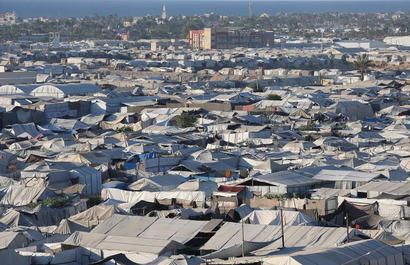
A tent camp in Khan Yunis on June 18.
Credit: Ramadan Abed/Reuters
There were episodes, he says, that he initially hesitated to include. He struggled with whether to write about feelings of helplessness, the humiliation of waiting for hours in long lines to access basic needs and the fear that accompanied the inability to protect loved ones.
"I was afraid the world would see my weakness," he admits. "But later I realized that honest pain is what reaches people, so I removed the mask. I wanted the real human being to appear on the page, with all his weakness and all his strength."
Many, he says, grasp the broader message of the book. But some experiences remain difficult to communicate across distance. "They understand the words," he says. "But they cannot fully understand what it means to wait for water, or to wonder whether you will survive until the next day."
He argues that books can preserve realities that are often flattened by news coverage and social media posts. One message that stayed with him came from a reader living abroad who told him that, after reading the book, Gaza no longer felt like a distant news story.
"For the first time, he could imagine the streets and the people behind the headlines," Abu Tebah says.
That's why his next goal is to publish an English translation, allowing it to reach audiences beyond the Arab world. Yet he says that translating the text is not a straightforward task.
Some words, he says, carry meanings shaped by experiences that are difficult to reproduce in another language. "'Displacement' is not just a term," he says. "It carries the smell of fear, the exhaustion of the road, the cold of sleeping in a place that is not your home. It carries all the details that come with being forced to leave."
In the final pages, he addresses readers directly. "We write not only to tell our story, but to live," he writes. "...We write because our story is greater than being buried beneath the rubble of homes and deeper than being erased by the world's silence."
Elsewhere, he poses a question that echoes one of the book's central concerns: "Will we become a lost memory in the shadows of the world, or are we still suspended between life and death, waiting for someone to discover that we exist?"
"I want readers to remember one thing: Behind every story in this book is a real person who struggled to stay alive," he says. "The difference between myself and someone outside of Gaza is not humanity. It is the circumstances we were forced to live through."
"We are not numbers. We are people who had dreams, loved, planned for the future and lived ordinary lives before everything changed."