As Rival Resorts Battle in a Bahamas Court, a Threatened Conch’s Nursery Is Caught in the Middle
Kate Waxman Inside Climate News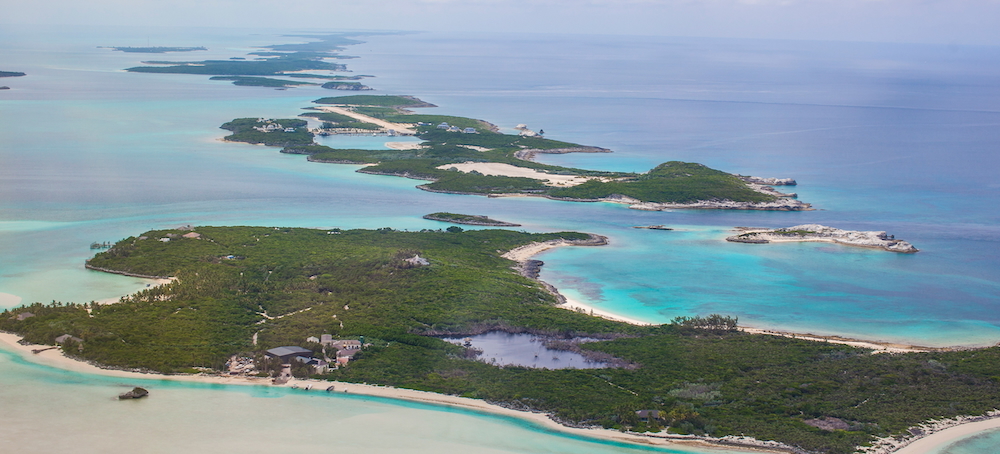 An aerial view of the Exumas region of the Bahamas. (photo: EyesWideOpen/Getty Images)
Scientists who study conch say the species’ habitat needs are more important than the needs of either property.
In the Exumas region of the Bahamas, just south of East Sampson Cay, Shedd Aquarium researchers recorded the third-highest mean density of juvenile conch among the sites in a 2019 survey.
But a developer, Miami-based Yntegra Group, plans to dredge about half a hectare (1.26 acres) of the cay’s North Bay for a service dock at Rosewood Exuma, a resort that Rosewood Hotels … Resorts would operate. Two neighboring developers, of Turtlegrass Resort … Island Club and the private island Over Yonder Cay, have asked the Bahamas Supreme Court to overturn the project’s environmental approvals. The judge has not yet ruled; a spokesperson for the Save Exuma Alliance, a coalition of Exuma businesses that includes Turtlegrass, said a decision is expected within weeks.
The case puts the queen conch, a species the U.S. lists as threatened, between these developers. The court won’t decide whether the dock harms conch, only whether the government lawfully approved the project.
Representatives for Turtlegrass argue that the public was consulted before key documents, including the environmental management plan, were released, and that the project was split into separate permits so its combined effects were never assessed together.
“They don’t need to dredge at all,” said Eric Carey, a paid consultant to Turtlegrass and former head of the Bahamas National Trust. He argued that the service dock could go in one of the resort’s southern marinas “without any additional dredge footprint.” He hopes the judge will rule that the consultation and assessment were too deficient to justify a commercial dock in the bay, pushing it to the south.
Yntegra says the southern end of the cay cannot support a service area, and the Bahamas’ Department of Environmental Planning and Protection director called the North Bay site “the most feasible option.”
An engineering analysis Turtlegrass commissioned estimated that, at the developer’s own design depth, a navigable channel and turning area would roughly double the volume of seabed dredged at sea compared with the developer’s assessment.
More dredging would result in disturbed seagrass, and scientists who study conch in the Exumas say it is the channels’ tidal flow, not just the acreage, that keeps nurseries like this one alive.
In April, Justice Leif Farquharson barred dredging and other works in North Bay until the case is decided. He wrote that he did not regard Turtlegrass’ case “at present to be particularly strong,” and he ordered Turtlegrass to post $3 million in security to cover Yntegra’s losses if the challenge fails.
Records filed in the case show the DEPP has twice stepped in at the site. After a March 2025 monitoring report, it issued a cease-and-desist order, finding that land clearing for soil testing had gone beyond what was needed. According to a sworn affidavit from DEPP Director Rhianna Neely-Murphy, the developer was told “not to widen the paths as if clearing for road construction.” The order was later lifted. Yntegra’s own environmental consultant reported to the department that “a large area was cleared” for a plant nursery that was “not within the plans,” before its environmental monitor reached the island.
In July, videos on social media showed a sediment plume spreading from barge deliveries to the cay. They “appeared to indicate” that a silt curtain meant to contain the sediment “had not been effective,” Neely-Murphy said in a sworn affidavit, and the developer’s consultants were told to halt that delivery method. A floating dock was installed so barges no longer touch the beach and seafloor.
Defending the approvals in court, Neely-Murphy said the project “did not initially meet with the standards for sustainable development” and that the review reduced its footprint. However, the review failed to factor in the conch.
The developer’s 2025 environmental impact assessment includes a photo of a juvenile conch in seagrass near the site but it does not estimate how many conch live there or how densely; queen conch does not appear in its list of marine species observed. Responding to public comments, the developer said conch “were not observed in abundance” during its surveys and that the project “does not intend to impact conch nurseries.”
Andy Kough, a Shedd Aquarium research biologist who studies queen conch in the Exumas, said nurseries like Sampson Cay’s persist because flood tides flush them with larvae and clean offshore water.
“Disrupting the flow patterns into these channels may irreversibly change their suitability as a place for young conch to settle and grow to maturity,” he said. Scientists still know little about how conch respond to development, he added, but in the Exumas most young conch settle in seagrass, and destroying it “would have detrimental effects on young conch.”
The stakes reach beyond one bay. NOAA Fisheries listed queen conch as threatened in 2024 and identified overfishing as the main threat. Florida closed its commercial conch fishery in 1975 and recreational harvest in 1985, and the population there has been slow to recover.
“You can’t expect the conch to recover if you’re harming their habitat,” said Megan Davis, a research professor who directs the Queen Conch Lab at Florida Atlantic University’s Harbor Branch Oceanographic Institute.
Yntegra casts the opposition as commercial. In a sworn affidavit, founder Felipe MacLean called Turtlegrass and its owner, Bob Coughlin, the project’s “most significant opponents,” citing its proximity and “inherently competitive nature.” Eric Carey, a former executive director of the Bahamas National Trust who speaks for the Save Exuma Alliance, said he is a paid consultant to Turtlegrass. He has known Coughlin since Coughlin was a donor to the trust.
Yntegra’s figures show the dispute itself enlarged the dredging: Moving the dock from about 150 to 370 meters (500 to 1,200 feet) from Turtlegrass, after it objected, more than doubled the dredge area, from 0.55 to 1.26 acres.
Even if Yntegra prevails, the dredging needs further sign-off: The planning authority’s March preliminary approval requires environmental authorities to approve “all dredging and marine works.”
Turtlegrass has also appealed that planning approval. The appeals board has heard the case, and a decision is expected by the end of the year, Yntegra said.