Arrest of American Who Has Given $1 Million in Aid to Palestine Prompts Fears of ‘Growing Repression From Trump’
Timothy Pratt Guardian UK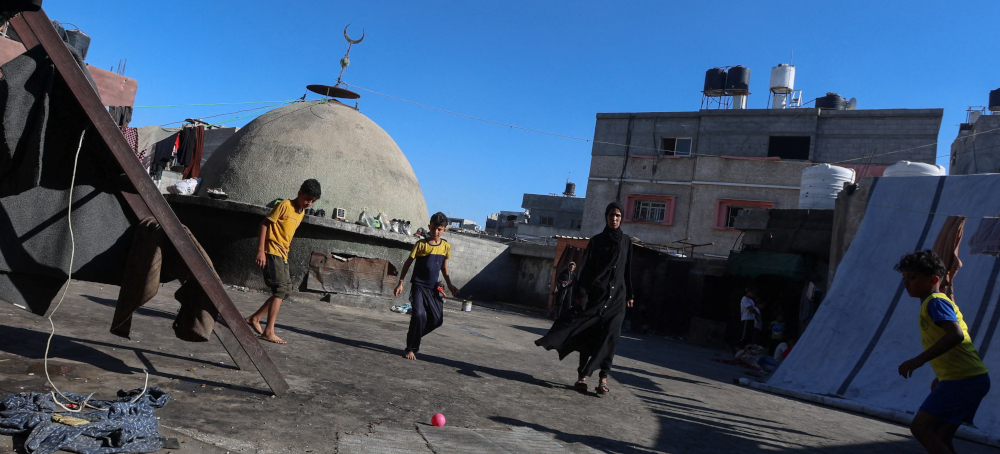 Palestinians displaced during an Israeli offensive shelter at a mosque in Khan Younis, in Gaza, on 14 July 2026. James ‘Fergie’ Chambers ‘is being jailed because he uses his wealth to support Palestine and those suffering genocide in Gaza’, his partner says. (photo: Ramadan Abed/Reuters)
Extradition request for James ‘Fergie’ Chambers sparks concerns that US government is conflating humanitarian aid with terrorism
Spanish authorities detained James “Fergie” Chambers on Friday and are now holding him without bail in Madrid. A hearing is scheduled for Thursday on whether he can be released on bail.
The Spanish high court has 40 days to decide whether to grant the Trump administration’s extradition request. If the court says no, the case closes there. If it says yes, the Council of Ministers has the final decision, according to a spokesperson for the court. The indictment against Chambers is sealed.
This is the first known case of the US seeking extradition of a citizen arrested and charged with supporting Hamas, according to Stanley Cohen, an attorney with 40 years’ experience working on terrorism cases.
“I don’t doubt the decision was made [to seek Chambers’ extradition] because it looks good for Trump, for Aipac and for Zionist supporters,” said Cohen, who has been following the case. “It’s a conscious decision to target for political purposes.”
Chambers is a self-described anti-imperialist and heir to one of the richest families in the US, owners of Cox Communications. He sold stock back to his family worth about $250m in mid-2023 and since then has been funding politically progressive and humanitarian projects, from a Black community group to a non-profit organization helping Middle Eastern children.
Stella Schnabel, Fergie’s partner, wrote in a statement: “Fergie is being jailed because he uses his wealth to support Palestine and those suffering genocide in Gaza. In short, he is facing political persecution for having dedicated his life to building a better society, rather than exploiting people and profiting from war. He should be with our family, continuing his important humanitarian and social advocacy work.”
Chambers has donated more than $1m to humanitarian projects in Gaza, his attorney, Llorenç Salvà, wrote in the same statement. The self-described communist has been extensively profiled in US media and was interviewed on local TV news in New Hampshire in late 2023 about a direct action against Elbit Systems, an Israeli defense contractor, staged by a group whose legal fees he paid, then called Palestine Action.
Shortly after, he moved to Tunisia – where he bought the hugely popular football club, Club Africain.
Chambers has said that he has known for more than a decade that he was on the US federal government’s radar, and the Trump administration, with its focus on targeting US funding for alleged terrorist activities, is now seeking his extradition.
Irene Montero, member of the leftist Podemos party and Spanish representative to the European parliament, posted on X on Monday that: “Spain can’t collaborate with Trump in the persecution of solidarity with Palestine: the government should protect him and not surrender him to Netanyahu’s friends.”
Similarly, six members of Spain’s congress from the leftist Sumar party wrote on Monday that Chambers’ arrest “was produced in the context of growing repression from the Trump administration against the Palestinian solidarity movement”.
The letter also refers to the Spanish government’s ongoing critiques of Israel’s actions in Gaza, and the tension this has created with Trump. The arrest and extradition request concerns human rights groups, they wrote, since these actions seem to have “political motivations related to his support for the Palestinian cause”. Extraditing him, they assert, would set a precedent that would impinge on “free expression, association and political participation”.
Trevor Aaronson, author of several books on the FBI and terrorism, pointed to the notion advanced by Sebastian Gorka, the Trump administration’s top counter-terrorism official, that “all leftist groups are part of some huge network and are active participants in terrorism”.
He sees the Chambers case as a continuation of “troubling precedents established in the post-9/11 ‘War on Terrorism’ and directed at foreign nationals, now being turned inward, at US citizens”.
Aaronson pointed to the Holy Land Foundation case of the mid-2000s, where the legal concept was advanced that money is fungible so that anyone financially supporting, for example, “school books in Gaza – that’s more money that Hamas could then use for terrorism”, since Hamas governs the area, he said.
The result of such an argument, including, potentially, with the Chambers case is “a chilling effect, where no one wants to give money to Palestinian groups or to other left groups, because it could be used against them”.
Aaronson pointed to the timing of the case. “Arguably, the need for humanitarian aid in Gaza is greater than ever. Conflating that with terrorism is remarkable.”