A Year In, the Data Center/AI Battle Starts to Clarify
Bill McKibben Substack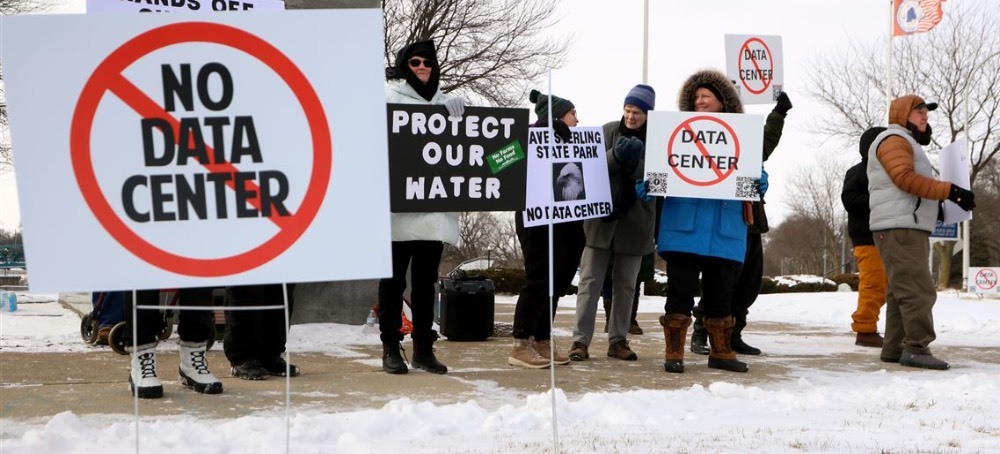 Protest against a data center. (photo: Getty)
And the anger is profound
I’ve had a front row seat for parts of it, because my Third Act colleagues across the country have been avid participants in many of the fights (we’re hosting a big webinar next week, in fact) and even so I’ve found it hard to really keep track of. But we’re about a year in to the most heated part of the battle, and I think we can say a few things with assurance. And a few things with less assurance. So here we go, in descending order of confidence.
One—It really is an environmental plague. Those impacts look different in different places; in dry areas, for instance, the use of water is egregious, and its effect on electric rates will vary from one jurisdiction to another. But for those who are concerned about the rapid warming of the planet, the last few weeks have made it finally clear that there’s an unholy alliance between Big Tech and Big Fossil. Many thanks to Bloomberg’s New Energy team for a comprehensive breakdown showing that the planned data center buildout will increase greenhouse gas emissions from the electricity sector by at least twenty percent, and perhaps as much as a third. That’s because—in their effort to go fast, and bypass as much permitting as possible—data center developers are increasingly opting to run them with what Matt Day and Mark Chediak called “bespoke” gas power plants. To give you a sense of the scale, here’s a couple of projects in Texas:
Earlier this month, Cleanview, which tracks US power infrastructure and data center development, identified Amazon as the developer of an 8,000-acre site in Pecos County, which will become among the biggest single sources of carbon pollution in the US.
About 30 miles (48 kilometers) to the west, past a pecan orchard and scrublands dotted with oil derricks, Chevron Corp. is building Microsoft a gas plant to power a new data center complex on a 2,000-acre site.
The two plants alone could generate more than 10 gigawatts of electricity, enough to power New York City on a hot summer day. Their combined annual emissions may be as high as 45 million metric tons of carbon dioxide equivalent, according to regulatory filings. That’s slightly less than half the cumulative emissions of Washington state, where both companies are headquartered.
In Ohio, as Kalley Kwang reported last week, Open AI and Nvidia are at work on a vast data center that will cost as much as half a trillion dollars and consume
eight gigawatts of computing capacity, or enough electricity to power about six million households in the United States.
One way to view a data center is as a machine to burn huge quantities of natural gas—which in turn is one reason why the oil-soaked Trump administration likes them so much. Indeed, earlier this month the president said that “data centers could be bigger than oil.” This comes at precisely the wrong moment, just when clean energy is offering us a chance to blunt the worst impacts of rapidly rising temperatures. California has managed to cut its use of natural gas for electricity in half in the last three years by building solar panels; that great gain would be wiped out by this sudden bloom of archaic gas technology.
Two—It’s clear by now that this is all part of the extension of oligarchic control over our lives. The data center buildout is the work of the biggest companies in America, controlled by the most callow human beings. Elon Musk fuels his weird and racist Grok AI by running huge diesel engines day and night in poor and Black neighborhoods to Tennessee and Mississippi; Meta is building out the biggest of the Texas plants in service of Mark “Pervert Glasses” Zuckerberg’s vision of a “personal superintelligence” “that understands you, your goals, and everything you care about.” Jeff Bezos’ Amazon is intent on a new Texas data center that Hiroko Tabuchi has reported may be the single most polluting facility in the entire country.
A few years ago these men were still held in some esteem. Not so now; they’re seen, rightly, as people whose own greed drives them. Another way of thinking about AI is as an IPO waiting to happen. These barons lined up behind President Trump on inauguration day (and Musk in particular got him the job); they get to share the rising hatred of the president.
Three—Its’s clear by now that AI, and the data center development underlying it, pose real and significant dangers. One is economic; what economic growth the Trump administration has managed to generate is focused in this sector, and it seems increasingly certain that it’s a bubble that will burst with real economic consequences. As the indefatigable journalist/gadfly Ed Zitron has been pointing out repeatedly, the revenues from large language models seem unlikely to equal the vast sums paid out to build the data centers; each day is a test to see whether the stock markets (and hence people’s retirement accounts) defy gravity a little longer.
But there’s a much deeper kind of risk from AI. I highly recommend listening to Ezra Klein’s interview with industry analyst Helen Toner earlier this week. Klein has been a (guarded) booster of AI tech, bringing knowledgeable enthusiasm for its uses. But the news in recent weeks that models from both AI and Anthropic broke the rules their programmers had set for them and figured out how to hack other companies had him talking in a new tone.
We are not out of the territory wherein we can be confident that the A.I. is not going to do something criminal and possibly catastrophic in order to solve an incredibly stupid problem.
A new industry open letter last month, signed by more than a thousand AI professionals, essentially begged the federal government to step in and impose some regulations. As they said,
The world's leading AI companies believe they could be close to automating AI research. It is hard to predict exactly how much this will accelerate AI progress, but there is a real risk that capability development rapidly accelerates beyond our ability to understand or control the resulting systems.
One of the signatories, an AI scientist at Anthropic, went further, tweeting:
Not only is AI "not guaranteed" to make a dramatically better future, the odds of failure are terrifyingly high: I think* there's something like a 40% chance we get an outcome around as bad as human extinction or worse
People intuit these risks, even if few of us really understand them.
Four—In part, that’s because the daily experience of using AI is so grim for so many people. We can acknowledge that certain forms of the technology—the machine learning that predates large language models, for instance—may help with things like medical research; for people with deep expertise in a field it can offer a (closely-watched) assist. But for most of us, day to day, this is just a new form of unwelcome harassment. Garrett Graff, the incisive journalist, used his newsletter this week to detail the many ways AI is “making everything worse.” Citing everything from the new scams it’s enabling to the much-touted hope by AI execs that it will steal millions of jobs, he concludes:
The ordinary Americans’ experience with AI is as if after the invention of electricity, every factory worker was assigned to start each workday by receiving an electric shock, and newly founded electrical companies went around to rural farms tasering farm children involuntarily and then dropping a dead electrocuted hog down the family water well.
(Which is the kind of robust sentence Claude is unlikely to produce.)
Pretty much all of us who teach are clear that it is undermining student’s ability to learn to research, and really to think; new data from China seems to show large-scale and alarming effects. Kids intuit this, and at some level resent being the guinea pigs in this vast experiment
Five—(and remember, these arguments are going by descending level of sturdiness), I think people intuit something else here. I’ve written an entire book and large parts of another trying to understand what it is about these technologies that worry me. Past the practical dangers, there’s a profound personal and even spiritual one: they’re basically about transcending the limitations of being human. But it seems increasingly clear to me that those limitations are precisely what makes being a human so interesting.
At the most basic level, much of the Silicon Valley fascination with this stuff stems from a widely-advertised fear of…dying. Ray Kurzweil, whose job at Google is “AI Visionary,” is the prophet of the Singularity, when we cross some threshold that moves us into a different world. Earlier this year he gave a series of interviews where he explained, among other things, that
Kurzweil’s most consequential medical date is 2032, when he predicts humanity will reach longevity escape velocity. He defines it as the point at which each passing year brings medical advances that add more than one year to a person’s remaining life expectancy. Chronological time continues, but improvements in prevention, diagnosis and treatment theoretically return more life than aging removes. When Ismail asked for his current date, Kurzweil answered simply: “2032.”
I have watched Kurzweil swallow his dozens of daily pills to make sure he stays alive long enough (he’s arranged to have himself frozen if he dies before Claude can assure his immortality). But even people who haven’t seen this kind of sad spectacle up close have, I think, have some gut reaction that utopia is not billionaires figuring out how to live forever on an overheating planet while entertaining the rest of us with AI “art” that erodes everything that matters about the world. But we have no real way of expressing those fears. Why would Zuckerberg or Sergey Brin or Musk or Bezos listen to us?
Except when we can, in the places where live, manage to block their blasted data centers.
Bill Kristol, the neocon turned never-Trumper, complained the other day that there’s
something bleak about seeing the policy debate over how we ought to shape and regulate this massive, unbelievable, titanic technology collapse down into what’s essentially a NIMBY squabble over where to park the chips that power it.
But that’s wrong, I think. People are rallying where they can, on ground that means something to them. We can’t compete with these guys when it comes to buying elections—Musk alone is pouring $100 million into Senate campaigns in the next few weeks. We can, however, organize in the places we care about, and in the process strike some kind of blow for the things we care about, even if we perceive the threats only dimly. Just as Minnesotans forced the beginnings of a reckoning with our repulsive deportation policies, so people across the country are forcing, as best we can, some kind of conversation about this disfiguring technology. One hopes that it doesn’t bleed over too much into attacks on completely useful technology—in some places the data center fight is leading to solar advocacy, in others to restrictions on solar farms. Resistance is always messy—but right now it’s required.
I remind myself regularly that I grew up in Lexington, Massachusetts, where farmers could not insert themselves into London’s parliamentary debates, and instead used their anger at the high-handedness of colonial authorities to force the start of a conversation on colonialism that’s still underway. We fight where we can and when we can
In other energy and climate news:
+Wanna see a pickup truck going airborne after a Texas heatwave buckles the pavement? Of course you do.
Especially if it comes with a long story about how this is happening all over the place. As Todd Frankel reports,
It was a dramatic example of what has been playing out repeatedly this summer along the nation’s roadways, railroad tracks and bridges: Intense heat is causing surfaces to expand to the point that they break.
The failures illustrate how the nation’s transportation networks, built for a different era, increasingly struggle to handle hotter modern-day summers. And this summer has been brutal. July, federal scientists have said, was the single hottest month on record in the contiguous United States.
Heat waves melt asphalt into goo. Train tracks twist. Overhead power lines sag. Concrete snaps into pieces in what are known as “blowups” — the technical term for what the Pennsylvania Department of Transportation defines as “a heave in a concrete or brick pavement caused by pavement expansion from excessive heat.”
The entire state of Wisconsin was cautioned earlier this summer to “watch for pavement buckles.” A blowup last month closed part of Interstate 97 near Severna Park, Maryland, clogging traffic for a quick repair and then for three straight nights. Interstate 49 in Shreveport, Louisiana, was also shut for hours while crews raced to deal with a blowup. After a bike path next to U.S. 36 buckled, officials in Boulder County, Colorado, warned residents to prepare for more
As long as we’re talking about pickups, the Wall Street Journal had an interesting report on why we can’t have nice things. As Christopher Otts reports, the V-8 engine is back for American pickups, mostly because some buyers can’t deal with the slightly decreased noise level from more efficient engines
What truck buyers and muscle-car fans love more than anything, it turns out, is the rich, throaty roar of a V-8 and the vibrations it causes.
After just one year of its new Hurricane engine, Ram brought back the old eight-cylinder engine to its lineup for 2026 model-year trucks—and it is paying off for parent company Stellantis. Buyers can pick a truck with a Hurricane or pay more for one with an old V-8 engine, called the Hemi. Ram sales are up 22% this year, bucking an industry decline of 3%.
“It just sounds like what a truck should sound like,” said Brian Ewart, a 39-year-old Kansas dad and Navy veteran who recently spent $80,000 on a Ram with the V-8.
+A former Colorado coal mine has been converted to a big solar farm. In fact, the story is even better than that
The Coors coal mine, which lies 40 miles northeast of Denver, operated from 1979 to 1987, then served as a fly ash disposal site until 2016. Since then, the land has sat unused.
Now, Molson Coors' energy is bringing energy production back to the area with a new 47-acre solar panel farm.
That’s right—an abandoned fly ash disposal site is now going to use the sun to brew beer.
+Phoenix firefighters and paramedics have to figure out how to keep people alive in infernal heat. Here’s an excellent short documentary about how they do it. (Lots of ice)
+The summer’s crazy series of European heatwaves is producing, among other things, some very fine journalism. Eric Klinenberg offers up an extended essay on the changing meaning of summer there
“Travelling to European cities is about cultural experience,” Daniel Scott, a scholar of tourism at the University of Waterloo, in Ontario, told me. “Whether it’s Paris, Barcelona, or Rome, you amble around, sightseeing, street shopping, taking a riverboat tour, going to a museum, a restaurant, a café. Most of that time, you’re outside.” Climate change increasingly turns pleasure trips into exercises in escaping pain. “When I’m in Europe, I always notice how many people crowd under trees and shaded areas,” Scott said. “But at some attractions, like the Acropolis, there’s no way to avoid the blazing sun. On especially hot days, they’ve got the Red Cross giving out water, medics pre-positioned because they know many people are going to be in trouble when they come down.”
Meanwhile, the ongoing heat and drought continue to make life difficult for the new UK prime minister, Andy Burnham, who would clearly love to prove his centrist moderation by approving some new North Sea oil drilling and gutting EV sales targets, except that people are starting to connect that up with the fact that their country has caught on fire. A bunch of green groups sent him an open letter; meanwhile, here’s the image that Greenpeace managed to make across hundreds of square meters in a scorched field.
Of course, you could take the position of UK’s MAGA wing, the Reform party, whose deputy leader last week penned an oped advising overheated Britons to lie back on their recliners and enjoy it.
“When it’s a bit warm, let’s enjoy it. And if it means that English wine and sparkling wine gets better and better, fantastic. That means we can take on the French – fantastic. Let’s celebrate some of these things rather than just be sort of doom and gloom about it.”
Right. Just a reminder that there were at least ten thousand “excess deaths” from the heat in June alone across Europe.
+Speaking of “excess deaths,” China has managed to avoid 262,000 of them so far by switching to EVs. As Fred Lambert points out
The study, published May 13 in Nature Health, used high-resolution satellite air-quality data and machine learning to measure pollution across 150 Chinese cities. The researchers compared actual pollution levels to a counterfactual scenario in which every vehicle on the road still ran on an internal combustion engine.
By 2023, the spread of new energy vehicles (NEVs) — a category that includes battery-electric, plug-in hybrid, and hydrogen vehicles — was linked to a 23.80% reduction in fine particulate matter (PM2.5), a drop of 8.97 micrograms per cubic meter. Carbon monoxide fell even further, down 30.67%.
The researchers estimate those air-quality improvements prevented roughly 262,000 non-accidental deaths, along with about 75,000 all-cause deaths.
The numbers matter because outdoor air pollution causes more than 4 million premature deaths worldwide each year, and roughly a quarter of those occur in China.
This is by no means confined to China. A new study shows that children in London have larger and healthier lungs thanks to regulations aimed at reducing car traffic in the city. As Damien Gayle reports
Air pollution from traffic has stunted the development of children’s lungs in London for decades. Previous research found that by the age of eight or nine, children from the most polluted areas had 5-10% less lung capacity than their peers elsewhere.
Meanwhile, China is exporting so many of those lung-saving EVs that they’re running out of ships to carry them on. Paul Berger writes:
Some automakers are so desperate to get vehicles to Europe, Australia and Latin America they are squeezing them inside shipping containers more commonly used to transport furniture, clothes and electronics.
The export supply is now so immense that Chinese automakers are expanding into the shipping sector, too. BYD launched its first dedicated car carrier in 2024 and now has a fleet of eight vessels.
+There’s less English-language reporting about the massive heatwaves that have plagued Asia this year, with country after country setting new records. But this, from Raphael Rashid in Seoul caught my eye
In a potato field in Yanggu county, 80 miles (130km) north-east of Seoul, Lee Sang-hyuk dug into the soil and found nothing worth saving.
A week earlier the crop, located in Gangwon province, had looked fine. Now the potatoes came up soft and collapsing, “like boiled potatoes”, spoiled by heat that had turned the ground into something closer to an oven.
“It’s not just one or two fields like this. How can I even put it into words? It’s so upsetting,” he told local broadcaster SBS.
His ruined harvest is one thread in a punishing summer across east Asia, as record heat swept through South Korea, Japan and Hong Kong in recent weeks.
On 2 August, the south-eastern city of Yangsan recorded a temperature of 42.5C, the highest registered in South Korea since modern weather observations began in 1904.
The heat has since been blamed for at least 31 deaths nationwide, according to the country’s disease control agency, while more than 900,000 livestock and 1.4 million farmed fish have died.
Authorities issued a heat warning, urging people to “immediately stop all outdoor activities”.
South Korea’s president, Lee Jae Myung, told his cabinet the extreme weather was “unlike anything we have experienced before”.
+The first signs of the dawning El Niño are showing up in the Pacific, as David Gelles reports from Kiribati:
Already, around Christmas Island, one of this nation’s 33 atolls and islands, the ocean surface temperature is 2 degrees Celsius, or 3.6 degrees Fahrenheit, warmer than usual for this time of year, compared with the previous 30 years. And as much as 10 percent of the corals appeared bleached in a series of dives over the past few days, Atwood said.
“We expect this to get worse and worse and worse until the end of this year,” she said. “This is just the tip of the iceberg.”
+Headed back to college? The good people at Rewild Your Campus are hosting their annual online advocacy bootcamp next month so you can learn how to work with the groundskeepers to make things better. Meanwhile, from Jaimie P. Cloud, a new book for “young people and those who love them” about living well on a working planet
+Sarah Hoffmann reports from inside ALEC (the rightwing legislative lobby) that the fossil fuel industry is counting on a conservative supermarjority in the Supreme Court to protect them from liability for the climate crisis.
“If we had a different Supreme Court, this would be a very different presentation that I’m giving you,” Paul Watkins said during this year’s annual meeting of the American Legislative Exchange Council (ALEC).
Watkins is the founding partner of Fusion Law, a firm in Arizona that has received millions of dollars from the political network of Leonard Leo, a conservative power broker and co-chairman of the Federalist Society, who is largely credited with orchestrating the Republican takeover of the Supreme Court.
During his late-July presentation to ALEC, a conservative lobbying and advocacy group with a long history of platforming climate denial, Watkins held out hope that the court would deliver a ruling favorable to the oil and gas industry when it considers a major climate lawsuit involving ExxonMobil and the Canada-headquartered company Suncor Energy in October.
“But it’s a good reminder of how close we are to really catastrophic outcomes,” said Watkins, who has played a lead role in Leo-backed campaigns to prevent companies and large financial institutions from considering climate risks in their investment decisions. Watkins, who also served as the inaugural director of the Consumer Financial Protection Bureau’s Office of Innovation during the first Trump administration, added that a different Supreme Court might allow such a lawsuit to move forward.
Meanwhile, with the redoubtable Sheldon Whitehouse in the lead, 99 Senators and Congressmen filed a friend of the court brief urging the Supremes to let Boulder Colorado have its day in court in the Suncor case.
“In the Clean Air Act, Congress created a comprehensive and detailed system for reducing air pollution,” they wrote. “It did not address deceptive marketing or sales of fossil fuels at all.”
The members of Congress also noted that many of the briefs written in support of Exxon and Suncor were authored by groups or people that have received funding from fossil fuel-linked donors: “These amicus briefs present as an outpouring of support for a legal position, but publicly available information shows them to be funded by a small and powerful phalanx of self-interested entities,” the congressional members write. “These industry front groups and their funders are part of a tightly connected web of organizations dedicated to protecting fossil fuel interests in Congress, at executive agencies, and in the courts.”
+Not only is Zorhan Mamdani bicycling around the city (with a helmet!), he and his team are exploring ways to put the sweltering heat in the city’s subway system to good use with:
a new technology that could cool subway platforms and reuse excess heat to warm nearby city buildings during the winter.
The proposed thermal energy network would be tested at the Brooklyn Bridge-City Hall 4/5/6 and Chambers Street J/Z station complex. Officials said it would be the first project of its kind in a U.S. transit system.
The study comes as the MTA prepares a major overhaul of the aging Chambers Street station. Officials said the location offers a chance to explore ways to address extreme heat, a growing challenge across the subway system.
According to the MTA, Brooklyn Bridge-City Hall is one of the system’s hottest stations, with average summer temperatures reaching 96 degrees Fahrenheit in 2025.
“There are few feelings worse than escaping the extreme summer heat only to find yourself on a subway platform that is even hotter,” Mayor Mamdani said. “We can make our subway platforms cooler and more comfortable while putting wasted heat to work during the winter.”
The proposed system would capture heat from subway platforms, store it underground and redirect it to nearby municipal buildings during colder months. Officials said the project could reduce energy costs while improving conditions for riders.