A Past FBI Inquiry Complicates Susan Collins’s Campaign Message in Maine
Ian Ward, Perry Stein and Jeremy Roebuck Washington Post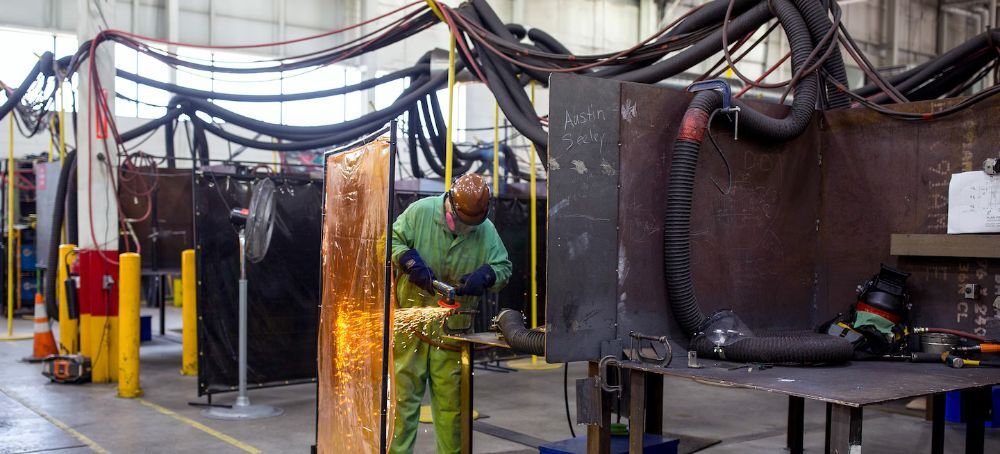 A student works at the Bath Iron Works training facility in Maine. The company builds ships for the U.S. Navy. (photo: Brianna Soukup/Getty)
News of a probe involving political contributions and federal contracts has some in a shipyard town raising questions about her influence.
This month, Collins appeared at that same shipyard, shaking hands with some of the 6,000 workers who assemble vessels for the U.S. Navy.
Before she departed, a group of workers delivered her a letter, signed by over 100 employees, thanking her for her work in Washington. As a member of the Senate Appropriations Committee, she has helped secure more than $10 billion in Navy contracts for the yard since 2020, according to her office.
Now, as Collins faces a tight reelection race against Democrat Troy Jackson, allegations involving a different defense contractor are putting her broader record of steering money to Maine under scrutiny and raising a politically charged question: Where does Collins’s aggressive advocacy on behalf of Mainers end and improper influence begin?
This week, the nonprofit newsroom ProPublica disclosed that FBI agents had examined allegations that campaign contributions benefiting Collins were connected to federal contracts sought by a Hawaii-based defense company.
Three people familiar with the matter confirmed to The Washington Post that the FBI last year closed an early-stage inquiry into allegations that a defense contractor made concealed political contributions benefiting Collins in exchange for help securing federal contracts. They spoke on the condition of anonymity because they were not authorized to discuss the previously undisclosed investigation.
The inquiry grew out of statements by Martin Kao, former head of the Hawaii-based defense contractor, Navatek. Kao told investigators that he discussed a large political contribution with Scott Reed, the chairman of a super PAC supporting Collins, while Navatek was seeking millions of dollars in Navy contracts. Kao later pleaded guilty to using a shell company to make a $150,000 contribution to the super PAC and to arranging separate illegal contributions benefiting Collins’s campaign.
ProPublica reported that Collins was aware of Kao’s contribution, based on an email between one of Reed’s subordinates and a Navatek lobbyist saying that “Senator Collins would like to call Martin to thank him.’”
Kao made his allegations while seeking leniency in separate campaign finance and fraud cases, giving him an incentive to provide information that might be valuable to investigators. He was not granted a reduction in his sentence. Collins and her staff have vigorously denied allegations of bribery or pay-to-play, calling Kao’s account “outlandish.” Reed has said he never communicated with Collins or her staff about Kao or Navatek. Neither Collins nor anyone who worked for her was charged.
In a statement, a spokesperson for the FBI said the bureau previously investigated the allegations reported by ProPublica and found nothing implicating Collins or her campaign.
Several agents handling the inquiry worked on a Washington-based public-corruption squad that FBI Director Kash Patel later dismantled, and some were pushed out after working on investigations involving President Donald Trump, according to the people familiar with the matter.
The allegations do not involve Bath Iron Works or the federal contracts Collins helped secure for the shipyard.
But the news, covered by several of Maine’s major news outlets, was front of mind Thursday for many in Bath, a quaint waterside city of just under 9,000 residents.
“I hope it goes far and wide, and I hope that people understand what it’s really about,” said Bath resident Matthew Glassman, who was walking his dog by the red-brick bookstores and boutiques that line the city’s main commercial stretch.
Glassman, a Jackson supporter who runs a local arts center in a former church, said he understood why neighbors who depended on the shipyard supported Collins. But he hoped the allegations would prompt them to look more critically at how she uses her influence in Washington.
“If they can see that it’s not always done in virtuous ways, and not in ways that are in people’s best interests, then hopefully we can have a different senator while keeping that industry thriving,” Glassman said.
Like much of coastal Maine, Bath has moved significantly toward Democrats in recent years — Kamala Harris won the township by 37 percentage points in the 2024 presidential election — but it retains strong pockets of support for Collins, thanks in large part to her support for BIW.
“She’s done a lot to support the yard,” said Lorraine Beaulieu, a planner at BIW who has worked at the yard for 38 years. “That’s my livelihood, that’s how I raised my kids, that’s what gets us through — so that’s what I’m pushing for.”
Beaulieu, an officer with IAM Local S7, one of the unions representing BIW workers, said the workforce at the yard is divided between Collins and Jackson. Moments later, Anthony Leeman, the president of S7, walked down the street to the local’s office wearing his hard hat and work boots.
“I’m supporting Troy Jackson,” said Leeman, who also serves as the president of the union’s state council. “If there’s any conflict between the locals and the company, she’ll choose the company’s side no matter what.”
Neither Leeman nor Beaulieu had heard the new allegations reported by ProPublica. But Leeman said that much of the support for Collins in the union is driven by her past support for the shipyard, as well as by a general perception that Democrats are too radical on issues like gun control.
“People don’t always understand what the fight really is. They think, ‘Oh, they’ll take my guns away,’” he said. Instead, he has been encouraging union members to think about the “three Gs” of affordability — gas, groceries and Grandma. “It’s more about: ‘What’s your paycheck? What’s your gas?’” he said.
Among some voters in Bath, news of the allegations reinforced a general sense of disillusionment with both Collins and her opponent.
“We all expect doctors to be God, and we all expect politicians to be honest and moral, and we’re stupid to think that about either profession,” said Alida Zimmerman, a retiree from nearby Waldoboro. “They’re all crooked.”
Zimmerman said she was undecided about which candidate she would vote for, though she said she was leaning toward Collins, calling her a hardworking advocate for the state’s interests in Washington. Jackson, by contrast, seemed “a little slimy.”
“I’m really not enthused about either one,” she concluded.
Other voters had not heard about the allegations and remained focused on more immediate financial pressures. Maryellen Spear, a 67-year-old part-time toy store employee, said neither Collins nor Jackson had offered a compelling answer to the rising cost of living.
Spear said she sold her father’s cabin on nearby Popham Beach to help cover his health care costs. She later sold her own Bath home because she could no longer afford its property taxes and maintenance. She now lives in an apartment where the rent, she said, costs four times her former monthly mortgage payment.
“I don’t want to have to work until I’m 80, but I might have to,” said Spear. “There’s not one, not a political person in this world, who’s going to [fix] that.”
At 3:30 p.m. on the other side of town, the afternoon shift change at Bath Iron Works had just begun. Hundreds of workers streamed out of the shipyard’s gates, carrying their hard hats and coolers to idling buses and nearby cars. Members of the incoming shift, nursing cups of coffee and cigarettes, swam upstream against the crush of departing workers.
Laurie, a 38-year electrician at the yard, headed toward a dusty parking lot. She was planning to vote for Collins. “She’s pretty powerful when it comes to the defense spending aspect of it,” said Laurie, who declined to give her last name out of fear of professional reprisal. “I just don’t see any of the other candidates having that kind of influence.”
But back in downtown Bath, Mal Carey, a former electrician and draftsman at BIW, wasn’t so sure that Collins’s support for the shipyard was enough to justify a vote for her. Carey called himself “a bad Republican” — still registered with the party but increasingly alienated by Trump and by Collins, whom he views as an enabler of the president.
Carey cited the latest allegations involving Collins’s political circle, which he saw as a symptom of the Republican Party’s growing tolerance for corruption. He conceded that Collins had brought tangible benefits to Maine. But the trade-off — between those local benefits and her enabling of Trump at the national level — had become increasingly difficult to ignore.
“Is national stability, from the Senate on up, worth paying a price for?” he asked.