A Palestinian Lies Paralyzed, While the Settler Who Shot Him Remains on the Hill
Gideon Levy Haaretz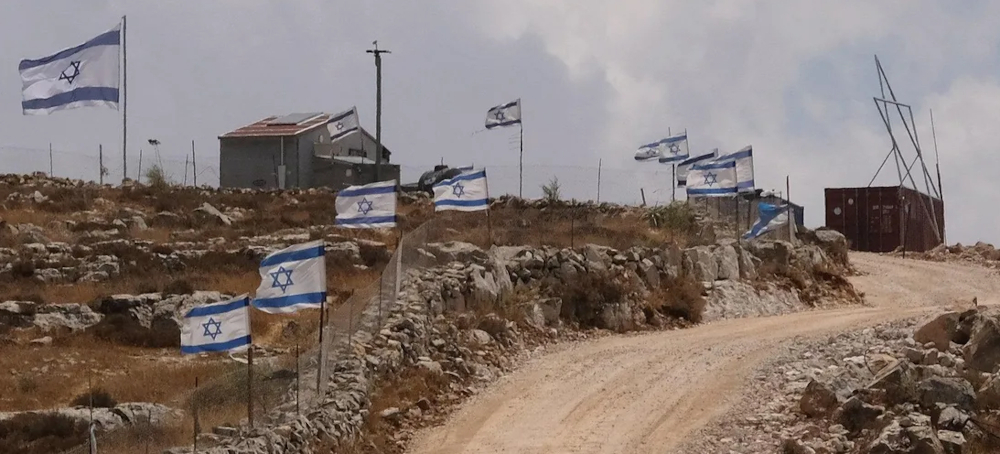 The new outpost on the hill across from Sa'ir. B'Tselem's al-Ja'bri: "We can only dream about a road like that." (photo: Alex Levac)
Harassment of the Palestinians began immediately after the new outpost sprouted up near the West Bank village of Sa'ir. A nurse seeking to help his neighbors after a settler opened fire was himself shot – and paralyzed for life
The hill looms across the way from the Dawara neighborhood in the Palestinian town of Sa'ir, northeast of Hebron in the West Bank. The land below belongs to its residents who, over many years, have cultivated olive, almond and fig trees there. Just four weeks after the settler ascended the hill with others of his ilk, however, a well packed-down dirt road leads up to the illegal settlement, three mobile homes had been planted at the site and a huge Star of David had been erected for all to see. Moreover, the outpost was already connected to the electrical grid and had been given a provisional name, painted on a makeshift wooden sign posted on the main road below: "Kiryat Arba Hebron East."
Nasser Nawaj'ah, head of the Susiya local council and a field researcher for B'Tselem – The Israel Information Center for Human Rights in the Occupied Territories – who accompanied us when we visited this week along with his colleague, field researcher Manal al-Ja'bri, looks at the road ascending the hill and says wryly: "We in Masafer Yatta [a cluster of Palestinian hamlets in the South Hebron Hills] can only dream about a road like that. For years we've been asking for one and have been turned down every time, and here there's a road within days."
The second young man in this story is Mohammed Um Tour, a 26-year-old nurse who works in a hospital in the town of Dura but resides in the Dawara neighborhood, where he was building a new home in advance of his upcoming marriage.
The place: ICU, on the second floor of Makassed Hospital, East Jerusalem. Mohammed lay there this week, paralyzed from the waist down, with poor to nonexistent prospects of recovery, his gaze fixed on the ceiling, apparently incredulous over what befell him.
Last Friday the settler on the hill shot Um Tour in the back from a long distance, hitting his spine. This week the victim contemplated the man who ruined his life, who also appears to be in his 20s, asking over and over why the settler had done this to him. The shooter, for his part, probably didn't give even a moment's thought to the disaster he inflicted on the innocent young man and his family. Why would he?
Attiya Um Tour, Mohammed's uncle, 51, receives us in his son's home in Sa'ir. It was here, in the yard, that his nephew was shot. Mohammed's father is mentally ill; no one has dared to tell him that his son has been seriously wounded and he thinks Mohammed is still doing a shift at the hospital and will soon return home.
The rest of the family gathered this week on the balcony of Attiya's son's house to relate what has occurred in the past month since the settlers showed up, and specifically what happened last Friday. Attiya, who has six children and owns a local grocery store, was the chief speaker.
On July 16, we are told, villagers awoke to the sight of bulldozers clearing a road in the sandstone leading to the top of the hill across the way. It did not bode well. When they asked the Israel Defense Forces soldiers who were guarding the site – which was on the Palestinians' land – what they were doing, the reply they got was that it was a "security route." To be on the safe side, the soldiers also detained three Dawara residents who had the effrontery to ask questions.
One of the three, Mahmoud Um Tour, 35, explains that he and the others were handcuffed, cursed and beaten before released after five hours.
Two weeks later, the first mobile home and its occupants arrived on the hilltop; a couple days later another two homes arrived. The "Kiryat Arba Hebron East" settler outpost had come into being. No one will dare remove it from here, virtually lodged as it is in the heart of the Palestinian neighborhood.
Two days went by and the army showed up and raided the homes of 15 local residents in the dead of night. The troops explained to the Palestinians that a new settlement had arisen, and warned: "It is forbidden to harass them. They are armed and might shoot."
The locals say they took the warning seriously and due to their fear of the hilltop settlers, stopped trying to access their fields. After most of the Palestinians were deprived of a living due to the ban on working in Israel after October 7, and tried to find a substitute by farming, they were now being deprived of that source of livelihood as well.
But harassment by the settlers became intense. They felled and vandalized olive trees, ripped out fences and threw stones at the villagers' homes. From their commanding position above the main road between Sa'ir and the town of Bani Naim, they pelted cars with stones and also blocked traffic at times. After all, are they lords of the land – or not? On one occasion, a young Palestinian who wanted only to irrigate his family's field was detained for a few hours by the army.
Last Friday, at around 6 P.M., a large number of settler youths, who had apparently come to spend Shabbat in the new holy outpost, started to stream down the hill. With them were dogs that roamed about unleashed, according to the residents. On the way down the mob slashed through the containers of water used for the villagers' sheep. Distraught, the Palestinians began to move toward the marauders, to prevent them from entering their neighborhood.
At this point, two armed men appeared, a security guard in civilian clothes and a soldier in uniform. The guard started shooting in the direction of the villagers, firing multiple rounds both in the air and at the ground. The Palestinians fled in terror. The guard, apparently a resident of the outpost, wore the same faded pink shirt and jeans that he did when we saw him at the top of the hill three days later, on Monday of this week.
At the time, Mohammed Um Tour was not far away, surveying the skeleton of his new home. Hearing the shots, he decided to go out to see if anyone had been wounded and needed medical assistance. He was standing on a path leading to the house we visited this week.
When more shots were fired, he tried to take cover behind the staircase that leads to the house. However, as he was running in that direction, a bullet struck him in the back; another just missed his head, grazing his forehead. Mohammed collapsed, bleeding, but did not lose consciousness. The bullet had lodged in his back.
Nawaj'ah, from B'Tselem, later measured the distance between the settler who did the shooting, and Mohammed, who was trying to take cover below. It's 138 meters (453 ft.). The soldier in uniform standing next to the settler did not open fire, but also did nothing to stop the shooting. The villagers tell us that the settler went on shooting even after Mohammed fell to the ground. As they were recalling what happened, one of the Palestinians suddenly noticed that the same settler was up on the hill, observing us. Our conversation was broken off for a moment; there was fear the settler might open fire again.
The first person to rush to Mohammed's aid was his uncle, Attiya. "I've been wounded, uncle, I've been wounded," cried Mohammed, who was evacuated in a private car to the medical clinic in Sa'ir, then by ambulance to Alia Hospital in Hebron and later to Al-Ahli Hospital in the city. On Sunday evening he was transferred to Makassed.
A spokesperson for the Israel Police this week stated, in response to a query from Haaretz: "Upon receiving a report of the incident, police officers arrived at the site, launched an investigation and collected findings, along with interrogating two suspects under caution."
Caution, caution – but the shooter is still walking about freely and inflicting terror from the hilltop he now controls.
No response was received by press time from the IDF Spokesperson's Unit.
In his hospital bed this week, Mohammed is weary and pale as he recalls in a whisper what happened to him, repeating the same account his uncle gave. He was scheduled to undergo further surgery this week. The physicians have already told him that the chance that he will ever be able to stand up again is less than 10 percent.