A Look at the Growing Movement to Stop Data Centers
Claire Brown The New York Times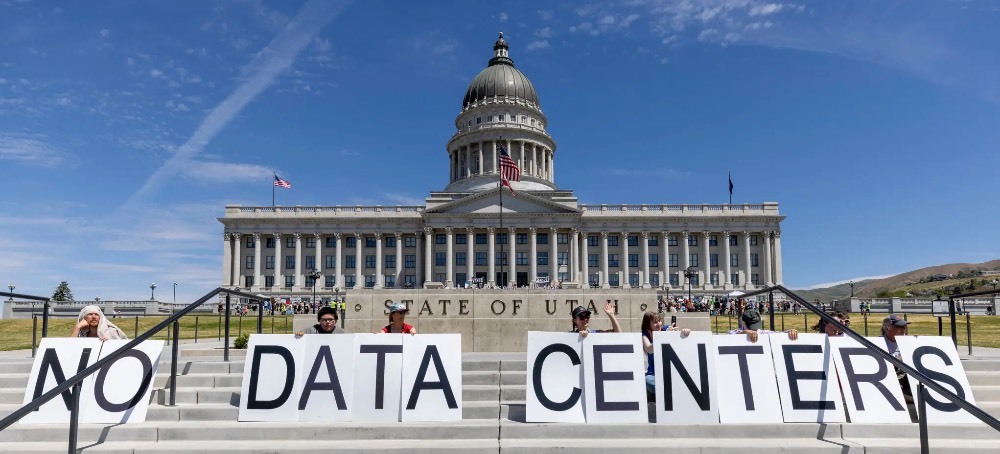 A demonstration at the Utah State Capitol in Salt Lake City last month. (photo: Natalie Behring/Getty) (edited)
Proposals for data center moratoriums fall into two categories: Most call for a short-term pause in permitting or construction to give local governments time to establish guidelines. A few others call for permanent construction bans.
Cities including Tulsa, Okla.; New Orleans; Birmingham, Ala.; and Ypsilanti Township, Mich.; have all implemented temporary bans on permitting or construction, as have dozens of other counties and towns, according to a database maintained by the hedge fund Interconnected Capital.
Bigger state-level proposals have so far seen mixed results. Democrats and Republicans in 14 states have proposed construction pauses. In April, Maine lawmakers passed a temporary statewide moratorium on new data centers, but it was vetoed by Gov. Janet Mills, a Democrat.
On Friday, New York lawmakers passed their own statewide ban on large data centers.
Today, we look at where this is happening, why the politics of the issue have shifted so quickly and why the issue does not fall neatly along party lines.
New York’s bill
If all 28 of the big data centers currently planned for New York State were to fire up, they could expand the state’s energy use by roughly a third, State Senator Kristen Gonzalez, a Democrat, told the Times.
New York, like some other Northeastern states, is already struggling to follow through on its plans to make deep emissions cuts by 2030, and the legislature recently watered down its climate goals. Advocates for climate action worry that it could be impossible for renewable energy installations to keep pace with all the new demand, and that many of the new data centers might be powered by gas.
The State Legislature approved a plan to pause construction of “hyper-scale” data centers, or facilities capable of using of more than 20 megawatts of electricity, for one year. If signed into law by Gov. Kathy Hochul, a Democrat, New York would be the first state to enact a statewide moratorium.
In New York, momentum for the one-year moratorium built quickly, said Alex Beauchamp, northern regional director at Food and Water Watch, a nonprofit advocacy group that pushed for the bill. The N.A.A.C.P. and the League of Women Voters both supported the measure.
“The politics and the movement on data centers is just growing at a speed that is unlike anything else in the environmental movement, and maybe unlike anything else happening in the U.S.,” he said.
Kristin Devoe, a spokeswoman for Hochul, said the governor would review the bill.
Public opinion sours
Voters’ opinions on new data centers have done a U-turn in recent months, according to polling by Heatmap News. Last August, four out of 10 respondents said they’d oppose a data center being built in their area. By May, the number had risen to seven out of 10.
The survey found that people don’t just care about their own backyards. More than half supported a moratorium that covers the entire nation. (Senator Bernie Sanders of Vermont, an independent, and Representative Alexandria Ocasio-Cortez, a New York Democrat, have introduced legislation to enact what they call a “reasonable pause” on data center development.)
Americans are blaming data centers for rising energy bills, and many are feeling pessimistic about the broader effects A.I. will have on society, the survey found. Opponents have also raised concerns about noise, water use and air pollution.
Another factor driving opposition is the speed at which new facilities are opening. As Bloomberg News pointed out this month, data center construction spending topped $50 billion in April, surpassing total U.S. public spending on transportation projects like airports and subways.
Put another way, power demand from data centers is expected to double in 2027 compared with 2025, Goldman Sachs estimated in May, even though about half of announced projects are expected to open late or get canceled.
Local groups opposing data centers have notched some high-profile wins in recent weeks. A massive facility proposed by the “Shark Tank” co-star Kevin O’Leary cut its footprint in half last week after intense blowback from residents and local politicians, Bloomberg News reported.
Politicians in a tough spot
Perhaps no state better exemplifies the strange political fault lines of the data center debate than Maine, where the Legislature, controlled by Democrats, passed a moratorium that was vetoed by the Democratic governor.
In a statement to the Legislature, Gov. Janet Mills wrote that while she supported a data center moratorium in general, she could not sign the bill because it would threaten the construction of a specific project that would bring jobs and tax revenue to the Town of Jay, which has about 4,600 residents.
A similar tension was evident in Michigan last week after Gov. Gretchen Whitmer, a Democrat, faced blowback from members of her own party for posing in a photo with Sam Altman, the OpenAI chief executive, at a groundbreaking for a $16 billion data center in Saline Township.
Asked about the criticism, Whitmer told an ABC affiliate that the facility was expected to create good jobs and run on a closed-loop water system. In the same interview, Whitmer said she would not support a data center moratorium.
In New York, Hochul faces the next data center test. Beauchamp said his group would push her to sign the bill. The politics of data centers are evolving quickly, he said. “It’s less left versus right, and more whether you see yourself as an establishment person or a populist,” Beauchamp said.
Hochul has until December to make her decision.