A Letter to Myself on 9/11
Mark Hertling The Bulwark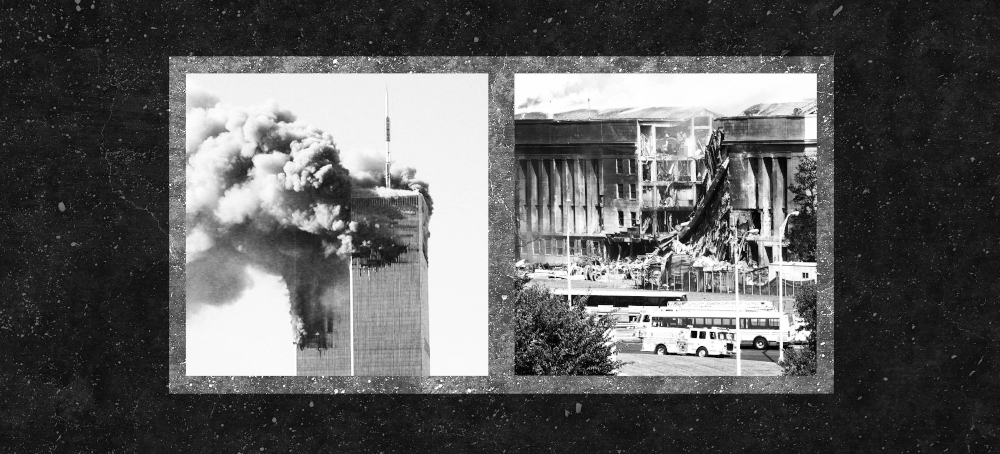 Images from the September 11th terror attacks. (photo: Getty)
I was one of a very few Americans whose 9/11 story began before September 11, 2001. In the late summer, I was among a group of newly selected generals and admirals at a classified lunch with CIA Director George Tenet. Asked about threats to the country, he described several but emphasized a terrorist organization called al Qaeda. I had little idea what al Qaeda was, but he made sure we remembered the name.
That was around the same time I reported to the Pentagon for my first Washington assignment, as vice director for force development (J7) on the Joint Staff. Our section handled contingency war plans, exercises, and force transformation. Someone had described it as a relatively sleepy assignment. My boss, a Marine lieutenant general, knew that after several years training soldiers in the California desert, I had seen little of my extended family on the East Coast. He encouraged me to take a long weekend before jumping into the job. My wife and I left Washington on September 8, planning to return four days later.
And then the phone rang while we were having a leisurely breakfast with my in-laws on eastern Long Island. My brother-in-law called to say that it appeared an airplane had just crashed into the World Trade Center. The United States was under attack. Soon, we would be at war.
Twenty-five years later, I know things now that I could not possibly have known as I turned on the television just in time to see the second plane hit. This is the letter I would send to myself if I could, warning about what was to come.
Mark,
You don’t have much time to read this. You’re going to be busy for the next several years.
You’re dealing with a lot of uncertainty right now. Some of it will be resolved; some of it never will be. You’ll know soon enough who attacked America and why—but questions about how many other attacks there could have been will linger for decades.
You’ve just watched the attack on the World Trade Center on TV, and the situation will become immediately disorienting. Keep your wits about you.
You’re going to call the staff section’s executive officer to ask what the Pentagon knew. The Navy officer you reach will speak to you only briefly before he stops and says he needs to call you back because something just happened in the building.
You’ll never get that return call.
You’ll get into the car and start heading for Washington. The Long Island Expressway will be choked, bridges and tunnels will be closing. At the Verrazzano-Narrows Bridge, a police officer will stop you and say the bridge is closed. You’ll explain that you’re an Army officer and need to return to the Pentagon. He’ll escort you across.
You’ll be the only car on that enormous bridge. Near its highest point, you’ll get a look toward Manhattan. The two towers that had dominated the skyline when the day began will be gone, and smoke will be rising from where they had stood. That image is going to stay with you.
During your drive, you’ll learn from the radio that the Pentagon has also been hit. You’ll feel the rush to get back there, as you don’t know what that means for those in the J7 you’ve just recently met.
You’ll drive silently through the night and reach the Pentagon at about five tomorrow morning. Smoke and the smell of aircraft fuel and fire will surround the building as you show your badge and enter.
Secretary of Defense Donald Rumsfeld will ask the Joint Staff what other sites inside the United States might require protection. The list of sensitive sites will quickly become enormous: the Sears Tower in Chicago, the Transamerica Pyramid in San Francisco, and other high-rises are possibilities, but so are dams, electrical grids, nuclear facilities, transportation hubs, military installations, ports, and bridges like the Golden Gate. America is littered with thousands of potential targets. One of the first things you will learn: Even the most powerful country in the world cannot defend everything. There will always be risk.
Yesterday, you and the whole country had a feeling of perpetual security. Today you’re feeling a sense of unalterable vulnerability. Learn to manage risk, prioritize, and be comfortable with tradeoffs.
Because you’re one of the newest general officers on the Joint Staff, you will volunteer as the night-shift general officer in the National Military Command Center. You’ll spend nights overseeing the flow of information and actions from around the world. You and your NMCC team will update the chairman and secretary of defense every morning.
From there, you’re going to get wrapped up in the planning for how America will strike back, even before you know whether September 11th was a single operation or the beginning of a series of attacks, whether other terrorist organizations or governments might be involved, or where the next threat might emerge. Get used to making decisions under uncertainty; that’s what leaders do, and there’s no other option.
You’re going to spend many, many hours with parts of the government neither you nor any of your colleagues have worked with closely: the State Department, CIA, FBI, Treasury, and others. Eventually, the relationships among these various parts of the government will be formalized for the specific purpose of fighting terrorism. But for now, you’re going to have to learn to work together at the same time as you learn where the bathrooms are in each other’s buildings. Learn to improvise.
You’ve learned in war college classrooms that military power is only one element of national power. You’re about to see that proven in real life. Intelligence organizations will find terrorist networks, Treasury will disrupt their financing, diplomats will build coalitions and gain access, and law enforcement will protect Americans at home. The military will soon be asked to do extraordinary things—but it will not be alone. You’ll see it now in the Pentagon, from the strategic level; soon, you’ll see it up close and personal in combat.
The people around you—intelligence officers, diplomats, soldiers, sailors, airmen, Marines, law-enforcement officials, allies, and partners—are doing and will do remarkable things. Admire them. Learn from them. Be proud of them. But be careful about the early conclusions you draw from what you are seeing.
You have spent about half of your professional life learning how to lead tactical military units. You’ll spend the next half learning just as much about their strategic limits.
Never confuse destroying a target with achieving an objective. Never confuse winning a battle with winning a war. Military power can create conditions for political success, but it cannot define what political success should be. And when the political objective is unclear, constantly changing, or impossible to achieve, even the finest military in the world cannot fix that. You will see this again and again.
The war beginning in Afghanistan now will become America’s longest. Less than two years from now, the United States will invade Iraq. You’ll soon be a part of that, on the ground there. Missions will expand. Objectives will change. Resources will move from one theater to another. Strategies will be rewritten.
The speed and professionalism of the response will be extraordinary. You’ll track force movements from combatant commands, intelligence reports from a dozen different agencies and dozens of allies, and operational decisions from around the government. You’ll monitor special operations teams and aircraft as they begin their work with Afghan tribal leaders to attack the Taliban and al Qaeda.
But understand this: Tactical successes will sometimes disguise strategic confusion.
Right now will, in some ways, be the high point of the war you and your comrades in arms will fight for a generation. The mission is clear. The country is united. Our allies are with us. Our strength is overwhelming. Don’t take any of this for granted. Always think very carefully and hard about who is truly a friend, and who is truly an enemy.
Be especially wary when everyone in the room seems certain they are right. Intelligence will sometimes be wrong. Assumptions will fail. Enemies will adapt, because they always get a vote. Plans that look brilliant on a briefing slide will collide with geography, culture, politics, human behavior, and chance. Ask the uncomfortable questions in those rooms: What are we trying to accomplish? How will military action help accomplish it? What happens after the fighting? What assumptions are we making? What does the enemy get a vote on, and how might we mitigate that vote? What will this cost if it lasts not six months, but six years—or twenty? Listen to the people who see the problem differently—listening doesn’t require agreement.
Listen to diplomats. Listen to intelligence officers and law-enforcement officials. Listen to allies. Listen to people who understand the history, language, religion, politics, and culture of the places where American forces will operate. You will discover that military expertise is indispensable in war, but insufficient for understanding all that war produces. You will also learn the value of allies.
Never forget that America is stronger when others want to stand beside it. In the days ahead, countries around the world will rally to our side. NATO will invoke Article 5 for the first time in its history. In the years ahead, allied soldiers will fight and die beside Americans in places far from their homes. Remember that, and build on it. Trust between nations takes years to build and minutes to squander. Alliances are not acts of charity. They are instruments of national power, built on shared interests, shared sacrifice, and trust.
You are also going to learn something about swagger.
You’ll see plenty of it in the years ahead. Some will mistake cockiness for competence and certainty for strength. Don’t be one of them. Humility will be one of the most important qualities in leadership and strategy. The stronger you become, the more important it will be to recognize what you don’t know.
There is something else you don’t know yet: This war is going to become personal. You will serve three tours in Iraq. Your two sons and a daughter-in-law will serve a combined eleven tours. Your wife will spend eleven years worrying about all of you. You will stand at memorial services for soldiers whom you knew and loved because they will have been part of your team. You will visit the wounded and present Purple Hearts, and you will visit their markers in cemeteries. You will watch families bear burdens most Americans will never see. Some of the people you meet will remain with you for the rest of your life, as friends or as a memory.
Remember the young Mexican immigrant in your unit who studies for his citizenship test in his spare time and then gives his life protecting his fellow soldiers. Remember the military police soldier who receives two Purple Hearts doing her duty. Remember the families who say goodbye at deployment ceremonies, welcome soldiers home in energy-filled gymnasiums, and sometimes receive the knock on the door that every military family fears.
And when the wars eventually become unpopular—and they will—remember something important. The infantryman patrolling Kandahar did not write America’s Afghanistan strategy. The Marine fighting in Anbar did not decide to invade Iraq. The pilot, medic, intelligence analyst, logistician, sailor, airman, special operator, diplomat, aid worker, and military spouse did not determine the political objectives or decide when and how these wars would end. They only answered when their country called. Many will answer repeatedly.
Twenty-five years from now, Americans will still be arguing about the decisions made after September 11th. They should. A democracy that sends its citizens to war has an obligation to examine those decisions relentlessly: the invasion of Iraq, the mission creep in Afghanistan, intelligence failures, detention and interrogation, civilian casualties, counterinsurgency, nation-building, and how the wars eventually end. Do not confuse those judgments about policy and strategy with judgments about honorable service.
When you’re a commander, do not let those under your command confuse the two, either.
You will also want to remember something about America in these next few months. For a brief period, the country will experience an extraordinary sense of common purpose. Flags will appear everywhere. People will line up to give blood. Police officers, firefighters, healthcare workers, and others will suddenly be recognized for what they contribute. Thousands of young Americans will walk into recruiting stations knowing they are volunteering for war.
Don’t romanticize this moment, because it will fade. Those who aren’t in the fight will claim fatigue. Fear will produce anger, prejudice, and some terrible decisions. Muslim Americans and immigrants will sometimes be treated shamefully. In trying to protect itself, the country will sometimes struggle to remain faithful to the values it says it is defending.
Remember those things. Remember what you’re fighting for—and what you’re fighting.
National unity does not require unanimity. Patriotism does not require silence. Disagreement does not mean disloyalty. A country can argue fiercely about its policies while its citizens remain committed to one another and to the institutions they share.
Most of all, remember the people. Remember the Navy officer who suddenly ends your telephone call because something has happened inside the Pentagon. Remember the New York police officer who sees an Army officer trying to get back to Washington and escorts you onto a closed bridge. Remember your wife sitting beside you as yours is the only car crossing the Verrazzano-Narrows Bridge.
Sometimes, look toward Manhattan. Don’t ever forget what you saw. Think occasionally about the lives they might have lived, the children they might have raised, the things they might have built, written, taught, discovered, or contributed to this country.
In the years ahead, you will learn a great deal about a lot of things in your profession. But try not to miss the simpler lesson: America’s greatest strength is not its ability to destroy an enemy. It is its ability to summon people to a common purpose, to learn from its mistakes, to sustain alliances built on trust, to substitute humility for swagger, and to persuade citizens that something larger than themselves is worth serving.
You don’t know any of that yet. Right now, you’re just a soldier doing a difficult job every night.
Do that job. Take care of the people around you. Ask hard questions. And pay attention.
You’ll want to remember all of it.