A Day of Disastrous Supreme Court Decisions
The Amp Media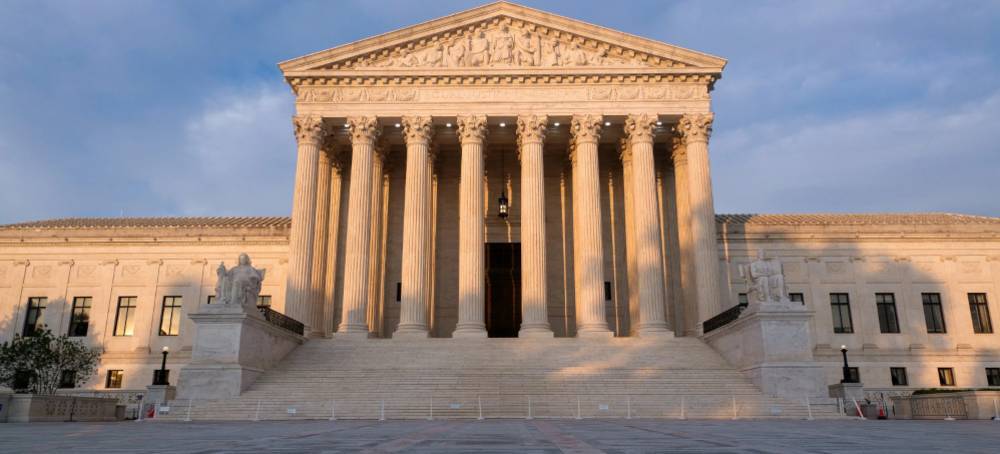 Supreme Court building in Washington, DC. (photo: Getty)
“The consequences of today’s decision are predictable,” she read. “More people will die. More people will attempt to cross the border illegally, and some will make it while others will not.”
Read about today’s rulings in detail below.
Immigration Decisions
The U.S. Supreme Court issued two major rulings that significantly strengthen the federal government’s authority over immigration policy. The decisions permit the Trump administration to discontinue humanitarian protections for large numbers of immigrants and impose broad restrictions on asylum seekers attempting to enter the United States.
The court’s conservative majority ruled that federal officials may deny entry to asylum applicants when border processing facilities are considered unable to handle additional cases. The decision could substantially alter how asylum claims are managed and affect many individuals seeking refuge in the United States.
In a separate ruling, the Court authorized the Department of Homeland Security to terminate Temporary Protected Status (TPS) for immigrants from Haiti and Syria. The change affects nearly 350,000 people who have been legally residing and working in the country under the humanitarian program.
Both decisions were approved by a 6-3 vote and authored by Justice Samuel Alito. Critics argue that the rulings may have far-reaching consequences for immigrant communities and could increase the number of individuals facing removal proceedings despite previously holding legal status.
Roundup Lawsuit Ruling
The Supreme Court also ruled in favor of Monsanto in a closely watched case involving allegations that its weed killer, Roundup, causes cancer. The decision limits the ability of plaintiffs to pursue certain state-level lawsuits against the company.
At the center of the dispute was whether federal law overrides state requirements that might compel Monsanto to place cancer warnings on Roundup products. In a 7-2 ruling, the Court concluded that federal regulations take precedence, preventing many state-law claims from moving forward.
Writing for the majority, Justice Brett Kavanaugh noted that the Environmental Protection Agency (EPA) has consistently determined that glyphosate—the active ingredient in Roundup—does not present a cancer risk. Because the EPA has not required cancer warnings on glyphosate-based products, Monsanto cannot be held liable under state law for failing to provide one, according to the Court.
The ruling drew dissent from Justices Ketanji Brown Jackson and Neil Gorsuch. Jackson argued that the majority’s interpretation unfairly limits access to the courts for individuals seeking compensation for alleged injuries.
The case originated with John Durnell, a Missouri resident who claimed that decades of using Roundup while maintaining local parks contributed to his development of non-Hodgkin lymphoma. A state jury awarded him $1.25 million in damages in 2023, but Monsanto challenged the verdict and eventually brought the case before the Supreme Court.
Monsanto, now owned by Bayer, continues to reject claims that Roundup causes cancer. Meanwhile, agricultural organizations emphasize the importance of glyphosate for crop production, while health advocates remain concerned about potential health risks.
Hawaii Firearm Restrictions Overturned
In another significant decision, the Supreme Court struck down portions of a Hawaii law regulating where firearms may be carried in public. The ruling marks another expansion of gun rights following recent Second Amendment decisions.
By a 6-3 vote, the Court held that Hawaii’s requirement for gun owners to obtain permission before carrying firearms onto privately owned property open to the public violates constitutional protections for bearing arms.
Justice Samuel Alito, writing for the majority, stated that the law conflicted with the Court’s 2022 decision in New York State Rifle … Pistol Association v. Bruen, which broadened the constitutional right to carry firearms outside the home for self-defense.
The decision could affect similar laws enacted in states such as New York, New Jersey, California, and Maryland after the Bruen ruling.
The Court’s liberal justices disagreed. Justice Elena Kagan argued that the Hawaii law was consistent with longstanding traditions of firearm regulation. Justices Ketanji Brown Jackson and Sonia Sotomayor contended that property owners’ rights to control access to their land should outweigh the claimed right to carry firearms onto private premises.
The Hawaii statute, enacted in 2023, made it illegal to bring a firearm onto private property open to the public unless the owner explicitly granted permission through signs or direct authorization. Other portions of the law, including restrictions on carrying firearms in designated sensitive locations such as bars and youth centers, were not part of the case before the Court.
The challenge was brought by concealed-carry permit holders and the Hawaii Firearms Coalition, who argued that the law imposed unconstitutional limits on their rights under the Second Amendment.