60 Days After Signing Iran Deal, Trump Is Stuck in a Quagmire as War Drags On
Cleve R. Wootson Jr. and Rachel Chason The Washington Post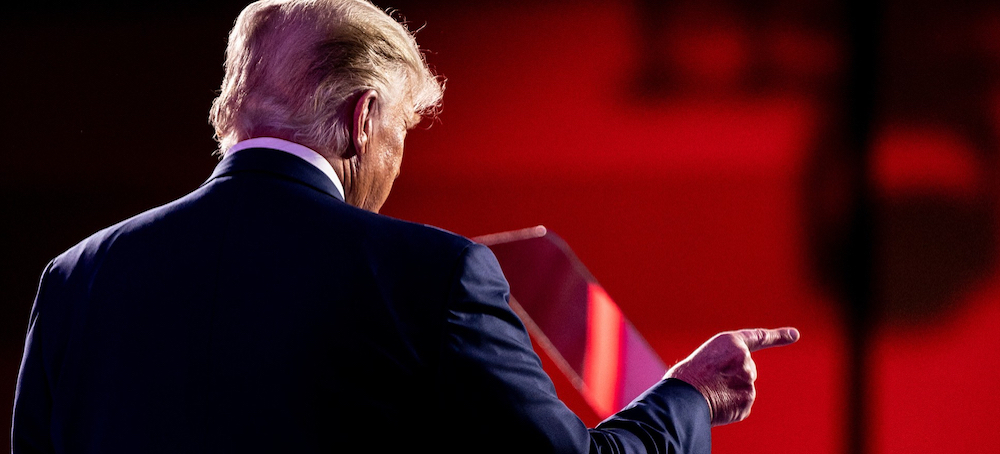 Donald Trump. (photo: Erin Schaff/NYT/Redux)
President Donald Trump’s interim deal with Iran in June set aside two months for negotiations, but the window has now closed and broader talks are at a standstill.
The “historic breakthrough” would lead to the reopening of the Strait of Hormuz and ensure Iran never obtained a nuclear weapon, the White House declared. Trump advisers said the deal would demonstrate that the president could end, rather than prolong, the kind of “endless wars” in the Middle East he had spent years denouncing.
The agreement set aside two months for talks to turn the interim truce into something more ambitious: a broader settlement of the decades-long standoff over Iran’s nuclear program.
That window has now closed.
The war has not ended. The Strait of Hormuz remains largely shut. Detailed negotiations over Iran’s nuclear program never began.
The United States has resumed its blockade of Iranian ports. Tehran is demanding concessions that the Trump administration has rejected. And the administration has now publicly disowned several of the key points in the ill-fated memorandum, including development of a plan “with at least $300 billion for the reconstruction and development” of Iran, a waiver of sanctions to allow Iran to sell oil, and a “dialogue” between Iran and Oman over how to run the Strait of Hormuz.
Trump on Monday went so far as to threaten to bomb Oman over its talks with Iran on management of the strait, through which 20 percent of the world’s oil used to pass.
If Oman “gets in the way,” Trump said in a Fox News interview, the U.S. would “bomb the s--- out of them.” He demanded that Iran raise “the white flag of surrender” while insisting that neither the approaching midterm elections nor the passage of time was putting pressure on him to reach a deal.
“I have no time schedule,” Trump said. “I’m not in a hurry. … Midterms have nothing to do with my thinking.”
Six months after he launched attacks on Iran in coordination with Israel and 78 days before elections that will determine whether his party retains control of Congress, Trump confronts the kind of open-ended conflict he claimed he was uniquely equipped to avoid: one with no obvious military resolution, no diplomatic breakthrough in sight, and mounting economic and political costs at home.
Continuing the standoff risks leaving him presiding over a war that undercuts one of the central premises of his political identity.
The war has helped to erode voters’ trust in Trump and may have larger consequences in the midterms, said Lee Miringoff, director of the Marist University Institute for Public Opinion.
“For a lot of voters, the war in Iran is linked with the economy. When the strait closed, the price of gas went up,” Miringoff said. “The problem for President Trump and the Republicans is that a lot of what he was elected on seems to not be being fulfilled. So there’s a sense of no rationale for why we went in, and no clear sense of how it’s going, and no indication of how we’re going to get out, which is the opposite of what makes for good politics.”
The White House did not respond on the record to questions about the memorandum’s expiration or its impact on the president’s political goals, instead noting his public statements.
But administration officials say the White House is leaning heavily on the hope that the U.S. campaign of economic pressure will push Iran to a breaking point.
“President Trump’s been very focused on the economic pressure,” Jared Kushner, the president’s son-in-law and envoy, said Monday in an interview with Fox News. “If you look at the Iranian economy, it’s way worse off. It was bad before the war, it’s way worse off now,” he said.
Kushner added, however, that so far Iran is “not showing any interest in doing something that makes sense for us.”
Officials point to Iran’s soaring inflation, record-low currency value, falling oil and tax revenue, mounting reconstruction costs, and growing strains on the banking system.
In the administration’s telling, those pressures are reaching beyond ordinary Iranians and beginning to hit the country’s elite, as well, eroding purchasing power and creating uncertainty even around government paychecks.
But the U.S. has applied economic pressure on Iran for decades, and even in the best case for Trump, the latest moves probably would take many months to play out.
Any economic pain will be felt primarily by the Iranian people, rather than forcing change from the increasingly hard-line regime, said Alan Eyre, a former diplomat who served on the U.S. negotiating team that secured the 2015 Iran nuclear deal. The U.S. withdrew from the deal in 2018, under the first Trump administration.
“The U.S. has no good options,” said Eyre, who is a distinguished diplomatic fellow at the Middle East Institute. “This war has broken a complex system. And it is not getting back to the way it was before Feb. 28.”
In the meantime, Trump’s standing has eroded as the war has dragged on. Strikingly, surveys show an erosion of support among Republicans, whose intense loyalty has been the foundation of Trump’s political power.
An Economist-YouGov poll released last week found Trump’s approval among Republicans at 79 percent, a second-term low and 15 points below its level shortly after he returned to office. The share of Republicans who strongly approve of his performance has fallen even more sharply, from 68 percent to 48 percent.
A Washington Post-Ipsos poll last month found a new low of 15 percent of Americans “approve strongly” of Trump’s job performance. The finding marked the first time the Post-Ipsos poll found that significantly more than half of Trump approvers support him only “somewhat,” rather than strongly.
The declines cannot be attributed to the Iran war alone. Voters have also expressed frustration about inflation, gasoline prices and other aspects of Trump’s presidency. But those issues have increasingly become intertwined: The war and the continued disruption of oil shipments have helped make Trump’s foreign-policy predicament an economic and political problem at home.
Trump has continued to insist that an end to the stalemate is in the offing. On Monday, he told Fox News that the U.S. was engaged in back-channel talks with Iran’s Islamic Revolutionary Guard Corps.
An IRGC spokesman quickly denied the claim. Brig. Gen. Hossein Mohebbi told Iran’s semiofficial Tasnim News Agency that there were no talks between Revolutionary Guard officials and the Americans, dismissing Trump’s assertion as a product of “defeat and desperation in the war.”
Robert Kagan, a Brookings Institution senior fellow who has written extensively about U.S. power and foreign policy, said that Trump has few attractive military options in Iran and that the U.S. has effectively lost control of the Strait of Hormuz for the foreseeable future, leaving the administration increasingly reliant on economic pressure.
But Kagan said that setback may not necessarily translate into lasting political damage for Trump. If gas prices remain relatively stable and the U.S. avoids another sustained shooting war, he said, Iran could gradually recede from voters’ attention.
“I can see a situation where the majority of Americans don’t care about the strategic defeat that we have faced if we are not shooting at Iran and if gas prices are not going up,” Kagan said. “He could get a political win out of a disastrous military defeat. He just has to spin it for his voters.”