
Top Nvidia Chips Still for Sale in China, Despite U.S. Ban
Joshua Yang The Washington Post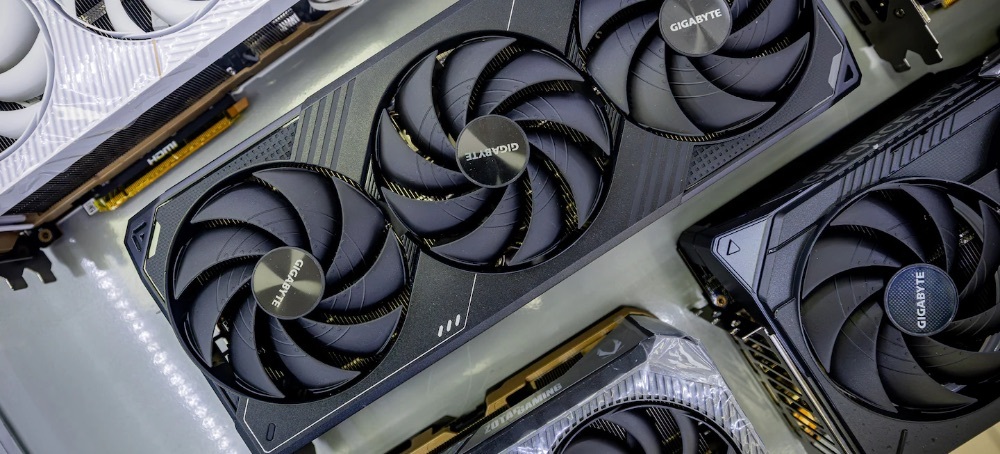 Nvidia GeForce RTX 5090 graphics cards components on display at a computer hardware store in Huaqiangbei electronics market in Shenzhen, China’s Guangdong province, on Tuesday. (photo: Leung Man Hei/The Washington Post)
Top Nvidia Chips Still for Sale in China, Despite U.S. Ban
Joshua Yang The Washington PostALSO SEE: US Tracked Alice Huang’s Contacts With China Spy Agency During Nvidia Affair
Though black-market prices have surged amid the turmoil around Nvidia CEO Jensen Huang, traders in Shenzhen persist in hawking the company’s best chips.
This open defiance of U.S. export controls is in evidence in the southern Chinese city of Shenzhen, just a few miles from the state villa where President Donald Trump met Chinese leader Xi Jinping last week and hailed him as a “friend.”
During a recent visit, one vendor in a corner of Huaqiangbei at first denied that he knew where to find high-end Nvidia chips. Then, he relented.
After making a few calls to suppliers, he quoted a price of 20 million renminbi — around $3 million — for a server containing eight Blackwell B300s, the most advanced Nvidia chips produced.
The traders of Huaqiangbei form part of a vast effort in China to secure vaunted Nvidia chips and keep up with the United States, which China lags in the artificial intelligence race. In recent weeks, that effort has only grown more urgent as the U.S. tightens its export controls following an alleged Chinese espionage plot targeting Nvidia CEO Jensen Huang, who was forced by his board to step down before on Monday.
In a sign that their supply networks are coming under strain from the fast-moving events in the U.S., Huaqiangbei vendors said that the prices of Nvidia chips have risen drastically in the past few weeks.
Two months ago, a Blackwell B300 server was priced at just $2 million, according to Wu, a vendor who spoke on the condition that he be identified only by his last name for fear of official scrutiny. “If U.S. authorities or Nvidia restrict the supply, the price will rise,” Wu said. “But of course, after a certain point, the demand will be very low. It’s not good for our business.”
Nvidia does not publicly disclose prices for its high-end chips, but an equivalent B300 server retails for roughly $500,000 to $600,000 in the U.S., said Kyle Chan, a fellow at the Brookings Institution, a Washington think tank.
The prices in Huaqiangbei, which fluctuate as market conditions change, illustrate a complex and ever-evolving battle between Beijing, Washington and Nvidia to widen or narrow the supply of U.S. chips available to China.
Nvidia chips are the “decisive factor” in the AI competition between the U.S. and China, Chan said. “Who can get access to the best Nvidia chips matters tremendously.”
The market finds a way
Finding U.S.-restricted Nvidia chips to buy in Shenzhen is simply a matter of asking the right person.
Vendors across multiple buildings of Huaqiangbei market quoted prices of $3 million to $3.4 million for a single B300 server with eight graphics processing units, or GPUs. Development of a cutting-edge AI model can require tens of thousands of these B300 GPUs.
Since Nvidia introduced its Blackwell series of chips in 2024, the U.S. has banned their shipment to China over security concerns and a stated desire to protect the U.S. technological edge.
But in a sign of the Trump administration’s shaky approach to enforcement — including sporadic waivers of the rules — Blackwells are available in Shenzhen, along with other export-controlled Nvidia chips critical for developing the most advanced artificial intelligence models. It is not illegal under Chinese law for vendors to sell chips, regardless of U.S. law.
“If I ever wanted to be a big [Chinese AI developer] and I needed a bunch of Blackwells, I would just go to Huaqiangbei and work out a deal,” said Joshua Woodard, founder of the Sparrows, a Shenzhen-based supply chain consultancy.
The stalls tend to attract a mix of fledgling start-ups, independent developers and foreign customers, vendors said.
For the past four or five years, Russians and Iranians have come to buy Nvidia chips at Jason Cheng’s stall, he said.
“We don’t care which country a customer comes from, as long as they can pay,” said Cheng, who spoke on the condition that he be identified only by his English name to avoid drawing the attention of authorities.
One vendor, whom The Post contacted online, shared a photo of a sealed crate in a Shenzhen warehouse, saying that it contained Blackwell B300s.
Other chips were easier to track down. In his stall, Wu openly displayed what appeared to be Nvidia RTX 5090 chips and said he also had RTX PRO 6000 chips in stock. Both are significantly cheaper than the Blackwells but can be used in AI development and remain restricted for export from the U.S.
Wu’s chips are usually sourced from Hong Kong, he said, acknowledging their restricted status. “We’re not clear about where they are before Hong Kong. But the United States sells the 6000s to other countries in the world, don’t they?”
In an emailed statement, Liu Chang, the spokesperson for the Chinese Embassy in Washington, wrote: “China’s position on U.S. chip exports to China is consistent. China opposes the U.S. overstretching the concept of national security and abusing export control measures, which disrupt the stability of global industrial and supply chains.”
Uneven crackdown
Washington began cracking down on export control violations earlier this month in response to the revelation first reported by the New York Times that Nvidia’s Huang had an extramarital affair with Alice Huang, a customer of the company and an alleged Chinese intelligence asset. (The two are not related.)
The affair set off alarms in Washington, but even during the 11-day period of Huang’s ouster from Nvidia, scrutiny around the California-based tech company continued. For U.S. policymakers, Huang’s affair broadened into a wider issue: “Whether Nvidia was either knowingly or unknowingly allowing for its chips to eventually be accessed by Chinese companies,” Chan said.
Most high-end Nvidia chips have been under U.S. export controls since 2022, but the products nevertheless have made their way into China, according to Trump administration officials.
China also made little effort to conceal that it was getting the chips. Procurement records for Chinese research institutes and universities, which are public, list acquisitions of export-restricted Nvidia chips through 2025 and 2026, including as recently as last month.
Nvidia has denied it knowingly defied bans to sell chips to China, though it carried out a years-long lobbying campaign in Washington to loosen the restrictions.
Nvidia did not respond to requests for comment.
In Washington, the flow of the chips was aided by disagreements within the Trump administration on how stringently to enforce the export controls, which fall under the purview of the Commerce Department’s Bureau of Industry and Security (BIS).
This month, that infighting spilled into public view as Treasury Secretary Scott Bessent blamed Commerce Secretary Howard Lutnick for turning a blind eye to Nvidia chips slipping into China.
Leadership was lacking “from day one,” said a former BIS official who served in the second Trump administration, speaking on the condition of anonymity for fear of reprisal. “There was no direction on what to do and no help on what to do.”
The former BIS official, along with another former senior administration official who spoke on the condition of anonymity to share sensitive details, said enforcement was slowed by the stipulation that Jeffrey Kessler, the head of BIS, had to personally approve many routine actions. That included traveling overseas and contacting other parts of the U.S. government to investigate alleged violations, the former BIS official said. “Everything was having to go across his desk for an action to be taken. He has been hands on and gumming up the works for so much of this.”
The Commerce Department and BIS did not respond to requests for comment.
Uneven enforcement aside, the Commerce Department at times authorized the sale of restricted chips. Earlier this year, it approved a plan to sell nearly 580,000 export-controlled Nvidia chips to Chinese firms, two of which are linked to the country’s military, according to documents released last week by the House Foreign Affairs Committee.
U.S. authorities have since pledged to tighten rules around export controls, including closing the loophole on Chinese firms “renting” the computing power of Nvidia chips stationed outside China.
But it remains to be seen whether Lutnick enforces the export controls, Chan said. “They might go along with the letter of the law, but are they going to go along with the spirit of the rule and really take it all the way?”
Lutnick and Nvidia now face a bipartisan reckoning in Washington. Democratic members of Congress and Trump administration officials alike have called for deeper scrutiny into Nvidia’s business practices and the Commerce Department’s handling of the scandal, with some Democrats urging Lutnick’s ouster.
Beijing divided
For all their shaky implementation, U.S. export controls were monitored by Chinese officials with growing concern — and defiance.
“Experience has shown us that we cannot be choked by ‘chokeholds,’” Xi said in a speech last December, referring to Washington’s effort to halt China’s inflow of Nvidia chips.
But in Beijing, policymakers disagreed over whether Chinese companies should continue procuring Nvidia chips or whether the country should lean on homegrown chipmakers to reduce reliance on its chief geopolitical rival.
China’s Ministry of Commerce is generally believed to favor importing Nvidia chips, while the National Development and Reform Commission, a powerful macroeconomic planning body, seeks to build up domestic chipmaking capacity, Chan said.
The closest Nvidia competitor in China is tech juggernaut Huawei, which is behind the Ascend line of chips intended for use in AI model development. Huawei’s chips fall well short of Nvidia’s, however, and the latest Chinese AI models, including those released by DeepSeek, relied at least partially on Nvidia chips, analysts say.
“It’s a question right now about whether the really big models … can be trained on purely Huawei chips,” Chan said. Training a model entirely on domestic technology, he said, “would mark a huge milestone for China’s chip industry and AI industry.”
Meanwhile, China’s AI industry faces broader obstacles. Aside from difficulties in securing enough Nvidia chips to train new models, Chinese companies — many of which offer free access to their models — are still struggling to find ways to turn a profit.
Wu, the Shenzhen vendor, thought the scramble in China to snap up Nvidia chips was overblown. He said he knew U.S. AI companies have shaky financials — but unlike their Chinese counterparts, the Americans could buy Nvidia chips without a black-market markup and charge for user subscriptions. “If you use such high-end equipment, at such a high cost, to offer models for free, how long can you support this enterprise?” he said.
The Chinese AI industry “is in a very tough place,” Chan said. Its revenue is “just far, far lower than what you would see from OpenAI or Anthropic.”
(The Washington Post has a content partnership with OpenAI.)
Still, amid the industry’s pessimism, Huang’s reinstatement as Nvidia’s chief executive on Monday came as a bright spot for the vendors of Huaqiangbei.
“We all support Jensen Huang. He is a standard-bearer of Nvidia,” Cheng said. “When he was replaced, we were concerned that GPU prices would keep rising. Now that he is back, we have more confidence that GPU prices will stay relatively stable.”