
Immigrants Fear Holiday Travel Amid ICE Crackdowns
Trevor Hughes USA TODAY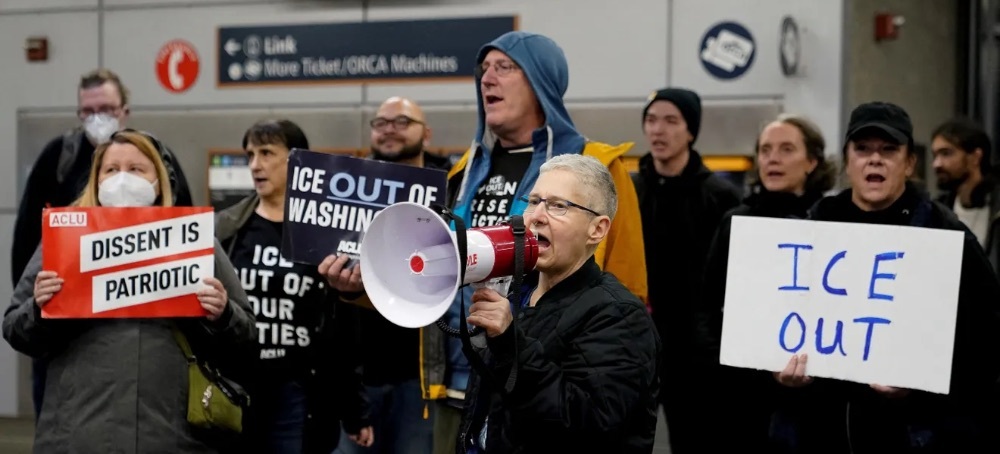 People protest at Seattle-Tacoma International Airport after the U.S. Immigration and Customs Enforcement (ICE) officers arrested two people boarding an Alaska Airlines flight earlier in the day, in SeaTac, Wash. on Nov. 21, 2026. (photo: David Ryder/Reuters)
Immigrants Fear Holiday Travel Amid ICE Crackdowns
Trevor Hughes USA TODAYMore than 81 million people plan to travel at least 50 miles from home for the holiday, according to AAA. But the Trump administration's aggressive immigration enforcement efforts, highlighted in part by the Nov. 21 detention of two people at the Seattle-Tacoma Airport, has some people reconsidering their movements.
That includes immigrants with the legal right to live and work in the U.S. but who want to avoid being stopped and questioned, said Zachary Mueller, a senior strategist with the advocacy group States at the Core.
"Some people are terrified to leave their house," said Mueller, whose organization has trained about 75,000 people to monitor and record ICE detentions. "For some people, that fear has become so palpable in day-to-day life that this holiday is nothing new on that level."
Mueller added: "For others, they're asking 'is traveling to go see family for the holidays worth the risk of never seeing my family again?' That's a real calculation."
The exact number of people facing deportation is unclear, but roughly 350,000 Haitians and about 600,000 Venezuelans lost Temporary Protected Status in the past two years.
The Department of Homeland Security reports that in fiscal year 2026, ICE carried out more than 483,000 deportations, the most ever in a single year. President Donald Trump has promised the largest mass deportation in U.S. history, and during his second term DHS reports that more than 3 million people have already left the United States either via deportation or self-removal.
Immigrants who leave the United States voluntarily can receive a $3,000 payment and a free flight to their home country.
Administration officials said they will continue to enforce immigration laws, including those that make it harder for undocumented immigrants to fly. Immigration and Customs Enforcement officers routinely check Transportation Security Administration manifests for potential immigration violators.
Last May, the Department of Homeland Security began requiring flyers to show REAL ID-compliant identification to board airplanes, a move that made it easier to detect people who lacked permission to live in the United States. People without REAL ID can fly but are subject to additional security checks and may have to pay a $45 fee.
“DHS reversed the horrendous Biden-era policy that allowed aliens in our country illegally to jet around our country. Under President Trump, DHS will no longer tolerate this," an unnamed DHS spokesperson said in a statement. "This administration is working diligently to ensure that aliens in our country illegally can no longer fly unless it is out of our country to self-deport."
Immigrants who are considering travel should check first with their attorney and make sure to carry copies of relevant paperwork, said Krish O’Mara Vignarajah, the president and CEO of Global Refuge. She said many refugees who sought safety in the United States are now worried about being targeted by the same government that asked them to fill out paperwork and register their home addresses.
She said many refugees, including those from Haiti and Venezuela are frustrated because Trump keeps saying ICE is targeting the "worst of the worst."
"These are people who did everything right, went through vetting, did all the paperwork," she said. "And now they're asking us whether following the rules has somehow put them more at risk."
Mueller said the harsh enforcement tactics also have impacts on travelers who witness anonymous and masked federal agents grabbing screaming people at airports. He said driving may not be a safe option for some people, particularly if they are driving through communities that have signed cooperative agreements allowing local police to help enforce immigration laws.
"It's not just the people who are first affected, but that kind of fear and trauma and concern, the wanton separation, the ability of ICE to do whatever it wants and create these chaotic scenes ... millions of Americans have been seeing this," Mueller said. "They're asking themselves when they travel, 'am I going to see something that's going to ruin my holiday because this administration wants to rip apart families?' That's the absurd reality of this moment."
Marjory Wentworth, a board member of the Haitian Support Center in Springfield, Ohio, said her family is hosting a handful of Haitians for Thanksgiving. Many members of Ohio's Haitian community lost their Temporary Protected Status in July. The Trump administration has revoked their work permission and urged them to leave the United States.
Wentworth said none of the Haitians she knows will risk flying. She said at last one local church hosted a Thanksgiving dinner for Haitian congregants over the weekend, allowing them to celebrate without traveling far from home.
"People can't go work, they've got ankle monitors," she said of her own invited guests. "I feel like people are still pretty fearful. I'm hoping we can distract them for a day."