
Zelensky Makes His Pitch to Trump
Simon Shuster The Atlantic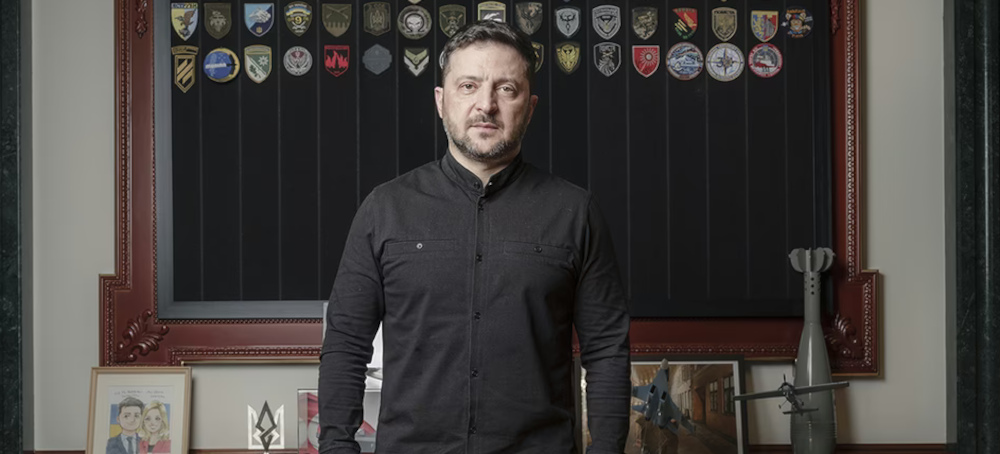 Ukraine’s president calls on his most powerful ally to not squander the chance to make peace. (photo: Christopher Occhicone/The Atlantic)
 Zelensky Makes His Pitch to Trump
Simon Shuster The Atlantic
Ukraine’s president calls on his most powerful ally to not squander the chance to make peace.
“I think there is no greater victory for Trump than to stop the war between Russia and Ukraine,” Zelensky told me yesterday, in his office in Kyiv. “For his legacy, it’s No. 1.”
It’s also, Zelensky said, a path to success for Republicans in November. “The most advantageous situation for Trump is to do this before the midterms,” Zelensky said of the chance to end the war. “Yes, he wants there to be less deaths. But if you and I are talking like adults, it’s just a victory for him, a political one.”
By this point, Zelensky knows well what motivates Trump. He is also, however, a realist when it comes to the odds that Trump actually forces the Russians to compromise. Throughout the hour we spent together in his office, Zelensky exhibited the quality that has been core to his character for years, even decades—his stubborn, sometimes-petulant habit of resisting outside pressure. If you tell Zelensky he has to do something, “he’s probably going to do the opposite,” said one of his longtime advisers who, like others, spoke with me on the condition of anonymity. “It’s always been like that.”
Some members of Zelensky’s inner circle are growing anxious that his window to cut a deal is closing, and that Ukraine will suffer through years of continued fighting if an end to the war isn’t negotiated this spring. But Zelensky told me that he would rather take no deal at all than force his people to accept a bad one. Even after four years of intense warfare, he says he is prepared to fight on if that’s what it takes to secure a dignified and lasting peace. “Ukraine is not losing,” he insisted emphatically when I asked him to assess his position on the battlefield.
Since the start of the Russian invasion nearly four years ago, many wartime protocols have eased inside Zelensky’s office. The chairs and bicycle racks that I remember barricading the doors against an expected Russian onslaught in the early days of the war have been cleared away. The lights in the hallways are on, freeing the staff from the need to shuffle around with flashlights. By inertia, some vestiges remain of the awful weeks in 2022 when enemy forces stood at the edge of Kyiv. Piles of sandbags still lean against the main doors of the compound on Bankova Street. When, at my photographer’s request, the president approaches the window of his office to open the blinds, his bodyguard lurches forward to close them. Such are the rules.
Zelensky does not object. Four years is long enough to grow accustomed to almost anything, and the president believes that Ukraine has been successful—both here in the capital and to the east, where the war is frozen in something close to a stalemate. Using an army of drones to help plug the gaps in its infantry lines, Ukraine has slowed the Russian advances in many sections of the front, and in others has stopped it completely. The invaders have spent nearly two years trying to seize the mining town of Pokrovsk, a railroad junction with a prewar population of only about 60,000 people, and they have still failed to secure all of it. By Ukrainian estimates, every square kilometer that Russia occupies costs its military more than 100 soldiers, either dead or gravely wounded, while its average monthly casualties add up to as many as 35,000 troops.
Zelensky’s newly appointed minister of defense, Mykhailo Fedorov, announced a plan in January to raise the rate of Russian losses to 50,000 a month, which he said would outpace the number of new soldiers Moscow can field. This spring, the total casualties in the war are due to reach 2 million killed, wounded, and missing across both sides, more than in any European conflict since World War II, according to a study published last month by the Center for Strategic and International Studies. With a population more than three times that of Ukraine and a nominal GDP roughly 10 times larger, Russia can absorb these horrifying losses far more readily than the Ukrainians. Ukraine’s allies know that the attritional math is not on their side. “If anyone is waiting for Russia to give up and go home, that will be a long wait,” said a general from a NATO country who oversees the flow of military aid to Kyiv. “It’s not happening.”
Even so, Zelensky kept repeating in our interview that he will not accept a deal on belittling terms. Some of his people may find his stubbornness maddening, but others commend it, arguing that it echoes the resilience of the nation as a whole. “We are in a hurry to end the war,” he said. But that’s not the same, he emphasized, as rushing to cut a deal, no matter the terms.
Trump has taken a different approach. On the campaign trail, he promised to bring peace to Ukraine within a day of taking office, and his failure after a year of halting attempts at diplomacy continues to irk him. Zelensky senses that, and so do his enemies. The American campaign season has become a ticking clock in their negotiating rooms, and the Russians also understand that the attention of the White House will soon be diverted by congressional races. Before that happens, there’s an opportunity. “The Russians can use this time to end the war while President Trump is really interested in that,” Zelensky said. “When it’s very important and valuable to him.”
After a pause, he added: “Valuable might sound too mercantile for some people. But let’s speak honestly.”
At the end of last week, after another long day of talks in Abu Dhabi, Ukraine’s envoys huddled around a phone for a call with their boss, who was waiting in Kyiv to hear their report. The most sensitive details of the negotiations with the Russians, such as the need to cede land in exchange for peace, would need to wait until the team got home. They could not risk the call being overheard or intercepted. But they felt secure enough to transmit the basic problems: The Kremlin would not budge in its demands for Ukrainian territory, and the American mediators were losing their patience.
The Ukrainians sensed that time was running out. In the coming weeks, as the campaign season consumes more of Trump’s attention, he could decide that the negotiations have become a political loser for him. He might then walk away, laying the blame for the failure of diplomacy on the intransigence of one or both of the warring sides. For nearly a year—ever since Zelensky engaged in a televised shouting match with Trump and Vice President Vance in the Oval Office last February—the Ukrainians have tried hard to demonstrate their willingness to compromise. “The tactic we chose is for the Americans not to think that we want to continue the war,” Zelensky said. “That’s why we started supporting their proposals in any format that speeds things along.”
The Ukrainians have all but given up on their earlier insistence that Russian President Vladimir Putin and his generals should face justice for war crimes. Zelensky has agreed to meet Putin just about anywhere but Moscow, with no preconditions. Two of his advisers told me that Ukraine may be ready to accept the hardest concession of all: giving up control of land in the eastern Donetsk region.
To legitimize such a compromise, they have considered holding a referendum on the peace plan this spring, allowing Ukrainians to vote on a deal that includes the loss of territory. They could couple it with a presidential election, in the hopes of giving Zelensky a fresh mandate for the first time since 2019. (Since the invasion, national elections have been indefinitely delayed.)
Zelensky said he would be fine with that approach because it would help increase turnout and make the results more difficult for the Russians to question. But again, he told me, it had to be the right deal. “I don’t think we should put a bad deal up for a referendum,” he said. The idea of holding elections during the war, he said, came from the Russians, “because they want to get rid of me.”
No matter the risk of losing Trump’s attention as a mediator, the Ukrainian leader says that he will stand firm on his core demand: The first step to peace must be a guarantee from the United States and Europe that, once a cease-fire takes hold, they will defend Ukraine against any future attack from Russia. Otherwise, the cease-fire would feel worthless to many Ukrainians, merely giving Russia a chance to prepare for another invasion. But the negotiators have made less progress on this issue than Zelensky has let on. At the end of last month, he said an agreement on security guarantees from the U.S. was “100 percent ready” for Ukraine to sign. “We are waiting for our partners to confirm the date and place when we will sign it,” he told reporters at a news conference.
The invitation never came, and Zelensky conceded in our interview that basic questions related to the document remain unresolved. Would the U.S. be willing, for instance, to shoot down incoming missiles over Ukraine if Russia were to violate the peace and resume its bombing of civilians? “This hasn’t been fixed yet,” Zelensky said. “We have raised it, and we will continue to raise these questions.”
For now, the American answers have been too vague and noncommittal for Zelensky to accept. “We need all of this to be written out,” he said.
For years, zelensky resisted pressure from the U.S. government and many of his closest allies in Ukraine to fire his chief of staff, Andriy Yermak, who served as Ukraine’s lead negotiator. An imperious figure with a tendency to grandstand, Yermak feuded with a succession of Western diplomats and just about everyone in Zelensky’s entourage. Only last fall, on the day investigators carried out a search of Yermak’s home as part of a corruption investigation, did the president agree to fire him. Yet Zelensky still refused to acknowledge in our interview that the corruption probe had pressured him to make that choice. “I had my reasons,” he growled, cutting off the line of questioning.
In late November, the day before Zelensky fired him, Yermak called me to discuss his most recent round of negotiations with the United States. It had just resulted in a 20-point plan to end the war on terms Ukraine could accept. The framework, Yermak told me, “does not contradict our interests and takes into account our red lines.” U.S. and Ukrainian negotiators have used that document as the basis for their talks ever since. But the Russians have rejected several of its points, in particular the promise that the U.S. will help guarantee Ukraine’s security.
To the Kremlin’s frustration, the plan also avoids any provision that would force Ukraine to give up territory to the Russians. “As long as Zelensky is president, no one should count on us giving up territory,” Yermak said. “Nobody can do that unless they want to go against the Ukrainian constitution and the Ukrainian people.”
Yermak’s successor, Kyrylo Budanov, a lieutenant general and spymaster who now leads Ukraine’s negotiating team, has been more amenable to compromises, even on the question of territory. He has presided over long discussions with presidential aides about the legal and practical conditions necessary for Ukraine to withdraw from some parts of the Donetsk region without allowing the Russians to advance and seize it. “They’re really being creative, looking for how to do it in a way that people would accept,” one official who participated in these sessions told me.
Meanwhile, Zelensky has made a convincing show of agreeing to Trump’s peace initiatives, even when they seemed unworkable or ill-conceived. He entertained the idea of turning parts of the Donetsk region into a “free economic zone” that neither Russian nor Ukrainian forces would control. “We weren’t thrilled about that,” Zelensky said. But he went along with the American proposals, doing his best to demonstrate that Russia, not Ukraine, remains the obstacle to peace. “Sometimes I get the impression that it’s like: What else can we offer the Ukrainians just to see if they’ll refuse?” he said with a smile. “We’re not afraid of anything. Are we ready for elections? We’re ready. Are we ready for a referendum? We’re ready.”
But, as ever with Zelensky, there are conditions and caveats. Any terms related to the loss of land, for example, can be resolved only when Zelensky and Putin meet face-to-face. The Americans have long proposed such a summit, and Trump has said he would be ready to mediate. The Kremlin, for its part, has urged the Ukrainians to come to Moscow, knowing Zelensky would not agree to that venue out of principle.
On the morning of our interview, the Financial Times reported that on February 24, the four-year anniversary of the Russian invasion, Zelensky would announce plans to hold presidential elections and a referendum on a peace agreement. Citing anonymous sources, the report even includes a deadline of May 15 for staging the vote. When I asked about this, Zelensky sighed and shook his head. “No one is clinging to power,” he said. “I am ready for elections. But for that we need security, guarantees of security, a cease-fire.”
It reminded me of the time in early 2022 when the White House was warning Zelensky of an imminent invasion, and President Biden, during a call with Western leaders, predicted that it would begin on February 16. Zelensky refused to believe it. Instead of mobilizing his military or calling on people to evacuate, he urged all Ukrainians to hang flags in their windows and sing the national anthem at 10 that morning. “We are told that February 16 will be the day of the attack,” Zelensky declared in a defiant speech. “We will make it the day of unity.”
The invasion began a little more than a week later, and it quickly turned into a disaster for the Russians. They lost the Battle of Kyiv that spring and the Battle of Kharkiv, Ukraine’s second-largest city, that September. A few weeks later, when Ukrainian forces evicted the Russians from the southern city of Kherson, Zelensky received an urgent plea from one of his closest Western allies: Begin peace talks now from a position of strength, and use the leverage to secure a favorable deal. “Seize the moment,” General Mark Milley, then the chairman of the Joint Chiefs of Staff, said in a speech in November 2022.
No one can say whether such talks could have ended the war. But looking back, that was the high-water mark for Ukraine’s successes on the battlefield. The war devolved afterward into a series of demoralizing setbacks for Ukraine, starting with a failed counteroffensive in 2023, when most of the front line settled into a stalemate. Neither side has since been able to break through the other’s fortified defenses and seize large chunks of territory for long. Over time, Ukraine’s strength has eroded, resulting in a weaker position from which to negotiate a truce. Does Zelensky regret it? Does he wish he had taken that chance to make a deal at the end of 2022?
“We’ve never been against ending the war. It’s the Russians who have shown they are not ready for a dialogue,” he said. After a pause to weigh his words, he added, “Today there are new people, with a different outlook on things.” He meant the people around Trump, who seem more interested in striking a deal ahead of the midterm elections than in making Ukrainians feel certain of their safety. But if Zelensky has any regrets about leaving the peace process in the hands of this administration, he kept them to himself.
As we stood to say goodbye, I saw General Budanov, the newly appointed chief of staff, standing in the anteroom, stone-faced, with a folder tucked under one arm. The rest of the negotiating team soon arrived, still fresh from their trip to Abu Dhabi. They would spend the afternoon preparing for the talks scheduled for next week. “Greetings,” the president said, standing next to the unruly pile of documents and briefing books that crowds his desk. “What’s new?”
Maybe one of the men filing into his office had a fresh idea for a breakthrough. But as they took their seats around Zelensky’s conference table and shut the door behind me, it seemed much more likely that they would talk in circles, looking for ways to inch closer to a deal as Russia continues its slow, implacable assault.