
With Time Running Out, Trump Digs in on Changing Midterm Election Rules
Patrick Marley and Ben Binday Washington Post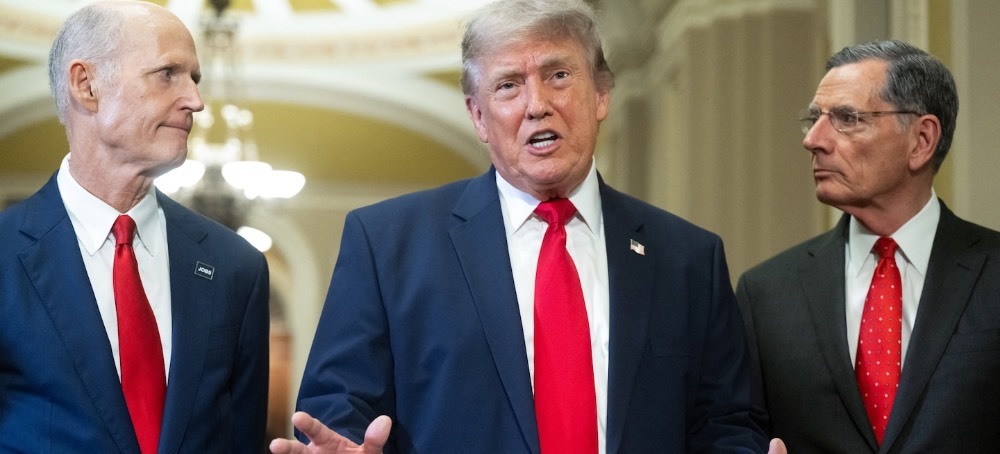 President Donald Trump, alongside Sens. Rick Scott (R-Florida), left, and John Barrasso (R-Wyoming), speaks to reporters on Wednesday at the Capitol. (photo: Saul Loeb/Getty)
 With Time Running Out, Trump Digs in on Changing Midterm Election Rules
Patrick Marley and Ben Binday Washington PostALSO SEE: Brittany Gibson | Trump Hits a Wall on Voter Fraud
Fearing a Democratic takeover of Congress, the president has spent months trying to alter how the midterms will be conducted, but obstacles keep cropping up.
The pushback has infuriated the president, who has ramped up his threats and demands as he openly grows increasingly worried about the investigations and impeachment that could come if Democrats win control of Congress.
But with the general elections just four months away, Trump is racing the clock as states make final preparations for early voting.
The urgent push to change election rules by several arms of the federal government has created a volatile sea of shifting and contested election policies, many of which are before the courts. The climate of uncertainty is creating headaches for election officials and risks confusing voters, reanimating conspiracy theories about rigged elections and spurring postelection disputes.
“The administration is doing as much as possible to inject chaos into the election cycle,” said Wendy Weiser, vice president for democracy at the Brennan Center for Justice at New York University, a voting rights organization that has sued the administration over election policies. “A top priority for this administration is to try to interfere in this election.”
Trump has issued executive orders on voting rules and cheered on Justice Department investigations of past elections. He’s pressed Republicans in Congress to require Americans to provide proof of citizenship to register to vote. He’s called for sharply curbing mail voting and urged ending the use of voting machines.
He has been hampered not only by judges and reluctant GOP senators, but also a portion of the Constitution that gives states — not the federal government — primary authority over elections.
“We can never let elections get rigged again,” Trump told supporters Tuesday during a stop in Macungie, Pennsylvania.
Courts are ruling against Trump
Courts dealt Trump five adverse rulings last week, the first coming on Monday when a judge barred using a federal immigration database to determine voter eligibility. U.S. District Judge Sparkle L. Sooknanan determined the use of the Department of Homeland Security database violates federal privacy laws and was responsible for revoking the voter registrations of some citizens who were wrongly listed as noncitizens.
“The federal government has knowingly trampled on the privacy rights of American citizens in a manner that threatens the sacred right to vote,” she wrote. “This Court cannot stand idly by while that happens.”
James Percival, the general counsel at DHS, expressed frustration with the ruling. “It’s amazing how hard the Left will fight to stop us from solving problems they insist do not exist,” he wrote on social media, responding to critics who emphasize the dearth of evidence of noncitizens voting in large numbers.
Trump ordered the creation of the database last year in an executive order that also sought to require voters to provide proof of citizenship to register to vote. The provision on voter registration has been blocked by other judges, including one who issued a decision on Wednesday.
Frustrated by the rulings, Trump has spent months demanding that the Senate pass a law requiring Americans to submit documents proving their citizenship to register to vote and show identification to cast a ballot. The measure remains stalled because GOP senators have declined to lift long-standing filibuster rules that would allow them to pass it with a simple majority.
Trump on Wednesday put new pressure on the Senate by canceling the signing of a bipartisan housing bill until it acts on the election legislation. Hours later, he urged Senate Republicans to pass the voting measure in a closed-door meeting.
“President Trump is committed to ensuring that Americans have full confidence in the administration of elections, and that includes totally accurate and up-to-date voter rolls free of errors and unlawfully registered non-citizen voters,” White House spokeswoman Abigail Jackson said.
DHS last week sought to prod states to go along with Trump’s plans by threatening to withhold federal funding from states if they don’t perform citizen checks on voters and agree to phase out some types of electronic voting systems.
Checking citizenship records, frequently updating voter rolls and tightening ballot deadlines would “enhance public trust in outcomes,” said Jason Snead, executive director of the conservative Honest Elections Project.
Trump is trying to achieve those goals with powers he doesn’t have, said Dax Goldstein, senior counsel at the nonprofit States United Democracy Center, a nonpartisan group that assists state election officials.
“It is all part of this overall effort to take power away from the states that they have constitutionally and aggrandize it to the administration so that the president can interfere in the way that elections are run,” Goldstein said.
Elections under a microscope
Amid the efforts to alter voting procedures, federal prosecutors have been investigating elections, often with Trump urging them along.
Trump last week said he recently asked a federal prosecutor to “take a look” at California’s ranked choice primary for governor, calling into question the state’s slow method of counting ballots. Separately, the FBI has seized 2020 ballots in Georgia, obtained images of 2020 ballots in Arizona, and questioned current and former election officials in Wisconsin about the 2020 election. The Justice Department has unsuccessfully sought 2024 ballots in Michigan, and the FBI recently raided the offices of a progressive group in Ohio that focuses on voter registration.
Trump has argued repeatedly and falsely that the 2020 election was stolen from him, despite ample evidence that Joe Biden won fairly.
Rattled by the investigations and worried the administration could interfere with voting, Senate Democrats said they would send election observers to the polls this fall. “We’re not waiting for the chaos to arrive,” said Senate Minority Leader Chuck Schumer (D-New York). “We’re preparing now.”
In March, Trump tried another tack by issuing an executive order that seeks to limit who can receive mail ballots. Postmaster General David Steiner told senators last week that proposed rules prompted by the order would bar mail ballots from being sent in states that don’t turn over voter information.
But a judge put a stop to Trump’s plans on Thursday, saying the administration doesn’t have authority to impose such sweeping changes. The White House said it will appeal, and election officials said if the measure goes into effect it could impede voting, particularly in states such as Colorado that conduct almost all voting by mail.
“Now is not the time for an experiment with people’s fundamental right to vote,” said Amanda Gonzalez (D), the county clerk in Colorado’s Jefferson County and a candidate for secretary of state.
Time running out to adopt changes
Election officials have little time to adjust to any new voting policies because they must start sending mail ballots for the general election to military and overseas voters by mid-September. Significant changes to rules would require them to retrain workers, buy supplies, redesign ballot envelopes and modify their voting procedures.
“Trump is sowing seeds of confusion into our election system,” said Rebekah Caruthers, chief executive of the Fair Elections Center, a nonprofit group focused on voting rights. “It’s confusing to young people, especially college students, who oftentimes are voting for the very first time.”
The fight over how elections are run is particularly acute in the swing state of North Carolina, where Republicans last year took over elections boards after GOP lawmakers put a Republican official in charge of making appointments. Republicans on county election boards have sought to eliminate early voting sites or move them to more conservative areas. The GOP-controlled state elections board will have the final say on determining the location of many early voting sites.
The Supreme Court may shorten mail deadlines
Other attempts to change the mechanics of elections have failed. The Justice Department has sued 30 states to get copies of their voter rolls but has lost each of the nine cases and one appeal that have been ruled on.
Trump’s allies are hoping to secure a victory before the Supreme Court soon in a case that could tighten deadlines for mail ballots. Republicans want to make sure mail ballots are counted only if they are in the hands of election officials by Election Day.
Fourteen states and D.C. allow mail ballots to be counted if they arrive after Election Day as long as they’re postmarked on time, and another 16 states allow late returns for military and overseas voters. New deadlines would prompt states to engage in costly campaigns to alert millions of voters that they’ll need to return their ballots sooner — especially amid concerns about mail delays.
Other cases are just getting started. The Republican National Committee this month sued Nebraska and Colorado officials to prevent some citizens living out of the country — including adult children of citizens who have never lived in the U.S. — from casting ballots.
Many Democrats see the attempts to make last-minute changes to election laws as voter suppression.
“Less access has always been something historically that has endangered more people than helped anyone,” visual artist Nadya Yaksich, 30, said after voting in the Democratic primary at a high school in Wheaton, Maryland, last week.
But book cataloguer Carola Lewis, 62, said after voting in the Republican primary at the same school that she would have more confidence in election results if all voters were required to show IDs and prove that they are citizens.
“As a citizen, I abide by the law, I pay my taxes, I do what I’m supposed to do, I go out and vote,” Lewis said. “And then to not be 100 percent confident that it’s only Americans that are voting is actually terrifying to me.”