
With Anti-DSA Bill, Congress Is Red-Baiting Like It’s 1955
Ben Burgis Jacobin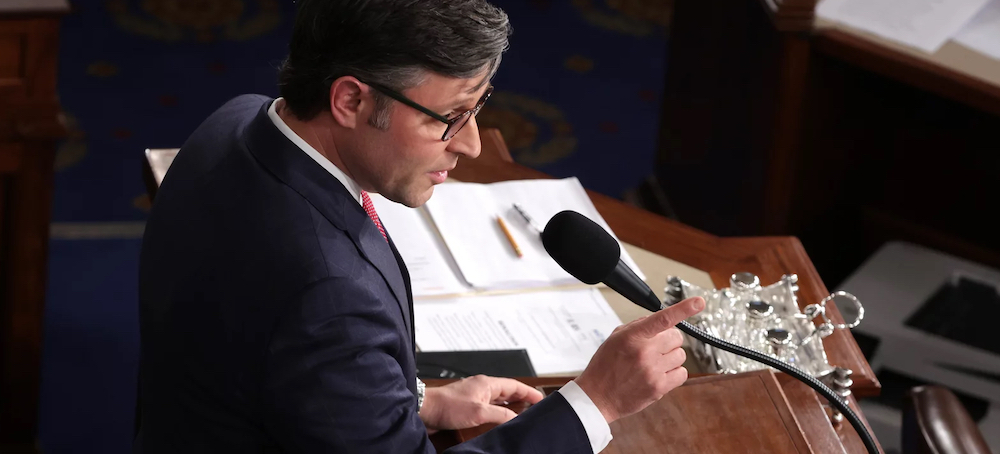 House Speaker Mike Johnson, R-La., delivers remarks at the U.S. Capitol. (photo: Alex Wong/Getty Images)
 With Anti-DSA Bill, Congress Is Red-Baiting Like It’s 1955
Ben Burgis Jacobin
The House just passed a resolution condemning the Democratic Socialists of America and socialism broadly. While it rehearses opposition to Stalinist authoritarianism, the bill’s real preoccupation is with socialists’ advocacy for expanded democracy.
Even with all this going on, though, the House found time on Tuesday to pass a resolution symbolically condemning the Democratic Socialists of America (DSA) and “all forms of socialism,” quite obviously inspired by Zohran Mamdani’s mayoralty and the primary victories of several DSA-backed congressional candidates.
The anti-DSA bill is a strange document. It starts so similarly to the other congressional resolutions condemning socialism over the last two years that I initially wondered whether the authors had simply cut and pasted an earlier one.
Then it cuts to up-to-the-minute complaints about DSA and the socialist mayor of New York.
In the final “resolved” section, the House “condemns and denounces socialism in all its forms, including the Democratic Socialists of America, and opposes the implementation of socialist policies in the United States.” But between here and there are hundreds of words of phantasmagoric Trumpian fearmongering about noncitizens illegally registering to vote in American elections. The only tenuous connection is that DSA’s platform calls for changing the laws so that everyone who lives in the United States is allowed to vote. But it reads as if whoever drafted the resolution had a particularly hysterical Fox News segment about noncitizen voting playing in the background, got distracted, and switched topics halfway through.
The resolution’s nominal argument is a mess. The first two “whereas” clauses are claims about the crimes of Stalinist regimes. But democratic socialists have always been critical of such regimes, even then. Condemning democratic socialists with claims about the crimes of Stalinist authoritarianism makes about as much sense as an atheist bringing up the Spanish Inquisition to condemn the Southern Baptists.
Even rhetorically, the resolution’s strategy of lumping democratic socialists with authoritarian states is dramatically undercut by clauses about DSA’s calls to expand voting rights, abolish the Senate, and enact ranked-choice voting to make it easier for third parties to compete. Letting more people vote, making political representation proportional to the number of voters in each state, and expanding the options on Americans’ ballots would take us much further from anything resembling an authoritarian one-party state.
So too little democracy or too much — which is it? One suspects that the latter is the more frightening option for signatories.
Playing up crimes committed by Stalinist dictators (whether real ones, Cold War exaggerations, or some messy mixture of the two) is a time-tested way of making socialism sound scary. But ironically, the fearmongering gestures here at the notion that America needs a powerful right-wing authoritarian government to protect us from the socialist menace, which seeks to introduce more democracy at the nation’s peril. Why else would a resolution condemning “all forms of socialism” include hundreds of words on the alleged plague of noncitizen voting and the importance of making it harder to vote?
The good news is that the propaganda doesn’t seem to be working on Americans. Far from rallying behind President Donald Trump as an American Julius Caesar who will save the republic from itself by taking on authoritarian powers, the public has made him historically unpopular. Far from DSA being exiled to the margins of American politics, a recent Pew poll found that Democrats and Democratic-leaning independents are far likelier to like leaders who identify as democratic socialists (32 percent) than to dislike them (11 percent). And centrist Democrats in Congress were leery enough of alienating their own constituents that only eight House Democrats joined the 212 House Republicans in voting for it.
The Republican-dominated Congress thinks that the mention of the S-word will inspire terror in the hearts of patriotic Americans, as though this were 1955. But it’s wrong to assume the American people are on board.