
Will Netanyahu Escape His Reckoning?
David Remnick The New Yorker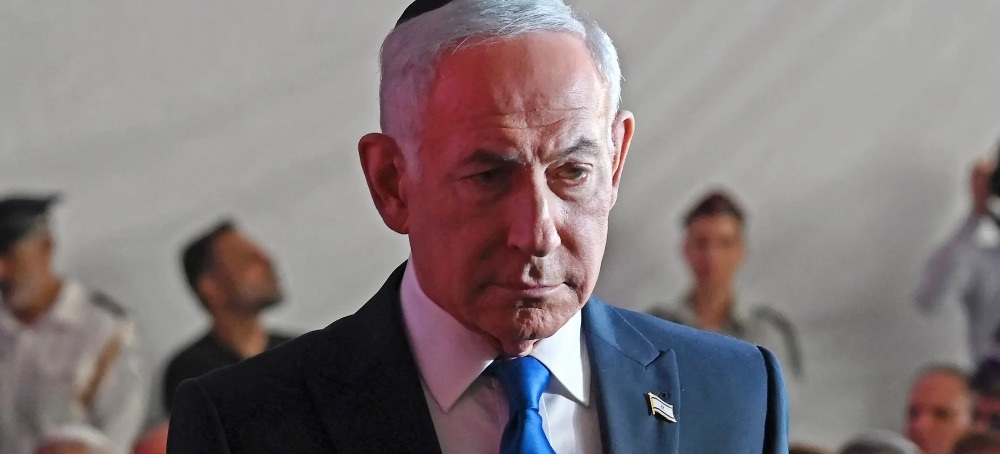 The Israeli Prime Minister, Benjamin Netanyahu, at a ceremony at Mount Herzl military cemetery, in Jerusalem, on Monday, to mark the third anniversary of the October 7, 2023, attack. (photo: Debbie Hill / Getty)
 Will Netanyahu Escape His Reckoning?
David Remnick The New Yorker
In his bid for reëlection, the Israeli Prime Minister is doing everything in his power to smear his opponents and evade blame for the security fiasco of October 7th.
The election is October 27th. Netanyahu and his party, Likud, are not ahead in most mainstream polls, and yet most observers of any credibility agree that damn near anything could happen, especially given Israel’s complicated parliamentary arrangements and wild array of parties. Netanyahu’s principal opponent, Gadi Eisenkot, a centrist former Army general and the leader of the Yashar Party, could end up forming a winning coalition with parties led by Yair Golan, Naftali Bennett, Yair Lapid, and Avigdor Lieberman, as well as a moderate Arab party called Ra’am, led by Mansour Abbas. Or there could be a deadlock and yet another election next year. Or Netanyahu, who sometimes in his long career has been stronger in the final ballot than in the polls, could find a way to form, yet again, a right-wing coalition.
What is astonishing—politically, morally, strategically—is that Netanyahu has any chance at all. Within days of the Hamas attack on Israel, the worst disaster in the history of the state, it was all but a given that he would soon be out of power. How could any electorate look past such a collapse and national trauma? For a while, Benny Gantz, a well-known former Army general who is seen as a Gary Cooper-like centrist, was the presumed favorite—but it turned out that he had very little to say and even less charisma with which to say it. As a presumptive Prime Minister, he proved no more durable than a wedding cake left out in the rain. Gantz quickly became the forgotten man of Israeli politics.
More recently, Eisenkot has emerged as a figure of solidity and a focus of sympathy. (He lost a son and two nephews in the war. Everyone knows this about him.) When he became the potential leader of a putative opposition coalition, Netanyahu made it clear how he would set out to attack him. He would declare his opponent soft on security, soft on the Arabs, and (God forbid) a supporter of finding a path toward peace with the Palestinians of Gaza, the West Bank, and Jerusalem. A blend of bravado and bigotry has worked for Netanyahu in past campaigns.
But it is one thing to predict the ugliness of a campaign, and quite another to watch it play out. Earlier this week, Yinon Magal, the leading talk-show host and commentator on Channel 14, an ardently pro-Netanyahu outlet, denounced a group of former hostages and their families who contributed to a book called “Mr. Abandonment: The Legacy of the Man Who Abandoned the Hostages.” Their argument was that the Prime Minister had failed to make freeing the hostages his main priority. Magal did not hesitate to smear them. “Anyone who took part in the campaign saying he abandoned the hostages will be remembered in infamy, on a pillar of shame,” Magal said during a radio broadcast. The hostages and family members who dared to criticize Netanyahu for his handling of the issue, he said, are “the lowest people living in the State of Israel.”
Eisenkot, who joined a war cabinet at Netanyahu’s invitation, quit that council when he determined that Netanyahu was refusing to make the hostages his first priority. Magal, who welcomes Netanyahu onto his show “The Patriots” with the audience singing praises to him as the “King of Israel,” spit venom at those who dared to criticize the Prime Minister. “I’m telling you,” Magal said of the former hostages and their families, “these are despicable people, and the only thing that can absolve them is if they put the Likud ballot slip for Netanyahu into the ballot box in the election. ‘Forgive us, absolve us, pardon us.’ That’s the only way they can atone for the abomination they committed by participating in ‘Mr. Abandonment.’ ”
Netanyahu’s critics have often pointed out that, even in the early days of the war, he rarely visited the hostage families or expressed much concern for them. That omission, that coldness, has not been forgotten. At a ceremony Monday, in Jerusalem, commemorating the October 7th massacre, a bereaved father, whose son was killed at one of the kibbutzim near Gaza, rose during Netanyahu’s speech and said, for all to hear, “You did not protect my son. You did not protect the twelve hundred people who were murdered in a single day, on October 7th. Shame on you, disgrace.”
At the same ceremony, the Israeli President, Isaac Herzog, called for an investigation into the security collapse. “No amount of time that passes can allow us to forgo this obligation. There are clear lessons we already know we must internalize: We must not ignore warnings or worrying signs.”
This is the very same message that has come from Eisenkot and so many of Netanyahu’s opponents. For three years, the opposition has demanded that Netanyahu do what the Israeli government did in the aftermath of the Yom Kippur War, in 1973, when Egypt and Syria attacked Israel, despite warnings from various sources in the security establishment. That exhaustive investigation, the Agranat Commission, led to numerous resignations and, eventually, the end of Golda Meir’s career as Prime Minister. By contrast, Netanyahu and his circle have done all they can to defer any kind of official inquiry and, at the same time, to put out the word that everyone but the Prime Minister is to blame. Leading figures in the security establishment have issued public apologies and left the scene. Netanyahu remains.
It has been well known for a long time that Netanyahu badly misread the intentions and capabilities of Hamas, treating them as little more than a hyped-up street gang compared to Hezbollah, in Lebanon. His singular focus has always been on Iran. Over time, there has been a wealth of investigative journalism making plain that the security establishment ignored clear warnings of peril from mid-level intelligence officers and other sources. No less startling, Netanyahu himself got clear warnings from both the United Arab Emirates and Egypt that a major operation was imminent. Reporters for Haaretz wrote last month that Sheikh Mohamed bin Zayed, the President of the U.A.E., told Netanyahu in late September that he had reliable intelligence about Hamas and its plans to attack Israel. (Netanyahu has denied the report and similar ones about warnings from Egyptian sources.)
In Trumpian fashion, Netanyahu and his circle have gone on the counterattack. The Prime Minister’s wife, who is known for treating aides and household help with high-volume contempt, even gave an interview recently that fed into widespread right-wing conspiracy theories that high-ranking Israeli security officials had inside information on Hamas’s plans. Speaking to Channel 14, Sara Netanyahu insinuated that Yair Golan, the former deputy chief of staff of the Army and leader of the center-left Democrats Party, drove south on the morning of the attack to rescue people, not because he was courageous or selfless but because he had advance knowledge of the Hamas assault.
“When you’re a military man of such high rank, claiming that you fought on October 7th, already early in the morning you were there, already dressed and ready at a very, very early hour when others didn’t know, such as the Prime Minister,” she said.
Netanyahu generally tries to distance himself from conspiracy theories, leaving that work to his supporters and family members. In the meantime, he has focussed on highlighting criticism from abroad as a badge of honor. In his recent appearance at the United Nations, Netanyahu was speaking not so much to the scattered delegates in the room but to the cameras and his electoral base at home. According to Reuters, Netanyahu’s team posted the speech online, with the Hebrew caption “Netanyahu takes on the world.” His self-depiction is as the Churchillian defender of the nation.
Just as Netanyahu refuses to take any responsibility for the cataclysm of October 7th, he insists that his military campaigns against Gaza, where more than seventy thousand have died; against Hezbollah, in Lebanon; and against Iran have made Israel stronger—and to hell with his foreign critics, whom he often paints as antisemitic. The new documentary film “NAZA,” which focusses on war crimes in Gaza, and the foiled hijacking of the FlyDubai flight have all become fodder for his political campaign. He will do and say anything to deflect attention from his failures or his readiness to accommodate the haredim, the ultra-Orthodox, who insist on avoiding mandatory military service. As Ilana Dayan, an investigative journalist and the host of “Uvda,” on Channel 12, put it to me, “The vast majority of those who are for Bibi tell you ‘There is no one else but him,’ and that he is showing the world how strong we are. That is one of the pathologies of this political campaign.”
Eisenkot, who entered politics in 2022, insists that the choice in this election is “between responsibility and running away from responsibility.” When I interviewed him recently, in Israel, he told me that among his most immediate priorities as a national leader would be the establishment of an official commission of inquiry, one that would investigate, among other questions, Netanyahu’s culpability. More recently, he has argued that the Prime Minister is an “anti-leader,” who dodges responsibility and thirsts for credit he has not earned. “The FlyDubai plane incident is an excellent example,” he told the Times of Israel this week. “He takes an incident that constitutes a massive security failure, which was averted only thanks to the extraordinary heroism of Israeli civilians and an Indian pilot, and shamelessly leverages it for a photo op.”
Eisenkot went on, “I look at the polls and I am convinced that in 21 days, Netanyahu will no longer be prime minister of Israel. It makes no sense for a man who failed in the greatest failure since the establishment of the state, who for three years failed to achieve either the war aims or any of the goals he presented in the Knesset, to continue ruling through a cynical policy of divide and rule and a culture of lies.”