
Will Donald Trump Be Allowed to Destroy His Records?
Ruth Marcus The New Yorker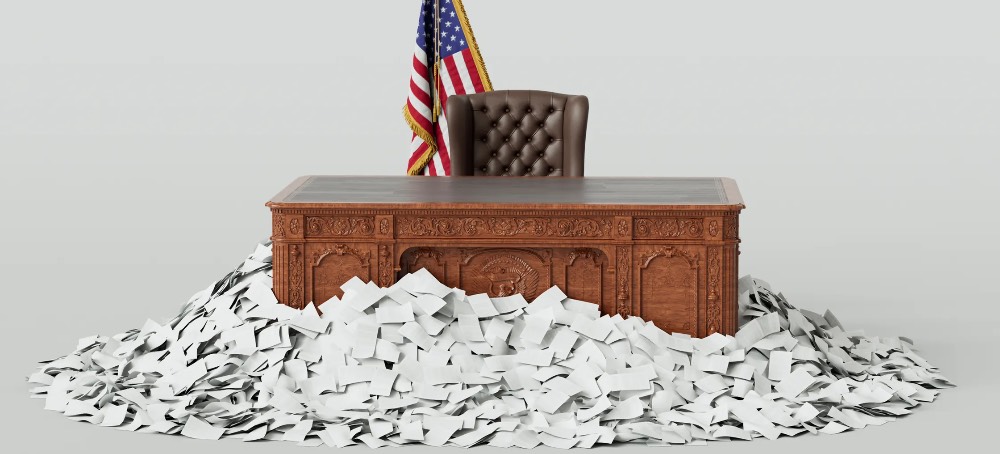 Illustration of the Resolute desk in the Oval Office. (photo: The New Yorker)
 Will Donald Trump Be Allowed to Destroy His Records?
Ruth Marcus The New Yorker
A law passed after Watergate makes Presidential records government property. The Trump Administration has declared it unconstitutional.
Trump’s apparent frustration with government demands for his records erupted after he left office, when he was investigated by the special counsel Jack Smith and charged with improper retention of classified documents. (The charges were eventually dismissed by U.S. District Judge Aileen Cannon, on the ground that Smith had been improperly appointed.) Boxes from the White House, some containing classified material, had been found crammed into a bathroom at Mar-a-Lago, next to a toilet and below a crystal chandelier. The Times reported that, according to several of Trump’s advisers, when officials from the National Archives pressed for the return of the records, Trump said, “It’s not theirs; it’s mine.”
In his second term, Trump seems determined to operationalize that “mine, mine, mine” world view. His White House counsel, David Warrington, asked the Justice Department’s Office of Legal Counsel to review the constitutionality of the Presidential Records Act of 1978, which requires that Presidents’ records be preserved while they are in office and transferred to the National Archives once their terms are up. The O.L.C.’s opinion, released last month, declared that the law is unconstitutional—that “Congress cannot preserve presidential records merely for the sake of posterity” and that, in addition, the law infringes on “the constitutional independence and autonomy of the Executive.” Therefore, the opinion concluded, “the President need not further comply with its dictates.”
Two lawsuits were quickly filed—one by the American Historical Association and American Oversight, a government-transparency organization, and the other by the Freedom of the Press Foundation and Citizens for Responsibility and Ethics in Washington—to require the White House to follow the law. “This case is about the preservation of records that document our nation’s history, and whether the American people are able to access and learn from that history,” the American Historical Association lawsuit asserts, warning of “a clear danger that official government records of the highest importance will be irretrievably lost.” On Wednesday, U.S. District Judge John Bates held a hearing on a request by the groups that he order the Administration to comply with the records law as the case proceeds.
Enacted in the wake of Watergate and the struggle for control of Richard Nixon’s White House tapes, the Presidential Records Act provides that a President’s official records are government property. (An earlier version of the Presidential-records law, passed in 1974, applied only to Nixon.) The law allows a President to exclude personal records, sets out timetables for releasing documents once the President has left office, and provides a mechanism for asserting executive privilege to keep certain material secret. (Trump unsuccessfully sued under that provision when the House Select Committee on January 6th sought access to his first-term records.)
The Administration, in its court papers, presents the Presidential Records Act as an “unconstitutional and ahistorical imposition on presidential autonomy.” Beginning with George Washington, who took his papers home to Mount Vernon and made no provision for public access, Presidents have treated their records as “personal property,” the Administration argues. “Just as it would flout the separation of powers for Congress to require the Supreme Court to broadly disclose its deliberative records to the public pursuant to legislative edict, so it is with the PRA.”
This history is correct but incomplete; it ignores a half century of Presidential compliance. Gary Stern, who served as general counsel of the National Archives for twenty-six years, collaborated with five Administrations—from Bill Clinton’s to Joe Biden’s—on preserving and releasing Presidential records. Under George W. Bush, Stern worked with Brett Kavanaugh, then a White House lawyer, as the White House crafted an executive order implementing the law. Stern recalled that those Administrations “all had their frustrations and complaints.” But “no one ever suggested that the law was unconstitutional,” he told me. “Everyone worked very constructively, including Trump 45 and his White House counsel, to implement the P.R.A. and make it work.”
Worse, the Administration’s account directly contradicts a Supreme Court decision. In 1977, the Justices rejected Nixon’s claim that the previous version of the Presidential Records Act violated the separation of powers and infringed executive privilege. The Court, voting 7–2, said that, given the “safeguards built into the Act” to protect confidential information and “the minimal nature of the intrusion into the confidentiality of the Presidency, we believe that the claims of Presidential privilege clearly must yield to the important congressional purposes of preserving the materials and maintaining access to them for lawful governmental and historical purposes.” In the decades since, of course, historians have mined the tapes and other Presidential material. Imagine an alternate world in which Nixon had instead been free to destroy those records.
The O.L.C. opinion, signed by Assistant Attorney General T. Elliot Gaiser, flicked this precedent aside. Nixon’s case, it asserted, “is distinguishable because it addressed a materially narrower statute under extraordinary circumstances.” Even more audaciously, the opinion added, the Court’s “separation of powers analysis is wrong,” because it fails to recognize that “congressional regulation of presidential records implicates the foundational constitutional principle of executive independence.” It dismissed the majority opinion, by the liberal Justice William Brennan, as reflecting an outdated, ancien-régime understanding of separation of powers, before a conservative majority adopted a new, pumped-up interpretation of executive authority.
O.L.C. similarly discounted congressional testimony the following year by the Deputy Assistant Attorney General, Larry Hammond. “It is well established that the work product of government employees prepared at the direction of their employer or in the course of their duties is government property,” Hammond told lawmakers. “Should Congress choose to extend this principle to cover records prepared or received by the President in the course of his duties, no substantial problems would, in our view, be raised.” The O.L.C. opinion dealt with this inconvenient testimony in a footnote: “That advice has not withstood the test of time.”
I recently spoke with Sarah Weicksel, the executive director of the American Historical Association. She acknowledged, “Ordinary people might think, ‘Oh, what does this have to do with me?’ It actually has a lot to do with all of us. Presidential records are essential for the transfer of power between Administrations and helping lawmakers understand how past decisions were made. They are essential for historians who come five, ten, fifteen, fifty, a hundred years later, asking historical questions about an Administration or about American life in the twenty-twenties. I think what’s the most important thing at stake is the ability of Americans in twenty, fifty years to be able to have access to a full history of the United States in this time period.” Future historians could find themselves searching in vain for records on Presidential decision-making about whether to launch the war with Iran, fire Cabinet secretaries, or grant pardons.
Chioma Chukwu, the executive director of American Oversight, warned of the long-term consequences if the O.L.C.’s advice is followed. “The Administration is trying to upend decades of settled law so that President Trump, and, frankly, any President who comes after him, would have unilateral control over the records that the public is entitled to,” she told me. “The White House does not get to decide what is preserved, what’s hidden, what’s destroyed, because the law is very clear that these records belong to the American people, not to any one President.”
The day after the opinion was released, Warrington, the White House counsel, released new guidance instructing staff that “even in the absence” of the law, they “should preserve any material related to the performance of their duties.” Those instructions have provided little comfort to the plaintiffs—especially given that the Administration declined their request to confirm in writing that it would comply with the law’s requirements. As Daniel Jacobson, representing the American Historical Association, told Bates at Wednesday’s hearing, “This is not some academic exercise where they’re still going to act exactly in accord with the P.R.A., and they just wanted to make it clear they think this law is unconstitutional. They issued a new policy right after for a reason.” Indeed, the guidance told staff only that they “should” preserve records, not that they were required to do so. It asserted that “text messages should only be preserved when they are the sole record of official decision-making, government action, or contain unique information not available elsewhere,” arguing that doing otherwise would “create an enormous technological burden while chilling the ability of presidential advisors to provide candid advice.” The guidance, Jonathan Maier, the attorney for the Freedom of the Press Foundation, told Bates, “is not only permitting Presidential records not to be retained—it’s actually instructing Presidential records not to be retained.”
The Administration’s lawyer, James Powers, argued that the Warrington guidance would protect the groups’ interest in insuring that records remain available. Bates, a George W. Bush appointee, seemed skeptical of that claim. “On the one hand, you’re arguing that the guidance that you’re following is substantially equivalent to the Presidential Records Act,” he told Powers. “And on the other hand, you’re arguing that following the Presidential Records Act would be extremely burdensome to the Presidency. I don’t see how those fit together.” Bates also expressed concern that, under the Administration’s view of the case, its determination that the Presidential Records Act is unconstitutional cannot be challenged in court. “This President and succeeding Presidents, if they chose to, could simply ignore the Presidential Records Act, not do anything consistent with their Presidential Records Act, and it would never be subject to judicial review,” he told Powers. “Isn’t that your position that you’re articulating?” Powers responded, “Any such review would be extremely narrow, and would certainly not be on the circumstances presented here.” In the Administration’s view, he said, “the records that the P.R.A. requires to be preserved are being preserved.”