
Wildfires Are Reversing Years of US Air Quality Gains, Study Finds
Avril Silva Inside Climate News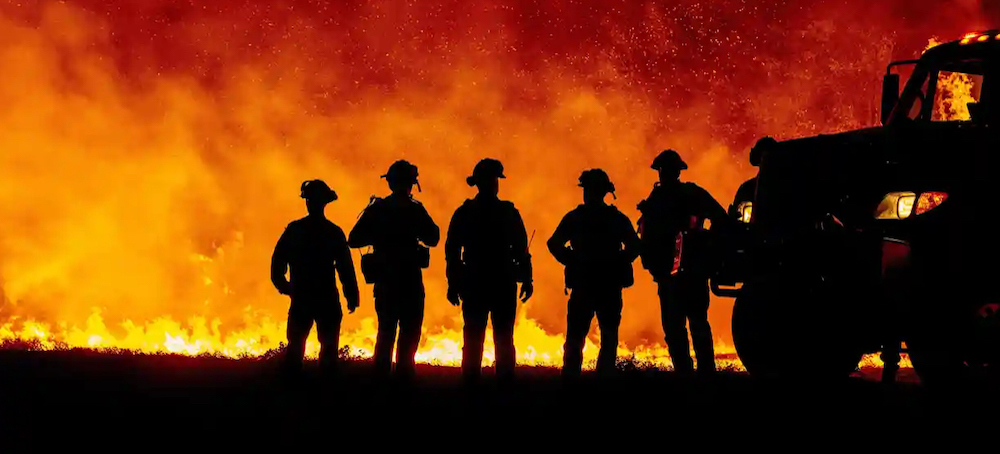 Firefighters tackle a wildfire. (photo: Josh Edelson/AFP/Getty Images)
 Wildfires Are Reversing Years of US Air Quality Gains, Study Finds
Avril Silva Inside Climate News
Tailpipe emissions standards implemented early this century helped reduce smog levels. Longer, more intense fire seasons have erased much of that progress.
Surface ozone levels, or smog concentrations, steadily increased from 2015 to 2024, deteriorating air quality across the Midwest and Western U.S., researchers at the University of Iowa found in a study released Thursday. According to the study authors, this contributed to an increase of 318 premature deaths per year from fire-sourced ozone since 2013. Their NASA-funded research mapped these ozone levels in kilometer-by-kilometer grids across the entire continental U.S between 2003 and 2024.
They also used AI and machine learning to incorporate different components, such as satellite observations and air quality forecasts into their models. The researchers said they strengthened this by measuring surface ozone levels by parts per billion (ppb) and comparing it against the data from the Environmental Protection Agency. While the models themselves cannot predict future ozone levels, Weizhi Deng, the principal author on the study, is concerned about the trajectory of ozone levels based on their conclusions.
“We want to send a message to the public that they may want to, from any individual standpoint, check the air pollution forecast during the summer wildfire season to limit outdoor activities,” Deng said. “To the policymakers, we want to call for consistent, continued monitoring of surface ozone.”
Surface ozone levels increased by about 0.13 ppb from 2015 to 2024, the study found. The authors said this result reverses any annual decreases in surface ozone levels since 2003 attributed to federal initiatives against tailpipe emissions. The total reversal, Deng said, is about four years of progress or as high as six in the Western U.S.
Their modeling showed the largest increase in ozone levels over the two-decade period they measured in the northern Rocky Mountains and across the northern Plains in North Dakota, South Dakota, Minnesota and Montana. While the Midwest does not experience frequent wildfires, Deng noted that elevated levels found in Iowa, Illinois and Michigan were influenced by smog traveling southward from Canadian wildfires and eastward from wildfires in California and other western states.
When wildfires were removed from their modeling, surface ozone levels continued to decrease. But when they factored in wildfires, the smog levels rose, suggesting to Deng and the other authors that wildfires were to blame. From 2003 to 2015, they measured an 11 percent decrease in smog levels. However, after 2015, they measured a 4 percent increase in surface ozone levels since 2003. That means one-third of ozone mitigation efforts implemented before 2015—such as shutting down factories or regulating automobile emissions—were wiped out by wildfires, said Meng Zhou, who also worked on the study.
“The fire season is getting longer, starting earlier and ends later,” Zhou said. “Fire intensities are getting heavier, and their frequency are getting higher, so we are concerned that, in these situations, those kinds of fire-triggered, high ozone episodes will be more frequent.”
Experts believe this research and modeling will benefit the current understanding of surface-level ozone, give communities greater access to comprehensive data and encourage future research into wildfire mitigation by bridging the gaps created outside EPA monitoring stations.
Brian McDonald, a scientist at the NOAA Chemical Sciences Laboratory who was not involved in the research, said this study aims to “get beyond limitations with our observing network” to identify this elusive source of air pollution that McDonald said continues to not get as much attention as particulate matter.
“It’s an important study that shows that wildfires are increasingly increasing, contributing to air quality challenges over the U.S.,” McDonald said.
While it remains difficult to pinpoint wildfire damage and ozone impacts because of how smoke travels, he commended the team for tackling a challenging task.
“This is the future of how we think about traditional kinds of physical models as well as how they are used or connected with AI-based models,” he said.
Like McDonald, John Balmes, a professor at the University of California, San Francisco, and a spokesperson for the American Lung Association, said the study can help inform medical providers and vulnerable communities about the ozone risks lurking in their own air while also providing a national map of ozone concentrations.
Balmes’s concerns, however, extend beyond public health to policymakers and what they are doing in his state of California and at the federal level to “set us back.”
“This article about ozone and wildfires is just another piece of evidence supporting why we need to be dealing with climate change as an environmental emergency, not pretending it doesn’t exist,” Balmes said.
Deng and Zhou said they hope their research can sound an alarm to others in their field and policymakers to explore different wildfire prevention techniques.
“We need other advanced tools to provide the public the information on our beloved planet,” Zhou said.