
Why the Backlash Was So Short-Lived
Rebecca Traister The Cut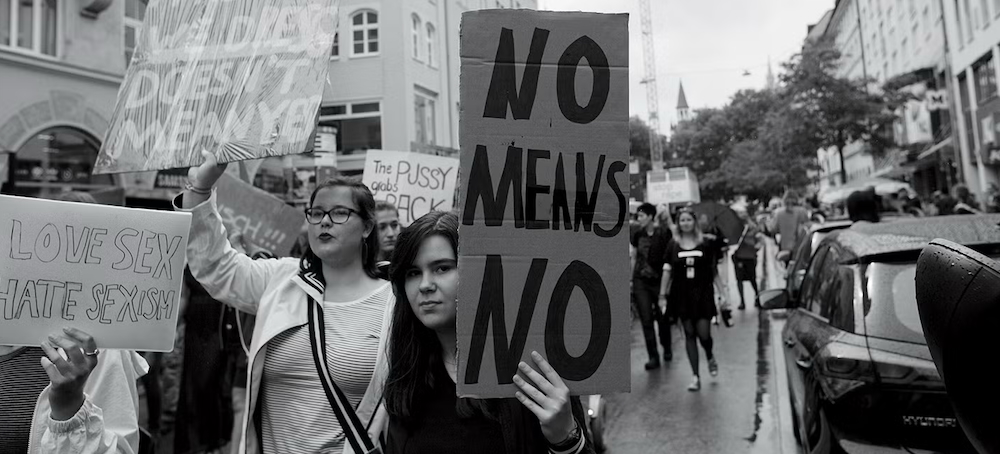 "Every day makes clear that the claim that Me Too went too far is simply a lie." (photo: NurPhoto//Getty Images)
 Why the Backlash Was So Short-Lived
Rebecca Traister The Cutomen are human beings,” intones one of the characters in Liberation, Bess Wohl’s new play about Second Wave feminism. “If you don’t believe that, at this point, I don’t know how I can help you.” The audience, gathered for a matinee on Broadway in mid-November, laughed dully in response.
“Women are human beings,” intones one of the characters in Liberation, Bess Wohl’s new play about Second Wave feminism. “If you don’t believe that, at this point, I don’t know how I can help you.” The audience, gathered for a matinee on Broadway in mid-November, laughed dully in response.
The grim joke was that the women onstage were already weary of ceaseless misogyny in 1970. And yet my phone had just been vibrating with texts and news alerts from 2025: about an infamous child-sex trafficker and his chummy emails with the most powerful men in America; about pregnant women dying thanks to a regressive Supreme Court decision; about the president telling a female reporter, “Quiet, piggy!”
While I was supposed to marvel at the notion that people were over still having to talk about all this back in 1970, I instead experienced a twinge of perverse relief that we were still talking about it now, a period in which no one is supposed to be acknowledging gender inequity at all. We have been repeatedly informed that, after hitting a fanatical peak around 2018, feminism is in retreat, is cringe, is over. We are in the midst of the Me Too backlash, the era of the manosphere and the wounded male psyche, auguring the sort of social-justice deep freeze that settled over feminism in the 1980s and ’90s.
And yet. Here we are. Aghast. Engaged. Again. So soon?
The contention “Me Too went too far” is not exactly bearing up under scrutiny. Rather, a year after Donald Trump’s reelection, we are beset by daily reminders of why Me Too, and feminism more broadly, came to exist in the first place. And why, despite the fondest wishes of those whose authority it threatens, it is not likely to go away anytime soon.
Mid-November saw the release of emails and text messages between Jeffrey Epstein and former Harvard president and Treasury secretary Lawrence Summers, in which the married Summers confers with Epstein on the probability of “getting horizontal w peril” (a racist nickname for a woman who appears to be a Chinese macroeconomist 27 years his junior — see the “Yellow Peril”). Summers grouses about penalties on powerful men accused of harassment and jokes about how he recently claimed that “half the IQ In [sic] world was possessed by women without mentioning they are more than 51 percent of population.”
Lest anyone think that these attitudes are limited to a pedophile and his gross buddies, jocular anti-feminist backlash has also bled into mainstream media. The Epstein revelations followed a trollish New York Times conversation with columnist Ross Douthat and two critics of feminism titled “Did Women Ruin the Workplace?” — a headline (straight from 1970) that was hurriedly changed after it caused an uproar among Times subscribers.
Meanwhile, the cascading evidence of how dehumanizing attitudes at the top shape the lives of those on the ground is in broad view: Mercedes Wells, a Black woman in Indiana who was turned away from a hospital by nurses while in labor, described how she was “treated like a dog”; videos of Kiara Jones, a Black woman in Texas, screaming and writhing in active labor, her pain ignored by hospital staff, went viral on TikTok. The day I attended Liberation, ProPublica reported on 37-year-old Tierra Walker, who was denied abortion care in Texas, developed preeclampsia, and died as her 15-year-old son tried to administer CPR and shouted, “I need you!” Maternal deaths rose 56 percent in Texas in the year after the state enacted its abortion ban in 2022.
As it turns out, banishing wokeness, getting to say retarded again, and romanticizing the time when sex pests roamed free just aren’t as satisfying as regressive leaders might have hoped. Trump lost his battle to keep the Epstein files under wraps, while Summers stepped down from the board at OpenAI and his teaching duties at Harvard. A video of a student heckling Summers’s colleague about the matter got 4.3 million views in 24 hours. (“We will miss his insights and his wisdom,” the professor said. “No, we won’t,” the student retorted.)
Andrew Cuomo bet on the backlash to the movement that held him accountable for alleged sexual harassment; his opponent Zohran Mamdani took that bet, beating Cuomo (twice). According to the anti-feminist right, as well as powerful people on the left and center discomfited by what they regard as recent feminist excess, we had been settling in for an era of reactionary politics of the sort chronicled by Susan Faludi in her 1991 book, Backlash: The Undeclared War Against American Women. Why doesn’t the tradwife boom seem to be taking as smoothly as it did when Ronald Reagan was president?
In part, our media and technology have changed. In the ’80s, we were fed narratives via a media monoculture. One inaccurate Newsweek story about single women being more likely to be killed by a terrorist than to find a husband could drive a frothing news cycle for months. Today, we have algorithms that put more communicative power in the hands of regular people. The government can shut down entire initiatives devoted to collecting statistics about Black maternal mortality, and a mom’s TikTok of her daughter’s labor agony being unheard can still go viral.
It also matters that the ’80s backlash happened in the wake of seismic cultural and policy shifts: the legalization of birth control and abortion; the ability of women to get credit cards and no-fault divorces, to object to sexual harassment and employment discrimination. Now efforts to foment anti-feminist sentiment under the banner of traditional family values are undercut by an alleged-rapist president eager to stock his Cabinet with other alleged rapists, by a masked police force ripping children from their parents’ arms, and by the 2022 Dobbs decision that struck down the right to an abortion. It’s harder to tell women they’ve overstepped when they are dying of pregnancy.
Every day makes clear that the claim that Me Too went too far is simply a lie. Powerful men never stopped harassing women; Cuomo was reportedly propositioning staffers in 2020, three years after Me Too’s peak; Summers and Epstein were yukking it up over how to get a subordinate in bed in 2018 and 2019. Reports of patriarchy’s death have always been greatly exaggerated. But so, too, have reports of feminism’s.
Which is the larger point. The story of women’s liberation isn’t a straight line; the state of women’s rights is blurry and contradictory. Things are moving backward and forward at the same time. There are no clean demarcations between feminism and its backlash and the backlash to the backlash, between progress and regress. It was always fanciful to conceive of progressive victories as permanent, just as it was a shortsighted fantasy that edgelord heterodoxy would remain cool. It’s never been waves but circular eddies, conversations among the same people again and again, creating a disorienting sameness as we try to get to the surface and determine where we are.
The Larry Summers who scoffed at the idea that women were as smart as men in an email in October 2017 also claimed women had less aptitude for science and engineering back in 2005; the Donald Trump who called a reporter “piggy” in November also called a Miss Universe winner “Miss Piggy” after her win in 1996.
The repetition may elicit a hollow laugh from a theater audience hearing the frustration of a character from 55 years ago. But it is also rousing — restorative, even. Because while the misogyny is hard to banish, so is the resistance to it.