
Why Israel's Police Are Ramping Up Violence Against the Families of Hostages
Rachel Fink Haaretz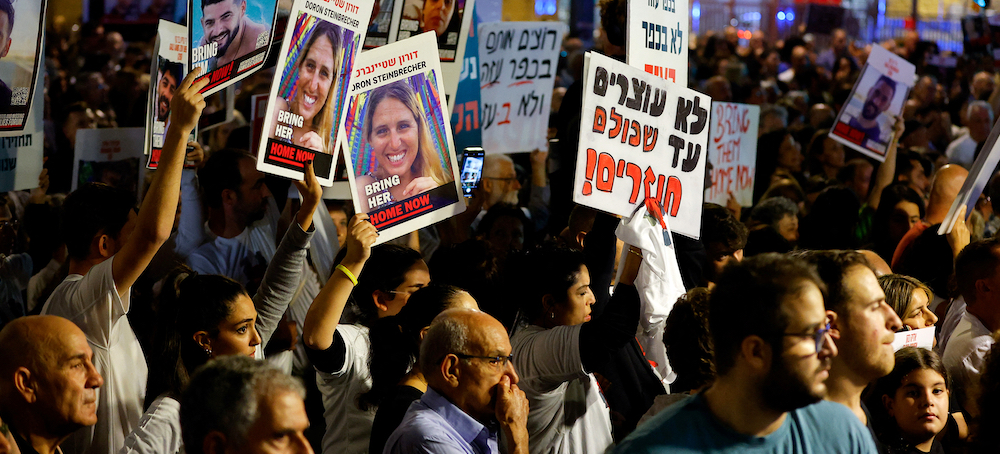 People hold signs as they await news of hostages held by Hamas on November 25, in Tel Aviv, Israel. (photo: Alexander Ermochenko/Reuters)
 Why Israel's Police Are Ramping Up Violence Against the Families of Hostages
Rachel Fink Haaretz
Last night's protest was notable not only because of the intensity of police violence, but the speed with which security forces began to react aggressively. It marked a significant turning point in Israel's protest movement. But the question is: For whom?
There was the "Night of Gallant" last March, when tens of thousands of Israelis spontaneously took to the streets after Netanyahu fired Defense Minister Yoav Gallant for daring to call for a stop to the judicial overhaul.
There was "Sarah's Haircut" – also last March – when protesters gathered outside a salon where the prime minister's wife was getting her hair done, and were met by police in riot gear who violently cleared them off the sidewalk.
And then, there was last night.
The protest, which took place in an area of Tel Aviv that was renamed Democracy Square during the height of the anti-Netanyahu government rallies, initially drew a relatively small crowd – especially compared to pre-October 7 levels, when the weekly Saturday night protests regularly gathered throngs of over 100,000. It also wasn't the first time mounted police and water cannons have been used to disperse anti-Netanyahu protests.
Instead, last night's demonstration was notable not only because of the intensity of police violence, but the speed with which security forces began to react aggressively. As protesters listened to speeches being made on the west side of Kaplan Street, police were already making their first arrests across the road. News of the arrests traveled quickly over WhatsApp and social media, causing them to have the exact opposite effect of their intended goal, as large numbers streamed toward the protest. Which is when the water cannons and police horses were brought out.
At one point – just as things seemed to be reaching a fever pitch – another group of demonstrators began approaching from Begin Road. The group of about 50 or so was made up primarily of the family members of hostages. Rather than the tell-tale Israeli flags and protest signs of the anti-Netanyahu government movement, they carried posters of their loved ones still held captive in Gaza and torches.
When the hostages' relatives arrived at Democracy Square, the protesters there – many of them soaked to the bone from the water cannons – made way for them, shouting cheers of "Bring them home!" in support. But just as the crowd parted, a police truck aimed its cannon directly at the hostage families, taking them by surprise and causing everyone to scurry out of the line of fire.
It marked a significant change in police tactics. Until now, the families have generally been given more leeway when it comes to how the police handle their protests. Just 24 hours prior, for instance, when a group of hostage family members blocked traffic on Ayalon Highway by setting up a Shabbat table in the middle of the road, every effort was made to clear the demonstration without the use of force or arrests.
This was not the case last night, the most turbulent of all the protests since October 7, which ended with 21 arrests, four injured, a mounted officer whipping a protester with his reins, and a blocked highway.
There is no doubt last night marked a significant turning point in Israel's protest movement. But the question is: For whom?
Was it for the leaders of the anti-Netanyahu government movement, two of whom were arrested last night, who will most certainly be looking to parlay Saturday night's collective fury into a resurgence of pre-war turnout and enthusiasm?
Was it for the families of the hostages, who – despite their best efforts to remain apolitical – are, after 142 days, being forced to confront decidedly political attempts to thwart a hostage deal?
Or is it for the police themselves, who seem to be leaning faster and further into their accused label of "Ben-Gvir's Police," a reference to National Security Minister Itamar Ben-Gvir and his undisguised efforts to use the police as his own personal militia?
We'll find out next Saturday night.