
White House Offers ‘Concierge’ Service to Fossil Fuel Firms, Official Says
Jake Spring The Washington Post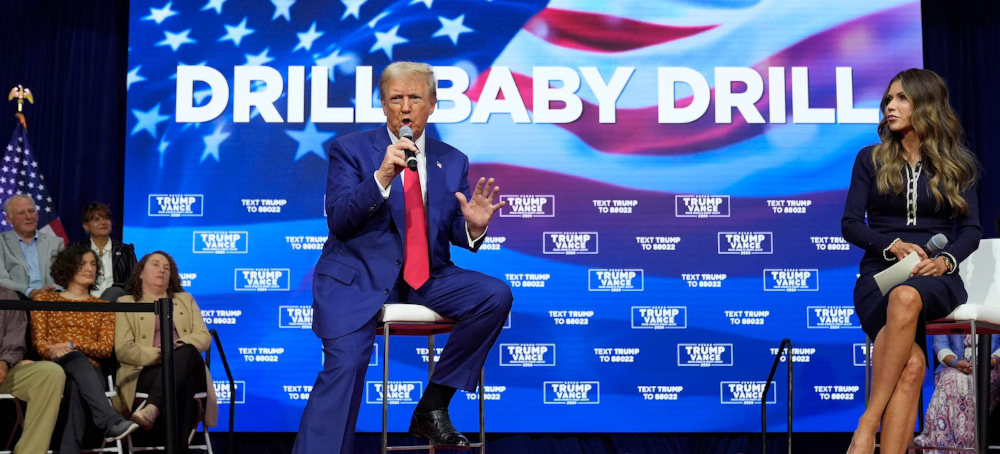 Donald Trump at a campaign event in Oaks, Pennsylvania, last year. (photo: Alex Brandon/AP)
 White House Offers ‘Concierge’ Service to Fossil Fuel Firms, Official Says
Jake Spring The Washington Post
Brittany Kelm, a senior policy adviser for the National Energy Dominance Council, detailed in a podcast how the council works to advance fossil fuel projects.
Brittany Kelm, senior policy adviser for President Donald Trump’s National Energy Dominance Council, detailed in an August podcast how she and the council work to advance fossil fuel projects. Trump established the committee in February with Interior Secretary Doug Burgum as its leader.
“We’re like this little tiger team, concierge, white glove service, essentially,” Kelm said. “We were put together very particularly with the president’s priorities in mind on energy. So keeping coal plants open, establishing critical mineral mining domestically and then that broader supply chain.”
Kelm did not immediately respond to a request for comment.
White House spokesperson Kush Desai said that the administration is ending former president Joe Biden’s preferential treatment for green energy projects and “war” on mining and fossil fuels.
“The American people gave President Trump a resounding mandate to ‘drill, baby, drill’ and unleash the power of American energy, and the Administration is committed to doing just that,” Desai said in a written statement.
National Energy Dominance Council Executive Director Jarrod Agen said in a statement that the council supports increasing “base load power generation.”
“Reliable sources like oil and gas, along with critical minerals, are essential to generating enough power to not only win the AI arms race but also sell energy to our allies so they don’t have to rely on our adversaries,” Agen said.
Trump wants to boost production of oil, gas, coal and critical minerals that align with his policy of favoring fossil fuels to address his self-declared national energy emergency.
At the same time, his administration has held up permits for solar and wind projects since July and blocked wind farms outright. The Energy Department last week canceled $7.6 billion in funding for projects aimed at curbing climate change including installation of renewables, grid upgrades and carbon capture projects. That’s on top of $27 billion in funding for clean energy that the Environmental Protection Agency is seeking to claw back.
“Fossil fuels and renewable energy face two very different permitting realities in this country,” said Ted Kelly, director and lead counsel for clean energy at the Environmental Defense Fund, an advocacy group, regarding Kelm’s comments. “For coal, oil and gas, it’s white glove service. For renewables and storage, it’s freezes, delays and cancellations.”
This is a normal way for the White House to operate, said Diana Furchtgott-Roth, director of the Center for Energy, Climate, and Environment at the Heritage Foundation, a conservative think tank. Companies consult with Trump’s energy council just as a financial firm might consult with the White House’s long-standing National Economic Council or a health care company with the Domestic Policy Council, she said.
“Elections have consequences. President Trump ran on a platform of increasing the use of oil, gas and natural resources,” Furchtgott-Roth said. “I see nothing nefarious in President Trump fulfilling his campaign promises through the National Energy Dominance Council. In fact, it would be odd if he didn’t.”
Kelm, who previously worked for oil companies including Shell and Valero Energy, described how she would connect a company looking to advance a pipeline with “the politicals” at the agencies that control permits. “They can walk out of our office, and they have all the contacts they need.”
Kelm said her team then follows up on the project to get a permit “unstuck” if it is being held up by a certain agency or stage of the process, working with the Interior and Commerce departments, Environmental Protection Agency and other government agencies.
“We know how to unstick what is stuck,” Kelm said. “It’s a lot of undoing old policies and getting rid of regulatory burdens.”
Kelm gave an example of an unnamed company getting approval in four days for what previously would take 45 days. She also described working with various departments on the proposal to open the National Petroleum Reserve in Alaska to development.
Trump issued a memo on Monday instructing federal agencies to issue any approvals necessary for a 211-mile road through Alaskan wilderness to be built to enable mining of copper and zinc deposits. The White House took a 10 percent stake in Trilogy Metals, a partner in Ambler Metals, which is seeking to develop a mine accessible from the proposed roadway.
The administration is also in the process of auctioning off the rights to mine for coal in Alabama, Montana, Utah and Wyoming, following on earlier efforts to expand existing coal mining leases and orders to prolong the life of coal power plants.
“This two-tiered approach — going to great lengths to prop up costly fossil fuels like coal plants while blocking the cheapest, cleanest energy sources — won’t lower electricity costs,” Kelly, of the Environmental Defense Fund, said in a statement. “It just saddles families and businesses with higher bills and more asthma-causing pollution.”