
White House Dismisses Scores of National Security Council Staff
Ellen Nakashima and Adam Taylor The Washington Post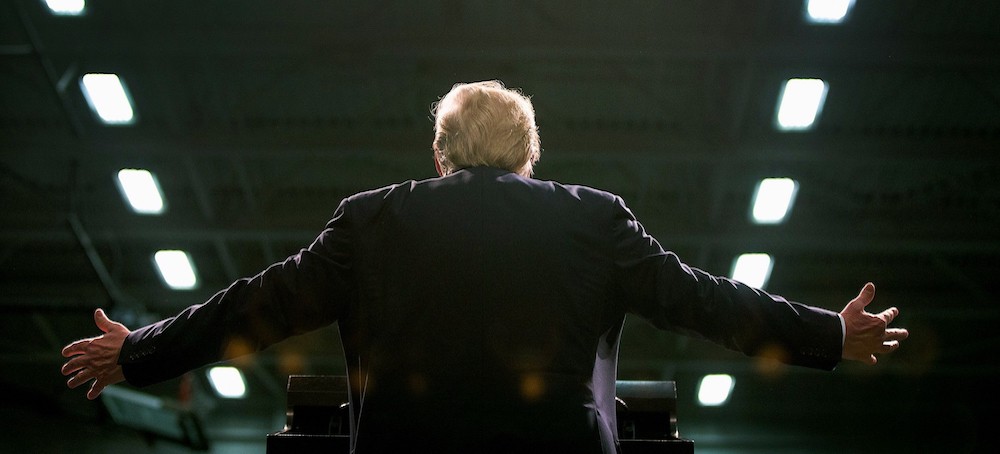 Donald Trump. (photo: Intercept)
 White House Dismisses Scores of National Security Council Staff
Ellen Nakashima and Adam Taylor The Washington Post
The dismissals, part of a plan to radically downsize the coordinating body, follow President Donald Trump’s recent ouster of his national security adviser.
The staff sent home included both career officials who were detailed to the NSC and some political appointees, these people said. Like others, they spoke on the condition of anonymity to discuss a sensitive personnel issue or because they do not wish to be seen criticizing the administration.
The cuts were made under President Donald Trump’s new national security adviser, Marco Rubio, who also is serving as secretary of state. Rubio, who has emerged as a key figure in the administration, was tapped for the White House post early this month after his predecessor as national security adviser, Michael Waltz, was pushed aside following a series of missteps. Trump has said he intends to nominate Waltz to be his ambassador to the United Nations.
It was not immediately clear how deep the cuts would be or if the dismissals on Friday afternoon would reflect their totality. Most NSC staffers are detailed to the White House from other parts of the federal government and were expected to go back to their home agencies, including the State Department, Pentagon and intelligence agencies, said people familiar with the shake-up.
Those who were told they were leaving had the news delivered to them via email shortly before 4.30 p.m. on the Friday before a long weekend, according to these people.
A White House official confirmed that cuts had been made and said that two new deputy national security advisers have been appointed: Andy Baker, who has been national security adviser to Vice President JD Vance, and Robert Gabriel, a policy adviser to Trump.
Alex Wong, who had been Waltz’s deputy, has been reassigned, according to two people familiar with the matter. Wong did not respond to a request for comment.
Axios first reported some of the details of the reorganization, including Baker’s and Gabriel’s appointment.
Since Waltz’s ouster, administration officials have signaled a major scale-down of the National Security Council was imminent. Some have argued that the NSC had become bloated under previous administrations.
According to Dilpreet Sidhu, NSC executive secretary and deputy chief of staff under President Joe Biden, the policy staff stood at 186 toward the end of Biden’s term. Citing NSC human resources data, she said the first Trump administration’s NSC policy staff numbered 119 at a similar point. Both George W. Bush’s and Barack Obama’s NSC staffs were larger, at 204 and 222, respectively.
Trump’s allies have called for the administration to follow an older model used by Brent Scowcroft, who first became national security adviser in 1975 and assumed the role for a second time in 1989. Scowcroft, who viewed his role as offering private counsel to the president, kept a small staff during his two stints in the job.
“The NSC is not there as a think tank or shadow department,” Alexander Gray, a former NSC chief of staff during Trump’s first term, said in an interview last week. “It is about coordinating and implementing work originated in the departments and then ensuring the president’s decisions are implemented.”
In an op-ed for the Washington Times, Gray and former national security adviser Robert O’Brien wrote that Trump inherited outsize NSC staffs from Obama and Trump’s most recent predecessor, Biden. Both, Gray and O’Brien argued, “had grown used to the … approach of NSC centrality in the policymaking process.” Such an approach, they wrote, “contradicts all historical models of a successful NSC staff.”
Gray and O’Brien wrote that “NSC policy staff could be streamlined to 60 people,” not including administrative staff, which they said would be the same number employed in the Eisenhower administration decades ago.
Other former officials said that for a leaner NSC to work, the White House would need to grant greater authority to other national security agencies — something that is hard to imagine, these people said, under Trump’s personalized style of leadership.
“I don’t see the Trump administration deferring national security policy to the State Department,” said Philip Gordon, who was Vice President Kamala Harris’s national security adviser and previously had roles on the Obama and Clinton NSC staffs.
“The president is going to run everything,” Gordon added. “If he’s going to do that, he should have the type of staff to do it effectively.”
A former senior NSC staffer in Trump’s first administration warned against conflating size and approach. “The NSC is a way to ensure that the president’s policies are actually being implemented,” said the former aide. “It ensures that the president is getting the best information possible, and that the president’s policies are being implemented. It’s very hard to accomplish those two objectives if you cut all the staff.”
For decades under both parties, the NSC has been composed “almost entirely of apolitical experts” on every significant issue to help the president manage any crisis in the world, said Jonathan Finer, deputy national security adviser under Biden.
“Whatever your view of esoteric debates about its size or org chart, that’s an enormous national asset to just throw away at a time when the challenges the United States faces — from terrorism to competition with China to Russian aggression to pandemic disease — get more daunting by the day.”
Battles within the NSC in some ways defined Trump’s first term in office, resulting in regular staffing churn. Trump had four national security advisers during his first presidency — the longest-serving, John Bolton, has emerged as a persistently vocal critic of the president’s foreign policy.
The problems had continued, to an extent, into Trump’s second term. The White House fired at least five key aides on the NSC staff in April after the far-right activist Laura Loomer visited the Oval Office and urged Trump to remove disloyal people. Waltz was ousted a few weeks later.