
Whistleblower Warns Trump Mail Ballot Plan Could Be ‘Catastrophic’
Zac Anderson USA Today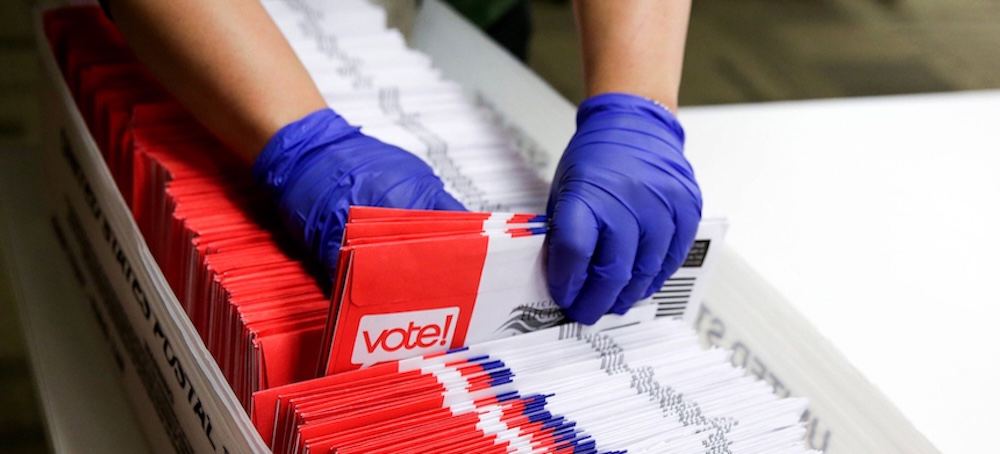 A poll worker sorts vote-by-mail ballots. (photo: Getty Images)
 Whistleblower Warns Trump Mail Ballot Plan Could Be ‘Catastrophic’
Zac Anderson USA TodayALSO SEE: Whistleblower Warns New Plans for Mail Ballot Rules Are Hidden From the Public
The whistleblower described a “secretive, rushed, chaotic, and fundamentally flawed process” by the Postal Service to implement the mail ballot plan.
The whistleblower, a federal official with direct knowledge of the plan, described a “secretive, rushed, chaotic, and fundamentally flawed process" that advanced despite court orders blocking the Postal Service from enacting the mail ballot changes.
"The Whistleblower also raises grave concerns that the administration has hidden the high likelihood that the new ballot mail verification processes will result in major disruptions in mail ballots ever getting delivered to voters," according to the report, which was prepared by the group Whistleblower Aid and sent to Sen. Richard Blumenthal, D-Connecticut.
A Postal Service spokesperson said the agency is "carefully reviewing" the issues raised by the whistleblower and in a letter sent by Blumenthal. The agency has spent months developing a "simple, secure, and efficient" mail ballot system, and the work was "conducted in a manner consistent with court orders," the spokesperson said.
Trump issued an executive order in March directing the Department of Homeland Security to develop lists of eligible voters in each state and requiring the U.S. Postal Service to only deliver ballots to voters on the approved lists. The president often has made unfounded claims about widespread problems with mail voting, despite casting his own ballot by mail.
Trump's order escalated his bid to place new restrictions on voting ahead of the 2026 midterm elections, when control of Congress is at stake. It was condemned by Democrats and voting rights groups, who said it interferes with state election administration and makes it harder for people to vote, and was quickly challenged in court.
A federal judge in Boston temporarily blocked the order on June 25 in a case involving 23 Democrat-led states, and also issued a nationwide block in a separate case brought by voting rights groups. The Postal Service moved ahead with the plan anyway, the whistleblower complaint states.
“Just a few weeks later, on or around July 29, 2026, the project was suddenly resumed without explanation of what authority permitted USPS to ignore the court order,” the complaint says in noting the June 25 block.
The Supreme Court ruled on Aug. 24 that the states' legal challenge was premature because a final Postal Service mail ballot plan hadn’t been issued, and lifted the lower court order blocking the effort. The Postal Service formally published the mail ballot rule on Aug. 26. It was quickly challenged again in court, with a judge temporarily preventing it from moving ahead while considering a long-term block.
The Postal Service’s mail ballot system could result in a major election disruption if allowed to proceed, the whistleblower complaint states, calling it "insufficiently tested" and "poorly planned." The complaint raises concerns that the technical systems developed to implement Trump's order will "crash" ballot processing.
"Potentially millions of American voters may not receive their mail-in ballot this election cycle in a timely manner, or at all," the complaint states, while "warning of catastrophic failure which could derail the midterm elections."
Blumenthal said in a letter to the Postal Service that the agency should scrap the effort.
"We urge you to abandon this ill-conceived, unconscionable plan and ensure that all Americans can exercise their constitutional right to vote, including by mail, without interference," he wrote.