
What You Are About to See From Oleshky, Ukraine, Is a Lie
Zarina Zabrisky The Atlantic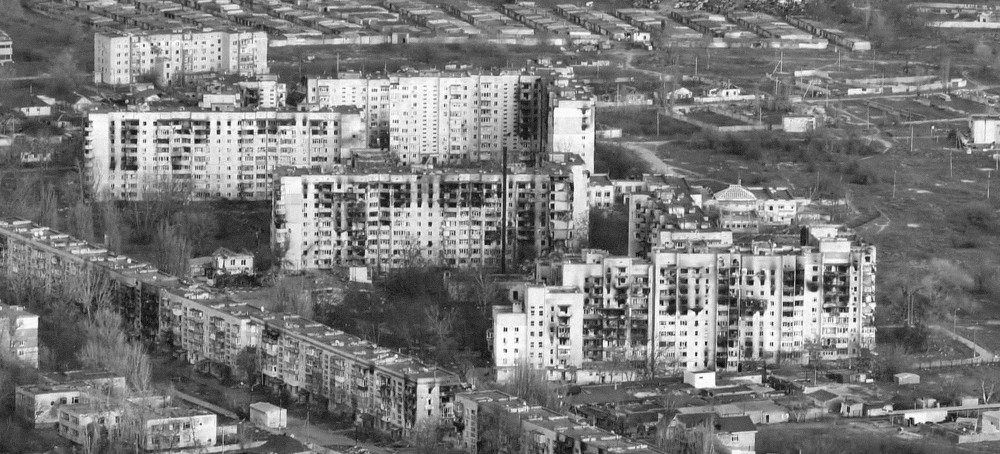 The Kremlin is staging whitewashed tours of a city it has terrorized. (photo: Volodymyr Obertas/Getty)
What You Are About to See From Oleshky, Ukraine, Is a Lie
Zarina Zabrisky The Atlantic
The Kremlin is staging whitewashed tours of a city it has terrorized.
Now Oleshky is the site of a humanitarian cease-fire reportedly brokered by U.S. First Lady Melania Trump. Ukraine has long pressed for access to Oleshky’s civilians in order to bring them aid or help them escape to safety. Russia is allowing this only now. At the same time, Oleshky will host a propaganda tour for media visitors under Russian military escort. Whatever these journalists learn about life here almost certainly won’t be the truth.
Oleshky lies just across the Dnipro from Ukrainian-controlled Kherson, a strategically important city in the south of Ukraine. This location makes the town a useful military foothold for the Russians, who launch attacks on Kherson from it while using the presence of its civilian population to shield their positions.
I am the only foreign journalist permanently based in Kherson, where I have been reporting since 2023. Since February, I have been investigating the humanitarian catastrophe in Oleshky and the neighboring settlements. My work has drawn on evacuee testimonies, contacts inside occupied territory, official data, and verified military footage.
According to the institute for the study of war, Russian occupation authorities have repeatedly obstructed efforts to evacuate the town or provide humanitarian access. Regular supply deliveries stopped at the end of last year, and food and medicine have not reached Oleshky through conventional channels since May. The city is under what has come to be called a drone siege: Drones monitor all access roads, streets, and civilian movement, remotely mining them to restrict logistics. With conventional access blocked, Ukrainian forces have resorted to delivering food by drone.
“Oleshky is an artificially created hell in the midst of the civilized world,” a woman named Liudmila wrote to me. She asked that I refer to her by only her first name, out of concern for the safety of her loved ones left behind. She prefers to write, rather than speak, about the four years she endured under Russian occupation, even though her eyesight is foggy from months spent sheltering in basements.
When Russian forces entered Oleshky in February 2022, Liudmila and her husband, Andriy, decided to stay. They wanted to protect their family home on the banks of the Dnipro, and they imagined that the occupation would soon end.
Within days, Russian soldiers poisoned their dog, an Alabai, along with all the other large dogs in Oleshky. They killed Liudmila’s nextdoor neighbor and raped his wife. A local butcher disappeared; no one knew whether he was also killed. Some neighbors were detained and beaten. Armed, masked soldiers searched Liudmila’s home three times, confiscating the couple’s Ukrainian passports and leaving them with no documents. And yet, Liudmila and Andriy stayed. They got a new puppy, also an Alabai. Russian troops started to move into civilian houses, parking tanks in what once were gardens.
In June 2023, the Russians blew up the Kakhovka Hydroelectric Power Plant dam, and Oleshky was swept by floods. Homes and corpses floated down the river; bodies washed up onto fences and were left in the sun—no one knew how many. Without access to municipal water or other utilities, the couple collected rainwater in summer and melted ice in winter. During one nighttime battle, Liudmila and Andriy woke to find their roof in flames. Andriy climbed up, and Liudmila handed him containers of water to extinguish the fire. After that, their water supply was gone, and the house was unlivable.
They moved to an abandoned home nearby. Russian soldiers killed their young dog with grenades. Andriy fell ill, and Liudmila prayed next to him at night as the windows trembled from explosions. Ambulances no longer came to their neighborhood, so one morning, she put Andriy in a wheelbarrow and pushed him to the hospital. But there was no medicine there, or fuel to run a generator, and the hospital couldn’t carry out an operation. Andriy died in 2025.
By then, Russian drones had started attacking civilians. Liudmila was afraid to turn on the lights at night, lest they attract drones. Sometimes drones would hover at window level for hours, seemingly spying on people inside.
Winter came, and water froze in buckets inside the house. Some neighbors froze to death. Liudmila, who was caring for her elderly mother-in-law, would push her wheelbarrow along heavily mined streets to look for food in abandoned houses. She’d wait for hours at the market for vehicles to bring supplies while drones circled over. Often, she saw dead bodies in the streets and dogs carrying human bones. When her mother-in-law died of untreated wounds, the Russian occupation authorities took her body to another town for a forensic examination. Liudmila was allowed to pick her up only a month later—from a pile of severely decomposed corpses at the morgue.
Liudmila escaped Oleshky at last this spring. From those left behind, she hears that scrounging for supplies is no longer possible. “Mines lie below; drones hover above. Death is everywhere: beneath your feet and over your head,” she wrote to me. “As you walk, you must watch every step, scan your surroundings, and keep your eyes on the sky.”
Ukraine has long sought to help Oleshky’s inhabitants either survive or escape. The country’s ombudsman, Dmytro Lubinets, proposed localized humanitarian cease-fires in May, July, and September of this year, but the Kremlin rejected all of them.
Now the White House has announced one that started yesterday and is credited to the first lady. The Trump administration has needed a success story on the eve of the midterm elections, and Moscow appears to have provided press access to exactly the sorts of tribunes that will give the American administration—and the Kremlin—a boost.
The right-wing television network Newsmax has said that it has been granted “exclusive television access” to accompany a delegation of Russian and Ukrainian representatives entering Oleshky this week. According to sources familiar with the arrangements, but who asked for their names to be withheld because they were not authorized to speak with the press, Fox News will also be permitted on the scene. A Russian Telegram channel suggested that Tucker Carlson plans to visit Oleshky too. Most Ukrainian and independent international journalists have been denied access.
What will happen is predictable. Journalists and influencers loyal to the Trump administration and sympathetic toward the Kremlin will likely spend a couple hours filming Russian soldiers distributing food, assisting the elderly, and facilitating evacuations. They will be permitted only supervised interviews with preselected civilians. Dependent on the Russian occupying authorities for food, health care, and permission to leave, these people will not express themselves freely in the presence of the Russian military. And even if they try, their testimonies will be filtered through the Kremlin-supplied interpreters accompanying the Western press.
The besieged population will appear to be wholly grateful to the Russian authorities for another reason too. After months of deprivation, people perceive even basic assistance as an act of generosity. By suddenly offering food and evacuation, the Russian authorities will present themselves as rescuers rather than as perpetrators, exploiting this psychological dependency to manipulate Ukrainian civilians and international public opinion.
Ukraine is accepting the conditions of this evacuation in order to save lives, and it will maintain an operational silence also to that end. By accrediting only Newsmax and other ideologically aligned outlets, Russia has signaled that it plans to seize the opportunity to control how Oleshky is presented to the world. The participation of a few approved media outlets will be touted as real press coverage, making those American journalists tools for the legitimization of a Kremlin whitewashing operation.
That’s if Newsmax allows it. Its representatives could choose not to. They could instead make their visit to Oleshky an opportunity to practice independent journalism, challenge the Kremlin’s narrative, and expose the reality behind the humanitarian spectacle, rather than becoming a part of it.