
What to Know as the Hate-Crimes Trial of Ahmaud Arbery's Killers Begins
Hannah Knowles The Washington Post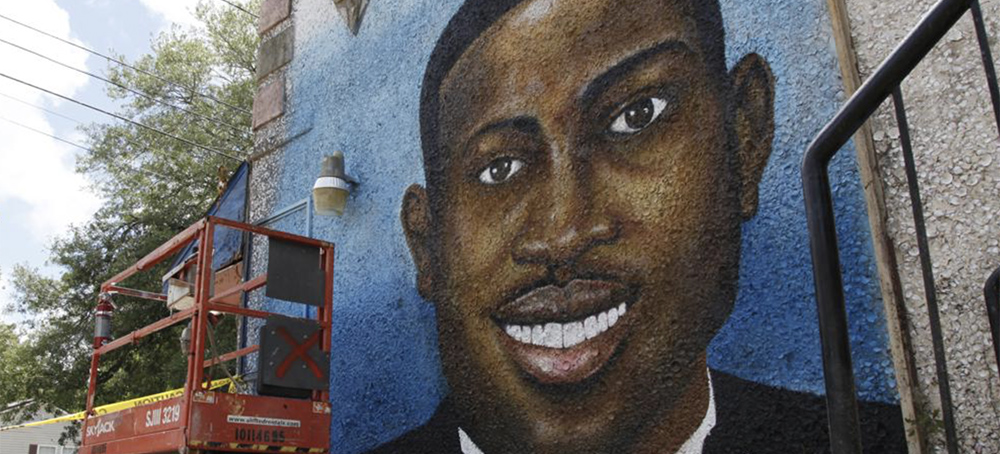 A painted mural of Ahmaud Arbery is displayed on May 17, 2020, in Brunswick, Ga., where the 25-year-old man was shot and killed in February. Arbery was shot and killed by two men who told police they thought he was a burglar. (photo: Sarah Blake Morgan/AP)
What to Know as the Hate-Crimes Trial of Ahmaud Arbery's Killers Begins
Hannah Knowles The Washington PostBut jurors heard little about race during the murder trial of Travis McMichael, his father, Gregory McMichael, and their neighbor William “Roddie” Bryan last November. Now a second trial will put the issue front and center.
The three men, who were convicted of murder in state court, are charged with federal hate crimes, accused of violently interfering with Arbery’s right to use a public street because he was Black. Opening arguments are expected Monday in Brunswick, Ga.
What happened in the murder trial?
A Glynn County jury found the McMichaels and Bryan guilty of charges including aggravated assault, false imprisonment and felony murder — meaning the defendants committed felonies that caused Arbery’s death. They also found Travis McMichael guilty of malice murder, which involves intent to kill.
The verdict was especially striking because local authorities initially declined to arrest anyone involved, concluding that the McMichaels and Bryan were carrying out a valid “citizen’s arrest” and opened fire only after Arbery “attacked” Travis McMichael. Then Bryan’s cellphone video of the incident spread online, drawing nationwide scrutiny and demands for consequences.
At trial, prosecutors called the McMichaels “vigilantes” who grabbed their guns and chased down an unarmed man they suspected of break-ins. Bryan joined the pursuit in his own truck after Arbery fled past his porch.
For five minutes, prosecutors said, Arbery tried to run away. But eventually he was caught between the two trucks.
Travis McMichael testified that he fired in self-defense after Arbery grabbed his gun, while prosecutors said the defendant was not trustworthy and that if anyone had the right to self-defense, it was Arbery.
Moments earlier, Greg McMichael had called 911.
“All of this, and what does he say his emergency is?” prosecutor Linda Dunikoski told the jury. “ ‘I’m out here in Satilla Shores, and there’s a Black male running down the street.’ That’s the emergency.”
Much of the state trial focused on whether the McMichaels and Bryan had legal grounds to chase Arbery, who had entered an under-construction home in Satilla Shores a few times in the months leading up to the shooting. Travis McMichael said he suspected Arbery of theft. But there was no evidence that Arbery did more than walk around the site, and prosecutors said the defendants’ suspicions were not enough for a “citizen’s arrest.”
The McMichaels and Bryan were sentenced in January to life in prison, as required by Georgia law. A judge granted Bryan the possibility of parole after 30 years.
Why is there another trial?
The McMichaels and Bryan were charged with federal hate crimes in addition to the murder charges prosecuted in state court. State prosecutors focused on proving that the defendants committed crimes rather than showing why they attacked Arbery.
A federal indictment accuses the McMichaels and Bryan of interfering with Arbery’s rights because of his race, using “force and threats of force.”
Georgia did not have a law specifically targeting hate crimes at the time of Arbery’s death. So the hate-crimes case against the McMichaels and Bryan relies on federal law, which forbids interfering with someone’s ability to use public accommodations because of their race, color, religion or national origin.
With the defendants already serving life in prison, the federal case will have little impact on their sentencing. But many advocates see this second trial as an important opportunity to finally litigate allegations of racism.
Hate-crime convictions for the defendants would send a powerful message, said Jeannine Bell, a professor at Indiana University’s Maurer School of Law in Bloomington who has studied hate crimes. She linked Arbery’s killing to a broader phenomenon of “move-in violence” targeting Black people because they are in White neighborhoods.
“Attacking someone because they are African American in a White neighborhood — because that’s absolutely what happened here — needs to be recognized as a violation of our norms,” Bell said.
What evidence could jurors hear?
Federal prosecutors have signaled they will bring evidence that the defendants shared racist views in messages and on social media. Travis McMichael, for instance, has referred to Black people as “savages” and “monkeys” and used slurs such as the n-word, prosecutor Tara Lyons said in a pretrial hearing last month. She said he also has “expressed a desire to see African American people, particularly those he viewed as criminals, harmed or killed.”
Bryan’s attorney sought in a court filing to keep jurors from hearing testimony “that would suggest Bryan did not approve of his adopted daughter dating an African American man.”
But proving that the defendants are biased is not enough. Prosecutors will also need to show that bias fueled the attack on Arbery.
They may emphasize Greg McMichael’s reference to Arbery’s race in his 911 call, or contrast the defendants’ attitude toward Arbery with their attitude toward White people. Lyons has said that Travis McMichael blamed Arbery for a prior theft of his gun, even though a White person was suspected in a similar theft of a neighbor’s firearm.
It is not clear whether jurors will hear about the most explosive allegation linking Arbery’s killing to racism — Bryan’s claim to investigators that Travis McMichael swore and said the n-word over Arbery’s body.
Defense lawyers in the state trial argued the allegation was inadmissible because Bryan exercised his right not to testify, meaning that Travis McMichael could not cross-examine Bryan about the out-of-court claim. The evidence was never introduced. Attorneys for the younger McMichael have also suggested that Bryan fabricated the accusation about the racial slur as he sought to become a witness for the prosecution. The slur was not recorded on a 911 line left open after the shooting, defense lawyers said.
Didn’t two of the defendants agree to plead guilty?
The McMichaels reached a plea deal with federal prosecutors last month, agreeing to admit to hate-crime charges and serve 30 years in federal prison before returning to state custody.
But U.S. District Judge Lisa Godbey Wood rejected the deal after Arbery’s family members protested. They said it would let the McMichaels serve their time in better prison facilities. Wood said she needed to learn more before deciding on a sentence.
Travis McMichael had already entered his guilty plea but withdrew it after the deal imploded, days before jury selection began. His father, who had yet to enter his guilty plea, also changed course.
The fact that the McMichaels were prepared to admit racial motives will not be admissible at trial, and jurors have been urged to set aside any prior knowledge of the case.
Is this trial the end of litigation over Arbery’s death?
Other court cases stemming from Arbery’s killing are still pending.
Former Brunswick Judicial Circuit district attorney Jackie Johnson has yet to be tried on charges that she violated her oath of office and obstructed police while handling Arbery’s case. Johnson recused herself from the investigation early on because Greg McMichael had recently retired from her office, but she is accused of taking actions to try to protect the defendants.
Johnson has denied wrongdoing. Voters ousted her in 2020 amid outrage over the case.
Activists and Arbery’s family have also called for charges against George Barnhill, the local prosecutor who argued in 2020 that Arbery’s death was not a crime. Barnhill remains in office. Announcing the indictment against Johnson last fall, Georgia Attorney General Chris Carr said that “our file is not closed, and we will continue to investigate in order to pursue justice.”
In addition, Arbery’s mother, Wanda Cooper-Jones, has filed a wrongful-death lawsuit against the McMichaels and Bryan. A judge put the suit on hold while criminal trials in Arbery’s killing proceed.