
What the US Would Lose If It Eliminates the National Center for Atmospheric Research
Steve Curwood Living on Earth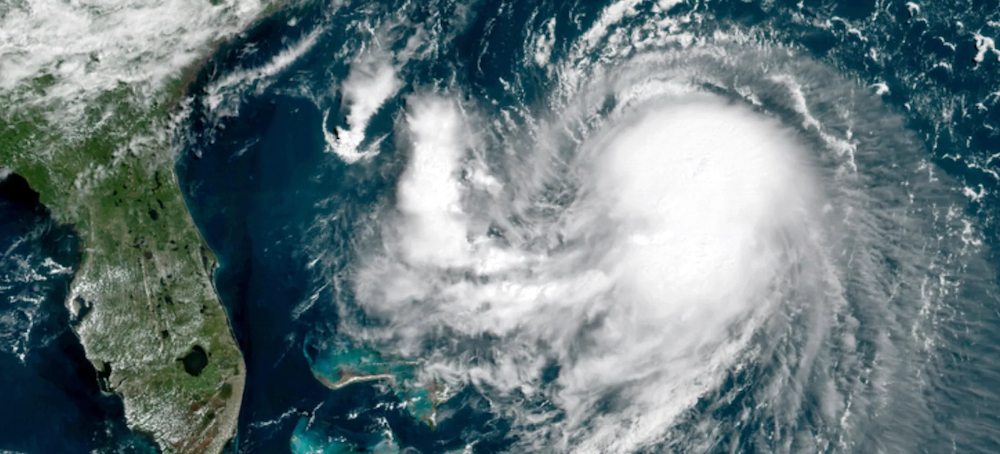 A tropical Storm in the Atlantic Ocean. (photo: NOAA)
 What the US Would Lose If It Eliminates the National Center for Atmospheric Research
Steve Curwood Living on Earth
“I think there's a great loss for the wrong reasons. There's no good reason for dismantling this or tearing it down,” a former NASA chief scientist says.
But in November, the Trump administration declared it was dismantling NCAR, citing its contribution to what the administration calls “climate alarmism.”
Now, NCAR’s parent organization is suing the Trump government, claiming it is “waging a campaign of retaliation against the State of Colorado” by trying to scuttle NCAR after Colorado’s governor refused to pardon an official convicted of election interference on President Donald Trump’s behalf.
With NCAR scientists muzzled, we spoke with Waleed Abdalati, a former NASA chief scientist who is now a professor and the director of the Cooperative Institute for Research in Environmental Sciences at the University of Colorado, Boulder, to discuss the potential implications of eliminating the center.
STEVE CURWOOD: Please describe what, exactly, the National Center for Atmospheric Research, or NCAR, does.
WALEED ABDALATI: NCAR carries out all aspects of atmospheric research and environmental research related to weather, climates, drought, fires—basically, how the Earth system works, how it moves energy, and what the implications are for weather and the way we live, from our day-to-day lives to our longer-term planning.
CURWOOD: The University Corporation for Atmospheric Research, the holding company, if you will, of NCAR, has filed a lawsuit arguing that dismantling NCAR would threaten national security, public safety and the economy. How well-founded are these claims, do you think?
ABDALATI: Well, I don’t have the legal expertise to make judgments on the merits of the case, but as a scientist, I can certainly say that our economic and strategic interests are closely tied to how well we understand the environment and its evolution, and so efforts that compromise that do put us at risk of not being as successful as we otherwise would or could be.
One good example is, the Arctic is changing rapidly. It’s changing more rapidly than other places on Earth, and understanding the processes that govern that change will help us understand what kinds of investments we should make. What are the economic opportunities associated with an Arctic where the ice cover is shrinking? When will it shrink? What does that mean to have an exposed border that we’ve historically relied on being ice-covered?
These are the kinds of questions that the work at NCAR and other related research can help us with and it is, in my view, detrimental to our interests to not be pursuing that understanding.
CURWOOD: The lawsuit also suggests that the move by the Trump administration is part of its campaign of retaliation against the state of Colorado, and that’s a direct quote from the suit. In the past year or so, the administration has blocked hundreds of millions in federal funding for states, vetoed an urgently needed water pipeline and threatened to withhold food stamp benefits from residents. Why does President Trump seem to have it out for Colorado?
ABDALATI: I’m not going to put myself in the mind of officials who make these kinds of decisions. What I will say is a lot of people believe that this is retaliation. Colorado, in particular, being singled out because the governor of the state of Colorado has not pardoned or shown leniency to Tina Peters, the county clerk who has been accused—actually, convicted—of tampering with ballots in her county.
This gets back to the current administration’s commitment to advancing the idea that the 2020 election was rigged, and the governor of Colorado is, I wouldn’t say, pushing back on that. He’s simply not agreeing to undo what a court has determined or has decided. And that—again, I’m not saying this myself—but many believe that has put the state in bad favor with the administration, and this is apparently an effort to retaliate. [Note: On Friday, after this interview was recorded, Colorado Gov. Jared Polis cut Peters’ sentence to make her eligible for parole June 1.]
CURWOOD: Tina Peters was convicted for tampering with the election results in 2020 on behalf of President Trump, but of course, being a state conviction, he has no power to pardon her.
ABDALATI: That’s correct.
CURWOOD: How are others in the world of climate research and weather reacting to the prospect of NCAR getting dismantled and the lawsuit itself?
ABDALATI: I don’t know how people are reacting to the lawsuit. I do think people are hopeful that they’ll prevail, because the issue from the science perspective is this is a tremendous capability that, at best, will be compromised [and], at worst, would be destroyed.
The administration did seem to single out NCAR’s climate work and “climate alarmism,” as they call it. One, NCAR does so much more. And two, I don’t think there’s alarmism by the scientists at NCAR. They do research and they report, through peer review, what they find. The fact that some of it is or can be alarming doesn’t make the alarm the goal of the work.
I think there’s a great loss for the wrong reasons. There’s no good reason for dismantling this or tearing it down … the allegations that are made are off the mark.
CURWOOD: To what extent do you believe that we should all be very concerned—indeed, alarmed—about the climate emergency that seems to be advancing?
ABDALATI: I think we should be very concerned. But I would frame it a little bit differently.
I would hope that everyone in this country, everyone in the world, would appreciate the importance of doing our best to understand what the future holds, so we can be best positioned to manage the challenges that come with it and capitalize on the opportunities that may come with it.
To be critical of the research itself is a tremendous disservice to the country. Speaking individually—I’m not speaking on behalf of the science community or anyone else—I’m very concerned, because the physics are pretty basic: If you put heat-trapping gas in the atmosphere, it will trap heat. More heat in the atmosphere has certain implications for the environment we’ve lived in for centuries.
So I’m very concerned about the challenges that may lie ahead, but my concern is much further exacerbated when we try to avoid understanding what those challenges may be. I see this effort and others that I’m seeing as compromising our ability to know what lies ahead, and as a result, I think it greatly compromises our national interests.
CURWOOD: Federal funding for climate and environmental research has faced a lot of uncertainty recently, including some impacts on your own lab. How has that uncertainty affected your team, both in terms of functionality and morale?
ABDALATI: That uncertainty has had a tremendous impact on morale, and when morale is low, people don’t function as well as they otherwise would. The removal of a huge percent of the workforce on the federal side, the challenges to grants so funds are not flowing, really takes a toll on our people—and in some cases, a real financial toll, and they’re unable to do the work that they’ve dedicated their careers to.
People don’t do this work for the glamor or for the money. People do this work because they care. And I think when a person has dedicated their career to something like that, and all of a sudden there’s kind of a, you know, “It’s not worth doing. We don’t support it anymore.” That really is a challenge, and it has a huge, huge impact on morale and ultimately, the work that people are able to do.