
What Redistricting Looks Like in Every State
Five Thirty Eight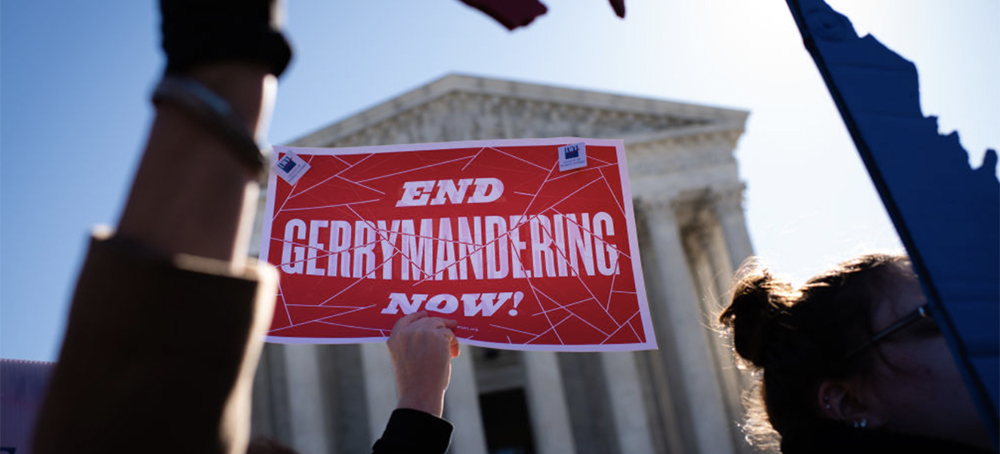 A sign calling for ending gerrymandering at a Fair Maps rally in Washington, DC, 2019. (photo: Sarah L. Voisin/WP/Getty Images)
What Redistricting Looks Like in Every State
Five Thirty Eight
An updating tracker of proposed congressional maps — and whether they might benefit Democrats or Republicans in the 2022 midterms and beyond.
A few other states also appear to be close to finalizing their congressional maps. Colorado’s new independent commission has settled on a map to submit to the state Supreme Court; the map would add a competitive, slightly GOP-leaning district with the seat Colorado gained in reapportionment. And the Arkansas legislature just approved a map to send to the governor. (Both plans, though, still require final sign-off before they become official.) In addition, a map that would essentially lock in 24 Republican seats and 13 Democratic seats — leaving just one competitive district — has passed the state Senate in Texas. Though the map is heavily biased toward Republicans and Democrats have complained it does not create enough majority-minority districts, some version of it is likely to soon become law in the Lone Star State.
On the flip side, the Iowa state Senate voted to reject the first proposed map drawn by the state’s nonpartisan Legislative Services Agency, sending it back to the drawing board. Iowa is one of a handful of states that have nonpartisan advisory redistricting commissions but where the ultimate redistricting authority still lies with politicians. Indeed, one of the biggest questions of this redistricting cycle is whether those politicians will ignore their commissions and draw their own maps. Similar advisory commissions in Maryland and New York have released proposed maps as well, but they are also expected to get the thumbs down.