
What Is May Day Strong, the ‘No Work, No School, No Shopping’ Protests Against Trump?
Kim Kelly Guardian UK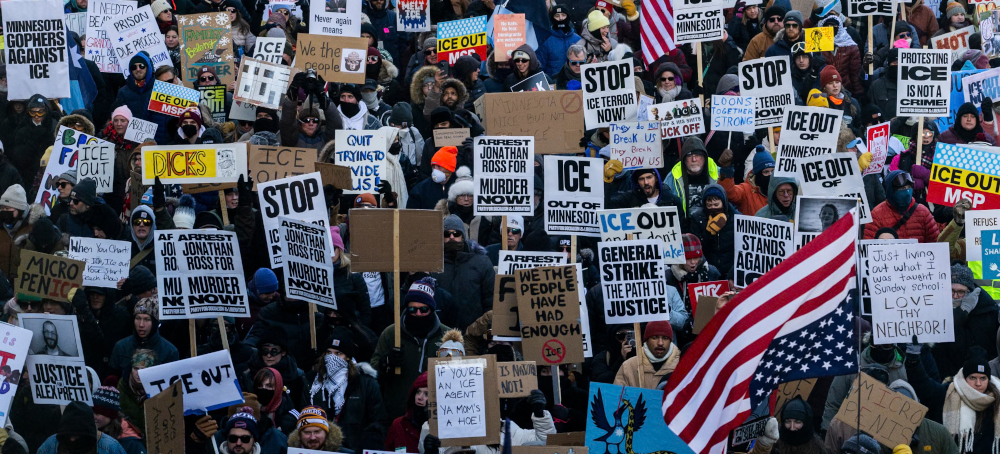 Protestors march during a nationwide shutdown demonstration against ICE in Minneapolis in January. (photo: Getty)
 What Is May Day Strong, the ‘No Work, No School, No Shopping’ Protests Against Trump?
Kim Kelly Guardian UK
Day of action to support workers set for 1 May – who is organizing May Day Strong, and how can people join?
The single-day protest on 1 May is taking its cue from the massive day of action that shut down Minneapolis in January by asking Americans not to shop, work or go to school. Rallies, marches and teach-ins will also take place across the country.
“The labor movement in our country cannot advance while ignoring the assault on democracy,” said Neidi Dominguez, founding executive director of Organized Power in Numbers and executive team member of May Day Strong.
“And the pro-democracy movement can’t ask working people to defend abstract principles while they can’t afford housing, paying bills or accessing healthcare. We need a national movement that does both. That’s why labor and community organizations are throwing down hard this May 1.”
What is May Day Strong?
Organizers are expecting more than 3,500 actions across the country – from street protests to walkouts – “under the banner of workers over billionaires, taxing the rich, demanding ICE out, money for people not wars, and expanding democracy”, said Dominguez.
Since 2024, the May Day Strong coalition has been hosting Solidarity School organizing trainings, sharing toolkits and encouraging people to set up their own May Day events. The labor unions involved are already using their institutional muscle to help, too: the Chicago Teachers Union (CTU) successfully fought to have 1 May declared a “day of civic action” in the city, and the National Education Association (NEA) has posted a handy May Day planning guide on its website.
The goal is “a nationwide day of economic disruption”, organizers said – by bringing business as usual to a halt, protesters will show how powerful the working class can be when it flexes its collective muscle.
Who is organizing May Day Strong?
The May Day Strong coalition is made up of a formidable list of unions, Democratic Socialists of America chapters, pro-democracy groups such as Indivisible (who have jumped on board to amplify the May Day message), and labor, racial justice, anti-war, pro-democracy, climate justice, immigrant rights and reproductive justice organizations.
That intersectional approach is a core aspect of their work, Dominguez said: “There’s more of us than there are of them. We just have to organize ourselves together.”
Where can I find May Day Strong events in my area?
May Day Strong’s website has a searchable map to help people find May Day actions and sign up to host their own. Signing the May Day pledge is another way to get connected and receive more information about events.
Is it a general strike (and does that matter)?
No – at least not in 2026. “A general strike is basically a work stoppage that paralyzes multiple major industries,” said Eric Blanc, an assistant professor of labor studies at Rutgers University.
That’s not what May Day Strong is planning for this year. As many organizers have noted, it will take years to organize a full-on, sustained general strike in the US – which is why 2028 has emerged as a target date.
Rather, May Day Strong organizers are amplifying the call for “no work, no school, no shopping” that anchored Minnesota’s Day of Truth and Freedom on 23 January, bringing millions of protesters out to demand an end to ICE’s occupation in their cities.
General strikes are rare in the US, though historically they have been one of organized labor’s most powerful tools. In 1877, railroad workers launched a strike that paralyzed the nation; in 1919, workers in Seattle shut down the city for five days. Minneapolis saw its own general strike in 1934, when unionized truck drivers brought the city to a standstill and lit a signal fire for other workers across the midwest to organize.
However, the passage of the 1946 Taft-Hartley Act essentially outlawed the general strike and severely limited workers’ ability to strike in solidarity with one another. The US hasn’t seen a true general strike since.
The tactic remains a potent lever for political change in other countries, such as India and Italy. “Experience across the world suggests that it may take such an action – or at least the credible threat of one – to reverse authoritarianism in the US,” said Blanc.
What is the May Day 2028 general strike?
That inconvenient piece of anti-labor legislation is exactly why the United Auto Workers’ call for a May Day general strike in 2028 has generated so much excitement. The union and its lawyers are well aware of those legal constraints, which is why they had to find a loophole.
In April 2024, Shawn Fain, president of the UAW, publicly called on all unions, across industries and sectors, to align their contract expiration dates for 1 May 2028. If those unions’ contracts expire, so do the no-strike clauses that many contain; with no contract, there’s nothing stopping members from going on strike. If it just so happens that thousands – or millions – of workers find themselves in that situation on the same day, well, there’s not much the law can do to stop it.
Several major unions, including the CTU, the NEA, the American Federation of Teachers and the American Postal Workers Union, have already pledged to join them. The May Day Strong coalition is also working to support the 2028 general strike by giving non-union organizations a way to get their members ready to participate.
“The fact is: without workers, the world stops running,” Fain wrote in an op-ed for In These Times. “A successful general strike is going to take time, mass coordination, and a whole lot of work by the labor movement. As working people, we must come together. We can no longer allow corporations, politicians and borders to divide us.”
What is the history behind May Day?
May Day, or International Workers’ Day, was first celebrated in the US in 1886, when anarchist labor organizers Lucy and Albert Parsons led 300,000 striking workers in Chicago on the first American May Day parade. While the first of May has a much older history rooted in ancient pagan rites and the changing seasons, in a political context it has since become known as a global day of celebration, struggle and remembrance for the working class.
May Day is an official holiday in 66 countries and is celebrated informally in many others, marked by marches, parades, strikes and demonstrations. However, in the US, 1 May is designated “Loyalty Day”; the workers’ holiday, Labor Day, has been relegated to the first Monday in September. And, yes, the lack of recognition for May Day is very much intentional. This has been a source of frustration for labor’s left flank for decades, and the recently renewed focus on 1 May as a day of collective action nods to labor’s history as well as its future.
As Fain said: “It’s time we reclaimed May Day for the working class.”