
What Happens When Disaster Recovery Becomes a Luxury Good
Rebecca Egan McCarthy Grist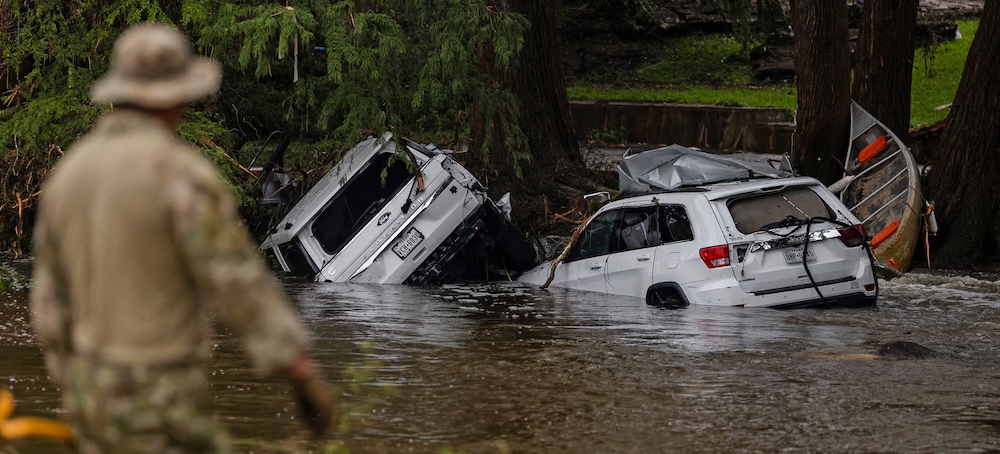 The aftermath of a flood in Texas. (photo: Jim Vondruska/Getty Images)
 What Happens When Disaster Recovery Becomes a Luxury Good
Rebecca Egan McCarthy Grist
As federal services deteriorate, a patchwork of private companies is taking their place — for better or for worse.
If your house is destroyed in a fire or flood, the basic logistics of righting your upturned life understandably consume your full attention, even if you’re a movie star. Under this level of stress, navigating the Federal Emergency Management Agency’s byzantine requirements for recovery assistance quickly becomes “a full-time job,” according to Bright Harbor’s chief growth officer, Emily Bush. “We help you understand what your options are and what’s the cost associated with each option that you take.”
Do you stay and rebuild? Does it make more sense to just move? Bright Harbor helps clients freeze their mortgage payments, apply for FEMA aid, navigate seemingly endless paperwork, and secure low-interest small business loans. Bush acknowledged that the company’s luxury services, which can significantly ease the financial burden of disasters, do not come at a cost that all victims can afford to front. (Services started at $300 per month for individuals when the company launched in 2024, but Bright Harbor now sells directly to companies — who purchase coverage for their employees.)
“To be clear,” she said, “I think the government should pay for this.”
It technically does. FEMA money is funneled to disaster relief nonprofits that then hire case managers to guide victims through the recovery process. But even before President Donald Trump took office with an eye toward diminishing the agency, recovery funds couldn’t keep up with victims’ needs. Now, as the administration slashes FEMA funding, withholds aid, and puts more of the onus of recovery onto individual states, victim-assistance organizations feel that they’ve been left totally unprepared, with too few case managers to go around. All of these issues are likely to grow more severe in the coming year, as a review board appointed to reform the agency prepares to make its recommendations.
That a service like Bright Harbor found a strong foothold in the U.S. is not surprising. The private sector’s creeping influence over disaster recovery has been noted since at least 2007, when Naomi Klein published The Shock Doctrine, the book that injected the term “disaster capitalism” into a broader lexicon. But as climate change accelerates and hammers the United States with more billion-dollar catastrophes than ever before, privatization has become more common — and complicated. Private interests can quickly mobilize huge volunteer networks, giving campaigns, and rebuilding efforts in the wake of extreme weather. But, whatever their intentions, such measures are a consequence — and sometimes a cause — of the corrosion of public institutions originally intended to safeguard Americans.
For Klein, Hurricane Katrina was a turning point for disaster capitalism. The Heritage Foundation, the conservative think tank that would go on to draft Trump’s Project 2025 policies, held a meeting on disaster relief in New Orleans just two weeks after the storm in 2005. The group recommended suspending wage laws for recovery contractors, replacing public schools with privately managed charter schools, and halting environmental regulations to reestablish oil and gas production that had been stalled by the storm.
The vision they set forth would shape disaster recovery for decades. In New Orleans, public housing was demolished, the public hospital was shuttered, and the federal government rapidly took over the public school system and set about turning it over to a charter network funded largely through private philanthropy. Over 7,000 teachers and staff members were fired, forcing veteran educators to reapply for their jobs, competing against a flood of Teach for America recruits who were largely whiter, less experienced, and from outside the city.
LUMA took control with a vow to decentralize the grid and incorporate more renewable energy, keeping generation in line with Puerto Rico’s 2019 Energy Policy Act, which set a goal of 40 percent renewables by 2025. But as of late 2024, fossil fuels still generated 93 percent of the archipelago’s energy. LUMA has argued that it inherited a crumbling grid and a power supply that’s insufficient to meet customer demand. The territory’s power plants are managed by Genera Energy, a subsidiary of the troubled New Fortress Energy, a natural gas company that critics say has kept the territory dependent on fossil fuels at the expense of reliability. According to PREPA’s most recent fiscal plan, performance has grown steadily worse over the past few years, with customers seeing approximately 15 percent more service interruptions and 21 percent longer outages in December 2024 compared to March 2023.
As in New Orleans, Puerto Rico was vulnerable to these tactics because of years of disinvestment. In June 2016, former president Barack Obama signed into law the Puerto Rico Oversight and Management Economic Stability Act, or PROMESA, which would essentially lead the territory through a court-supervised bankruptcy process. Eight years later, Puerto Rico is still primarily controlled by the unelected financial oversight board established by PROMESA. The board handed many assets over to private interests after the hurricane. Charter schools, previously shut out of Puerto Rico, began to make inroads; the water system was nearly privatized; and toll roads were sold off to multinational corporations like Goldman Sachs.
“There’s a debt crisis, so there’s no public funds to fix anything,” said Marisol Lebron, an associate professor at the University of California, Santa Cruz, and the author of Aftershocks of Disaster: Puerto Rico Before and After the Storm. “Puerto Ricans are left holding the bag in a lot of ways, for both the failures of the state, but also the failures of these private entities that are claiming to be able to do the job better and cheaper than the government.”
But even privatization has its limits. While major cities and territories are lucrative targets for private interests, disasters often devastate remote regions, where asset values are low and labor is hard to come by. “For small towns, the private sector is not going to step in if it’s not a money-making business,” said Divya Chandrasekhar, a professor of city and metropolitan planning at the University of Utah, adding that depopulating areas in particular struggle to attract private investment. In remote parts of California, for instance, an alarming firefighting staffing crisis has left many small towns without adequate protection. Offers of private firefighting services — hired by insurance companies to protect their assets, or the very wealthy to protect their property — have risen accordingly. Critics, including city and state firefighters, have called for the regulation of these private services, arguing that they can hamper rescue efforts and pull badly needed water from public hydrants. During the Los Angeles fires in January, billionaire Rick Caruso hired a private company to protect the Palisades Village mall, which he owns, while nearby homes burned.
While climate change is poised to exacerbate familiar inequities like these, experts point to the opacity of privatized public services as a cause for growing concern. As more companies begin to incorporate artificial intelligence into their daily operations, it’s important for municipalities to look very carefully at the restrictions being placed on contractors and public-private partnerships.
“You can imagine a situation where a community has been impacted by a natural disaster. We’re going to give temporary housing to people, but this AI system is going to make the determination whether they qualify for this or not. I mean, that could be really problematic,” said Shahrzad Habibi, the research and policy director at In the Public Interest, a nonprofit that studies public goods and services. “I just think there’s an interesting philosophical underpinning on all of this. What are public goods? What do we, as a society, think everybody should be entitled to? And when do we, as a society, think you’re on your own?”
LUMA took control with a vow to decentralize the grid and incorporate more renewable energy, keeping generation in line with Puerto Rico’s 2019 Energy Policy Act, which set a goal of 40 percent renewables by 2025. But as of late 2024, fossil fuels still generated 93 percent of the archipelago’s energy. LUMA has argued that it inherited a crumbling grid and a power supply that’s insufficient to meet customer demand. The territory’s power plants are managed by Genera Energy, a subsidiary of the troubled New Fortress Energy, a natural gas company that critics say has kept the territory dependent on fossil fuels at the expense of reliability. According to PREPA’s most recent fiscal plan, performance has grown steadily worse over the past few years, with customers seeing approximately 15 percent more service interruptions and 21 percent longer outages in December 2024 compared to March 2023.
As in New Orleans, Puerto Rico was vulnerable to these tactics because of years of disinvestment. In June 2016, former president Barack Obama signed into law the Puerto Rico Oversight and Management Economic Stability Act, or PROMESA, which would essentially lead the territory through a court-supervised bankruptcy process. Eight years later, Puerto Rico is still primarily controlled by the unelected financial oversight board established by PROMESA. The board handed many assets over to private interests after the hurricane. Charter schools, previously shut out of Puerto Rico, began to make inroads; the water system was nearly privatized; and toll roads were sold off to multinational corporations like Goldman Sachs.
“There’s a debt crisis, so there’s no public funds to fix anything,” said Marisol Lebron, an associate professor at the University of California, Santa Cruz, and the author of Aftershocks of Disaster: Puerto Rico Before and After the Storm. “Puerto Ricans are left holding the bag in a lot of ways, for both the failures of the state, but also the failures of these private entities that are claiming to be able to do the job better and cheaper than the government.”
But even privatization has its limits. While major cities and territories are lucrative targets for private interests, disasters often devastate remote regions, where asset values are low and labor is hard to come by. “For small towns, the private sector is not going to step in if it’s not a money-making business,” said Divya Chandrasekhar, a professor of city and metropolitan planning at the University of Utah, adding that depopulating areas in particular struggle to attract private investment. In remote parts of California, for instance, an alarming firefighting staffing crisis has left many small towns without adequate protection. Offers of private firefighting services — hired by insurance companies to protect their assets, or the very wealthy to protect their property — have risen accordingly. Critics, including city and state firefighters, have called for the regulation of these private services, arguing that they can hamper rescue efforts and pull badly needed water from public hydrants. During the Los Angeles fires in January, billionaire Rick Caruso hired a private company to protect the Palisades Village mall, which he owns, while nearby homes burned.
While climate change is poised to exacerbate familiar inequities like these, experts point to the opacity of privatized public services as a cause for growing concern. As more companies begin to incorporate artificial intelligence into their daily operations, it’s important for municipalities to look very carefully at the restrictions being placed on contractors and public-private partnerships.
“You can imagine a situation where a community has been impacted by a natural disaster. We’re going to give temporary housing to people, but this AI system is going to make the determination whether they qualify for this or not. I mean, that could be really problematic,” said Shahrzad Habibi, the research and policy director at In the Public Interest, a nonprofit that studies public goods and services. “I just think there’s an interesting philosophical underpinning on all of this. What are public goods? What do we, as a society, think everybody should be entitled to? And when do we, as a society, think you’re on your own?”
LUMA took control with a vow to decentralize the grid and incorporate more renewable energy, keeping generation in line with Puerto Rico’s 2019 Energy Policy Act, which set a goal of 40 percent renewables by 2025. But as of late 2024, fossil fuels still generated 93 percent of the archipelago’s energy. LUMA has argued that it inherited a crumbling grid and a power supply that’s insufficient to meet customer demand. The territory’s power plants are managed by Genera Energy, a subsidiary of the troubled New Fortress Energy, a natural gas company that critics say has kept the territory dependent on fossil fuels at the expense of reliability. According to PREPA’s most recent fiscal plan, performance has grown steadily worse over the past few years, with customers seeing approximately 15 percent more service interruptions and 21 percent longer outages in December 2024 compared to March 2023.
As in New Orleans, Puerto Rico was vulnerable to these tactics because of years of disinvestment. In June 2016, former president Barack Obama signed into law the Puerto Rico Oversight and Management Economic Stability Act, or PROMESA, which would essentially lead the territory through a court-supervised bankruptcy process. Eight years later, Puerto Rico is still primarily controlled by the unelected financial oversight board established by PROMESA. The board handed many assets over to private interests after the hurricane. Charter schools, previously shut out of Puerto Rico, began to make inroads; the water system was nearly privatized; and toll roads were sold off to multinational corporations like Goldman Sachs.
“There’s a debt crisis, so there’s no public funds to fix anything,” said Marisol Lebron, an associate professor at the University of California, Santa Cruz, and the author of Aftershocks of Disaster: Puerto Rico Before and After the Storm. “Puerto Ricans are left holding the bag in a lot of ways, for both the failures of the state, but also the failures of these private entities that are claiming to be able to do the job better and cheaper than the government.”
But even privatization has its limits. While major cities and territories are lucrative targets for private interests, disasters often devastate remote regions, where asset values are low and labor is hard to come by. “For small towns, the private sector is not going to step in if it’s not a money-making business,” said Divya Chandrasekhar, a professor of city and metropolitan planning at the University of Utah, adding that depopulating areas in particular struggle to attract private investment. In remote parts of California, for instance, an alarming firefighting staffing crisis has left many small towns without adequate protection. Offers of private firefighting services — hired by insurance companies to protect their assets, or the very wealthy to protect their property — have risen accordingly. Critics, including city and state firefighters, have called for the regulation of these private services, arguing that they can hamper rescue efforts and pull badly needed water from public hydrants. During the Los Angeles fires in January, billionaire Rick Caruso hired a private company to protect the Palisades Village mall, which he owns, while nearby homes burned.
While climate change is poised to exacerbate familiar inequities like these, experts point to the opacity of privatized public services as a cause for growing concern. As more companies begin to incorporate artificial intelligence into their daily operations, it’s important for municipalities to look very carefully at the restrictions being placed on contractors and public-private partnerships.
“You can imagine a situation where a community has been impacted by a natural disaster. We’re going to give temporary housing to people, but this AI system is going to make the determination whether they qualify for this or not. I mean, that could be really problematic,” said Shahrzad Habibi, the research and policy director at In the Public Interest, a nonprofit that studies public goods and services. “I just think there’s an interesting philosophical underpinning on all of this. What are public goods? What do we, as a society, think everybody should be entitled to? And when do we, as a society, think you’re on your own?”