
War and Peace: Those Words Are Forbidden in Russia Today
Elena Kostyuchenko Guardian UK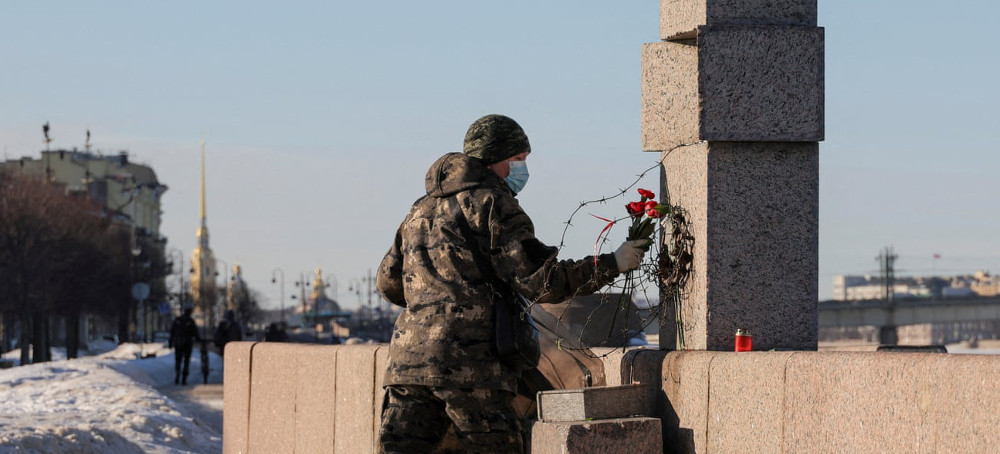 Flowers that have been laid in memory of Alexei Navalny being removed, St Petersburg, 19 February 2024. (photo: Reuters)
 War and Peace: Those Words Are Forbidden in Russia Today
Elena Kostyuchenko Guardian UK
My mother plaits camouflage nets for soldiers, and when we try to talk about what’s happening in Ukraine we end up shouting
I haven’t been to Russia in two years. I went on assignment to Ukraine in February 2022, but there was no returning: in the eyes of the Russian state my work became a crime, which put my life in danger. My Russia now is only dreams and voices.
The last time I saw my mother, it was just before the new year. She brought me a shawl – crimson, with asters and morning glory – and then she put on a song for my fiancee that went, “As long as there’s no gays and wars.” She doesn’t want to come and live with me in exile. “You might not be able to live in Russia any more,” she says, “but why should I have to give up my life? I want to live in my own homeland and to speak Russian.”
My mother keeps the TV on; she is afraid of silence. The TV is all about the Russian army’s victories in Ukraine, about the un-patriots who get in the way of these victories, about how the Ukrainian army is shelling its own cities, and about the west, where life keeps getting worse. She also watches WhatsApp videos: everybody in Russia is on WhatsApp. Mama sends me links to old Soviet songs. Prayers, horoscopes, interior design. There’s no war on WhatsApp.
In Russia, you speak about the war only with those closest to you, the ones you love the most. New laws forbid the dissemination of any information that contradicts the official line (this carries up to 15 years’ incarceration) and expressing negative feelings about the war (a fine for the first offence, then prison). Certain words are essentially forbidden: “war” (you should say “special military operation”, “occupation”, “aggression”, “peace”.
Informing is rife – people turn one another in after a fleeting conversation, or the wrong media channel is glimpsed on a phone screen, for wearing Ukrainian insignia, or posting on social media. But more than informing, people dread hearing something that makes further contact impossible. Some families are no longer on speaking terms; for others, topics of conversation have become off limits.
When Mama and I talk about the war, we are soon shouting. It’s easier with my sister. We both used to work for Novaya Gazeta, Russia’s foremost independent newspaper. Then Russia attacked Ukraine, Novaya had its licence revoked and I quit, but Sveta stayed and is still working as a journalist, without any accreditation or pay, still living in Moscow. Her reality seems like a fever dream to me. One time, she was simultaneously trying to find a bomb shelter (Ukrainian drones approaching Moscow) and an air conditioning unit (summer was expected to be hot). When the paper closed she trained as a nurse, saying, “Now I can always help, nobody will be able to stop me.” Three times a week she changes wound dressings for homeless people.
Many have turned to volunteering. Working for hospices, charities, hospitals and refugees – a collective outpouring of voluntary labour. You can also go to one of the monasteries, to plait camouflage nets and assemble trench candles. Everyone describes their motivation in the same words: “To keep from losing my mind.”
My mother says, “I was thinking of going to the monastery to make camouflage nets.” “You’re taking part in war,” I tell her. “Do you remember your teacher, Vera Grigorievna?” she says. “Her son was called up. I don’t want Valera to get killed.” Mama believes that nets knotted by careful fingers will hide them from death.
My friend Denis’s son was kidnapped. The boy went to pick up his passport and disappeared. The police had been waiting for him, and they spirited him away into the army. “What if we kidnap him back?” I say. “I’m scared of ending up behind bars,” Denis says. “I’ve got a daughter too to look after.”
My friend Vika and her wife are also parents to a son, but families like theirs have been outlawed by Russia’s supreme court for being part of what it called an extremist “international LGBT public movement”. This month the first convictions were handed out: a 1,000 rouble (£8.69) fine; five days in administrative detention for wearing rainbow-coloured earrings. The maximum sentence is 15 years in prison.
Vika’s son is six now. She tells me how hard it is to convince a child that you have to lie. They only believe you if you believe it yourself, with all your heart. “So I’ve made myself believe we have to,” she says. “And I forced my wife to believe, too. And now we believe that families like ours shouldn’t exist, and that’s why we must hide.” The authorities are constantly on the lookout for internal enemies – the ones you can blame, on TV, for messing up the victory. It’s very hard to explain to a six-year-old what fascism is, Vika says. What repression is. What prisons and orphanages are.
I tell Mama all this. Remember Vika? A few days later she calls me and says: “I don’t understand what this war is for.” I say nothing. Mama says: “On TV, they’re always saying ‘victory, we need victory’, but what is victory? Even if we conquer Ukraine, all we’ll get is a country in ruins and a people who hate us. Ukrainians know how to hate, we’ve taught them.” I say nothing. Mama says: “Fine. What am I to do about it, then?” And I say: “Mama, that’s a really good question.”
The next day, in a maximum security prison beyond the Arctic Circle, they murder Alexei Navalny – political prisoner, patriot, anti-corruption activist and, in the hopes of many, the future president of a liberated Russia. The jailers declare that Navalny just dropped dead – “sudden death syndrome” they say, while the TV adds helpfully that it was a blood clot. They’re hiding his body, refusing to release it to his family.
Across the country, people bring flowers to the memorials for political prisoners – it was possible to put up such memorials once upon a time. Police and caretakers clear the flowers away immediately, moving people on, taking their photos, sometimes detaining them. Four hundred mourners are detained in the first 24 hours, 46 in St Petersburg alone; some are incarcerated. Some of the memorials are cordoned off. They’re telling people there are mines; they’re cutting off every approach. And so people lay their flowers in the snow. They leave notes for one another: “Don’t be afraid.” People keep coming, day after day. Flowers briefly blot out the snow.