
Unmasking the Paramilitary Agents Behind Trump’s Violent Immigration Crackdown
Ali Winston and Maddy Varner WIRED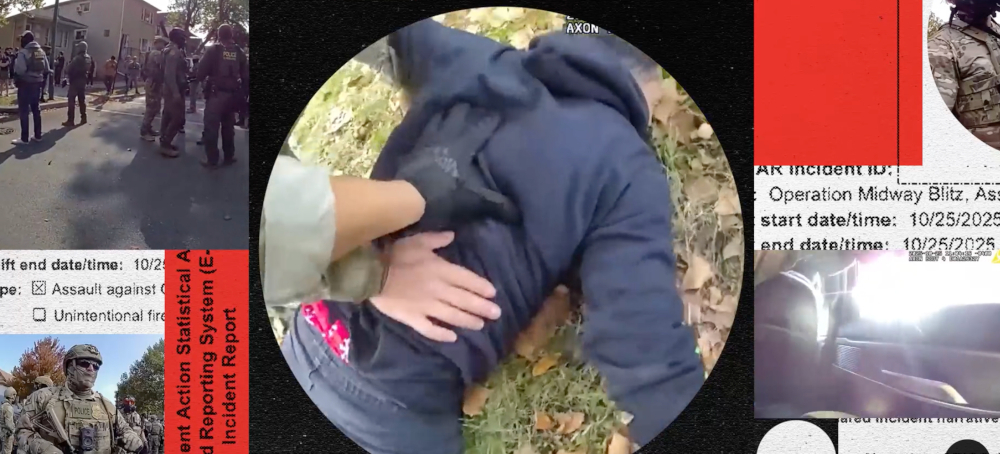 An analysis of DHS records identified dozens of specialized federal agents who used force against US civilians during the largest known deployment of its kind in US history. (photo: DHS)
 Unmasking the Paramilitary Agents Behind Trump’s Violent Immigration Crackdown
Ali Winston and Maddy Varner WIREDALSO SEE: Two-Thirds of People Arrested by ICE in Minnesota Surge Had No Criminal Records, New Data Reveals
A WIRED analysis of DHS records identified dozens of specialized federal agents who used force against US civilians during the largest known deployment of its kind in US history.
A group of burly, masked agents wearing helmets and bulletproof vests, and toting suppressor-equipped M4 rifles, moved through the hallways in a rapid, tightly organized file. Padraic Daniel Berlin, a 34-year-old Michigan native and son of a Detroit firefighter, held Yoda, his Belgian Malinois, on a leash. David Dubar Jr., a 53-year-old onetime construction worker, followed closely behind him. Their team leader, Corey Myers, a Marine veteran from the Border Patrol’s Tucson sector, checked apartment doors. Paul Delgado Jr., a standout cross-country runner in high school, was the final member of the entry team.
The four men are members of the Border Patrol Tactical Unit, or BORTAC. Based mainly out of Fort Bliss, with at least 11 detachments stationed around the United States, BORTAC and its sister unit, Border Patrol Search, Trauma and Rescue, or BORSTAR, were once reserved for desert rescues, executing high-risk warrants, conflicts with armed drug cartels, and manhunts.
Under Donald Trump, however, they have been sent into the streets of major US cities. The result is the largest known deployment of BORTAC and BORSTAR agents in US history, a fact made difficult to pin down due to the government's secrecy around their operations. Many of the agents’ identities have remained hidden from the public. The decision to use offensive, heavily armed paramilitary units for street-level immigration sweeps in American cities is a first—a bellwether of the Trump administration’s project to militarize domestic law enforcement operations.
Myers, Berlin, Dubar, Delgado, and their teammates seemed keyed up. The intelligence briefing they received claimed the building was controlled by Tren de Aragua, a Venezuelan street gang the Trump administration categorized—despite contrary evidence amassed by its own intelligence services—as a foreign terrorist organization. Gang members were supposedly occupying the building and storing grenades, handguns, and rifles on the second floor, where a suspect with an open warrant for firearms possession lived. This intelligence was never released or substantiated, and Illinois later launched an investigation into whether the property owner had sent baseless claims to the feds. But at that moment, it didn’t matter.
At every door approached by his team, Berlin yelled, “Police! Speak to me now or I’ll send the dog!” In a second-floor unit, the BORTAC team detained one man. Further down the hall, Myers noticed “signs of forced entry” and smashed open the door. Tolulope Akinsulie, an undocumented immigrant from Nigeria, happened to be hiding in the bedroom. Without issuing a warning or verbal command, Berlin let go of Yoda’s leash and the Malinois pounced, sinking its teeth into Akinsulie’s leg as he screamed in agony. Yoda bit Akinsulie repeatedly in the leg, hip, and hands before Berlin called the dog off and his team placed the man in cuffs. Akinsulie, who was not a target of the raid and has no known history of violent crime or gang affiliation, was treated for his injuries and taken to the Broadview Processing Center to face removal proceedings.
Berlin’s actions that morning were not isolated. He was involved in at least five uses of force during Operation Midway Blitz, the Trump administration’s 2025 surge of hundreds of immigration agents into Chicago and surrounding communities. Nor were the actions of his team, according to a WIRED analysis of US government records, which appeared to escalate tensions with civilian onlookers rather than quell them. Since last year, BORTAC and BORSTAR have fronted several of the US government’s invasions of its own cities, often engaging in almost theatrical uses of force that litter newscasts and social feeds, adding a new salience to US Border Patrol Special Operations Group’s self-proclaimed status as the “tip of the spear.”
THE AGENTS SENT to Chicago—and Los Angeles, North Carolina, Boston, Minneapolis, New Orleans, and Sacramento—come from a secretive, tightly knit world. Their names, many of which are available in a narrow set of court records and reported here for the first time, are typically excluded from official documents and shielded from public records requests. In the streets of American cities, they are usually masked, identified only by “call signs” that are sometimes visible on their uniforms and mean nothing to people demanding badge numbers.
One BORTAC agent is married to a TV news anchor who reports on the Border Patrol. Another, who also engaged in a gun battle with a school shooter in Uvalde, Texas, in 2022, has posted frequently in an online gun forum with thread titles like “Whipping Haitians.” Many are military veterans, some of whom saw combat during the Forever Wars. Several have histories of domestic violence or sexual assault. Others are former cops who joined the Border Patrol after questionable uses of force. BORTAC and BORSTAR agents are not police—they are paramilitaries who operate by a different standard and with different rules of engagement, trained and suited not for law enforcement but for war.
A WIRED review of over 78 incident reports from Operation Midway Blitz found that BORTAC and BORSTAR agents were, as a group, the most violent of the hundreds of federal agents deployed to Chicago. In these documents, CBP employees recorded over 144 discrete uses of force by CBP personnel from September through early November. Sixty-two BORTAC and BORSTAR personnel were involved in these incidents over an eight-week period. Of that group, 25 were involved in two or more incidents, and 16 more used force at least once during this period. Of the 234 federal law enforcement personnel WIRED identified in these reports, BORTAC and BORSTAR agents represent almost a quarter of all personnel involved in documented confrontations with civilians during Operation Midway Blitz
Hennepin County attorney Mary Moriarty is actively investigating 17 separate incidents involving federal agents for potential criminal conduct. At least two of those incidents—the January 21 gassing of a crowd in South Minneapolis and a chaotic enforcement action outside Roosevelt High School—involve BORTAC personnel, per videos and photographs taken on scene.
The Department of Homeland Security has kept data and documents about the federal immigration deployments closely guarded, disclosing records only in response to litigation. US senator Thom Tillis of North Carolina has been wrestling with DHS over data regarding last fall’s Operation Charlotte’s Web in his state. Tillis requested records on stops, detentions, questioning, searches, releases, uses of force, and property damage incidents, as well as the total number of detentions and a tally of all encounters with American citizens.
During Operation Midway Blitz, incidents beyond the South Shore Apartment raids included the gassing of an affluent Northside Chicago neighborhood right before a children’s Halloween parade, a chaotic car chase on the city’s South Side, and clashes with protesters outside the Broadview immigration detention facility.
BORTAC’s and BORSTAR’s uses of force in Chicago included punching and kicking protesters, throwing tear gas, macing civilians, firing pepperballs and 40-mm foam rounds into crowds, shocking people with tasers, unleashing dogs on deportation targets, and shooting unarmed civilians, killing at least one of them. This violence tracks with a loosening of the Border Patrol’s use-of-force guidelines following Gregory Bovino’s directives, as reported by the American Prospect.
“I think if we push this whole fucking block back, that ought to teach ’em a lesson,” says Bovino on an agent's body camera recording from September 27, during clashes with demonstrators at Chicago’s Broadview detention facility. “And if it doesn't, we arrest.” Bovino, the now-retired face of Trump’s immigration surges throughout 2025 and early 2026, is a longtime BORTAC member who led dozens of these agents on incursions into Southern California, Chicago, and Minneapolis, putting them front and center at some of the most high-profile clashes between immigration enforcement and the public during the past nine months.
Other body camera footage from nearly a month later captured one BORTAC agent, Edgar Vazquez, telling his colleagues that he planned to refuse Bovino’s directives. “The chief wanted us to throw gas, and I was like, we can’t!” said Vazquez. “Nah, I’m not gonna fucking do it—I’m gonna stay within policy.”
“It’s clear the administration likes the optics of BORTAC—the long guns, the camouflage, the body armor. They certainly did for Trump’s first go-round,” says John Sandweg, who was director of ICE from 2013 to 2014. However, he says, the unit is not generally familiar with urban policing, and its record in Chicago demonstrates the poor fit of borderland tactics for densely packed cities. “It’s malpractice to have paramilitary teams try to impose order by force,” he says.
In a response to WIRED’s requests for comment, CBP cited the threat of “doxing” and refused to confirm employment of the Border Patrol agents identified in the government’s own records. CBP personnel are “trained to use the minimum amount of force necessary to resolve dangerous situations to prioritize the safety of the public and themselves,” a spokesperson wrote in a statement.
CBP also declined to comment on whether any of the use-of-force incidents from Operation Midway Blitz are the subject of internal investigations, stating that the agency’s Office of Professional Responsibility handles all such probes before submitting them to CBP’s Use of Force Review Boards.
The documents, body camera footage, and other material WIRED used to identify more than 60 BORTAC and BORSTAR operators were pried loose during litigation against DHS over alleged First Amendment violations, unconstitutional arrests, and grievous uses of force during Operation Midway Blitz, including the killing of Silverio Villegas González and nonfatal shooting of Marimar Martinez by ICE and Border Patrol agents, respectively.
No BORTAC or BORSTAR agent named in this story responded to WIRED’s request for comment.
In Illinois, civil rights attorneys and civic organizations are pressuring the Cook County state’s attorney to appoint a special prosecutor to investigate and potentially prosecute ICE, CBP, and Border Patrol agents for uses of force and wrongful arrests during Operation Midway Blitz.
To date, no Border Patrol, CBP, or ICE agent has faced criminal charges for their conduct during the operation in Chicago.
THE FULL FORCE of the paramilitary surge into American cities was on open display the morning of October 25, 2025, when a convoy of BORTAC and other Border Patrol agents swept through the tranquil North Side Chicago neighborhood of Irving Park, trailed by whistle-blowing “ICE watchers” in cars and on bicycles.
Shortly before 10 am, a gray Suburban with BORTAC agents Andy Chavez and Tee Rico riding in the back seat cruised through Irving Park’s tree-lined streets. A black Wagoneer filled with Border Patrol agents followed closely behind, carrying BORTAC agent Javier Puente, an Army veteran, in the rear seat. All the agents wore masks and camouflage tactical gear, with pistols at their hips and M4-pattern rifles near at hand. Puente’s body camera video shows him gripping a 40-mm grenade launcher intended to fire pepper-spray-loaded “less lethal” rounds.
On the sidewalks around them, Irving Park residents gathered for the community’s Halloween parade. Before the hour was up, chaos would erupt in the residential neighborhood.
Chavez and Rico spotted a Latino man running from their convoy, leaped out of their vehicle, and tackled the man on the front lawn of a white townhouse. The home’s owner, Brian Kolp, an attorney and onetime Cook County state’s attorney who used to represent Chicago police officers in civil litigation, stormed out of his house, barefoot, screaming at the feds to get off his property and take their masks off.
“This has nothing to do with enforcing the law, and everything to do with intimidating citizens with military tactics,” Kolp tells WIRED of the incident.
Other residents and members of ICE-watch groups joined in, blowing whistles, cursing out the agents, and recording the incident on their phones. As the Border Patrol convoy attempted to leave the scene, enraged onlookers—at least one still wearing a bathrobe—moved to block their path.
As the crowd grew more hostile, agents ramped up their uses of force. Michael Brosilow—a photographer, Irving Park resident, and decorated long-distance runner—pulled into his neighborhood after returning from a training session. Rico and Chavez confronted the 68-year-old man, who yelled, “Fuck you!” as he stepped out of his silver Toyota. Rico then tackled Brosilow, planted his knee in his back, and handcuffed him. “This is my block!” Brosilow screamed. Six of Brosilow’s ribs were broken in the encounter, and he suffered internal bleeding.
Chavez pulled the pin on a can of tear gas and tossed it into the street as bystanders screamed. Puerte, meanwhile, spotted 25-year-old ICE watcher Maria Bryan allegedly hit Rico in the head and slammed her and her bicycle to the ground, fracturing seven of her ribs.
The agents eventually loaded into the vehicle, drove off, and radioed in that they had arrested two US citizens for “impeding” and “assault.” (Neither Brosilow nor Bryan were charged.)
As the agents moved out of Irving Park, the horns of trailing cars and whistles from ICE watchers were clearly audible. When the SUV stopped at a red light, two men on the sidewalk stepped up to remonstrate with the feds.
Puente photographed one with his iPhone, then rolled down his window and pointed his grenade launcher at a second man.
“Get the fuck out of the way!” he yelled, aiming his muzzle at the civilian as the vehicle pulled away. “Fuck you!”
Created in 1984 to deal with riots in immigration detention camps, BORTAC has been sent to South America for narcotics interdiction missions alongside the Drug Enforcement Administration; conducted missions in Iraq, Afghanistan, and Jordan; and, in the recent past, raided desert aid stations. While BORTAC is designed for close combat, BORSTAR, which was created in 1998 in response to a rise in migrant deaths on the southern border, specializes in open-country operations. Members of both teams undergo Survival, Evasion, Resistance, and Escape training, are taught complex military surveillance and countersurveillance tactics, and tend to be recruited from specialized military units like the Army Rangers.
“They go in real hot—in my opinion, too hot and too unruly,” says a former Special Forces member, speaking on condition of anonymity. This veteran says that in his experience, BORTAC members tend to be “ego-driven hotheads” who are highly trained but have little or no operational war-fighting experience. “Even then, they’re definitely not the people I’d want in any sort of civilian law enforcement context.”
Beginning in February 2020, the first Trump administration sent BORTAC into Democrat-run “sanctuary cities” for civil immigration enforcement, a surge that was short-circuited by the Covid-19 pandemic. Later that summer, BORTAC agents were documented snatching protesters off the streets of Portland, Oregon, during the George Floyd protests.
Since the start of the second Trump administration, BORTAC and BORSTAR agents have participated in immigration blitzes in California, North Carolina, Minnesota, and Vermont. Since October, the Border Patrol’s paramilitary units, led by Timothy P. Sullivan, the head of the Fort Bliss–based Border Patrol’s Special Operations Group, have also commanded the federal presence at an ICE facility in Portland, Oregon, that has been a constant target of protests, often resulting in violent clashes. More recently, in mid-March, agents from one of the Border Patrol’s local Special Operations detachments used crowd control munitions on protesters in South Burlington, Vermont, during a chaotic immigration arrest.
Peter Kraska, a professor at Eastern Kentucky University’s School of Justice Studies who has studied police militarization and paramilitary units for decades, says that BORTAC’s presence in Chicago was a textbook case of authoritarian overreach. “Why are they enforcing civil immigration violations with paramilitary teams?” Kraska says. “Armored personnel carriers, hostage rescue tactics, Special Forces–grade weapons, SEAL-style tactics—why do you need all that for civil violations?”
A WEEK AND a half before the Irving Park incident, another event between Border Patrol agents and a Latino couple shows how quickly Border Patrol agents escalated to tear-gassing dozens of civilians and Chicago police officers.
On October 14, Border Patrol agents were involved in a car chase and a collision with a Latino couple. One of the agents involved in the crash, Carlos Chavira Jr., radioed for help, and several BORTAC agents drove to the scene.
One of the SUVs that arrived was driven by John Bockstanz, a Michigan resident and former Marine who runs a company that sells pre-workout supplements on the side—“Conquer each day with unparalleled potency,” promises the “Alpha Testosterone Booster.” With him was agent John Leslie from BORTAC’s Detroit detachment.
The other agents who answered Chavira’s call for help were Derek Volmering, a 39-year-old Michigan native, BORTAC supervisor, and onetime Buffalo Bills linebacker prospect; Paul Beaulieu, a New England native assigned to the Border Patrol’s rough-country search and rescue team; Edgar Vazquez, a 39-year-old firearms instructor from BORTAC who joined the Border Patrol in 2007; Padraic Daniel Berlin, who sicced his dog on a Nigerian immigrant during the South Side apartment raid two weeks earlier; David Dubar Jr., the BORTAC Michigan agent who’d also been on the South Side Apartments entry team, and supervisory agent Warren Becker from the Del Rio BORTAC detachment, who exchanged gunfire with the Uvalde school shooter in 2022 after the gunman executed 19 children.
The crew met a furious and growing civilian crowd. Television news crews arrived on the sidewalks. A CBP helicopter circled overhead. “It’s gonna be a nightmare getting out of here,” Volmering grumbled.
“Yeah, we’re probably going to get stuff thrown at us,” Bockstanz replied.
They immediately began positioning themselves around the scene. Two combat veterans, who reviewed incident body-camera footage for WIRED, said the agents moved in the same way that active-duty troops would to protect and extract a disabled vehicle from a hostile crowd in a war zone.
Tensions between the agents and the crowd escalated as someone threw an egg into the mass of feds, and agents tackled one of the onlookers to the ground in response. By then, Border Patrol agents had already donned gas masks and retrieved gas canisters from their vehicles in preparation for their exit.
Bockstanz heard an object strike one of the CBP vehicles and walked over to Volmering, who was speaking to a group of Chicago police commanders. “Hey, they’re starting to throw rocks,” Bockstanz said, his voice muffled by his gas mask. “I’m gonna have to deploy gas,” he told CPD deputy chief Dan O’Connor, who appeared to object. “We gotta worry about ourselves.”
“Well, give us a minute to talk to ’em and let’s go get you guys out of here,” O’Connor replied.
Bockstanz and Volmering ignored him. As projectiles sailed overhead and struck their cars, Bockstanz took a step forward, pulled the pin on a can of tear gas, and skipped it along the pavement towards the crowd without a warning, right through a line of unmasked Chicago cops.
Bockstanz waved to a Border Patrol SUV to leave and tossed another can of gas as the first one was thrown back, yelling, “Get the fuck out of here” at his colleagues. At the skirmish line, Dubar tossed his canisters into the crowd. Demonstrators began throwing and kicking gas canisters back toward the feds, prompting Vazquez, who had previously been involved in clashes with the public in Southern California and would later use less-lethal weapons on civilians in Minneapolis, to fire a round of tear gas at the fleeing crowd before the agents sped away.
More than a dozen cops and an unknown number of residents were sickened by the tear gas, with three American citizens arrested for “assaulting” federal agents, in addition to the two “deportable” people detained. No criminal charges were filed.
THE OPERATION TAPERED down by mid-November amid a national backlash and a series of adverse legal rulings that restricted the feds’ ability to use less-lethal and crowd-control munitions on civilians. While a key court decision was later overturned, the judge said in her opinion that Border Patrol, ICE, and CBP used force without clear warnings, failed to wear marking insignia, and failed to justify uses of force.
At least 3,800 people were arrested during Operation Midway Blitz as of late last year. More than 2,500 have been deported, and more than a hundred may have been illegally removed from the United States. None of the dozens of people whom BORTAC and BORSTAR agents arrested for alleged assaults or other crimes against them appear to have been convicted.
Six of the BORTAC agents involved in Operation Midway Blitz—Michael Sveum, Dubar, Vazquez, Delgado Jr., Belen Lleras, and Chavez—were involved in immigration enforcement operations in Los Angeles, Minneapolis, Charlotte, Boston, and other cities. Vazquez and Sveum used force on angry Minnesotans in the immediate aftermath of Renee Good’s killing, per reporting by Chicago outlet Unraveled. It does not appear that they have faced any internal discipline or criminal charges.
For Brian Kolp, the Chicago lawyer whose Irving Park street was shaken by the October 25 BORTAC raid, the incident had a “radicalizing effect” on him. He still seethes with rage about the masked Border Patrol agents, and has been working overtime to research legal strategies that would hold the feds accountable for brutalizing his neighbors and terrifying their children.
“I’m never gonna be satisfied,” Kolp says, “until there’s some kind of accountability and justice for what happened on my street.”