
Two Days Inside the Movement to ‘Reindustrialize,’ and Rearm, America
Farah Stockman The New York Times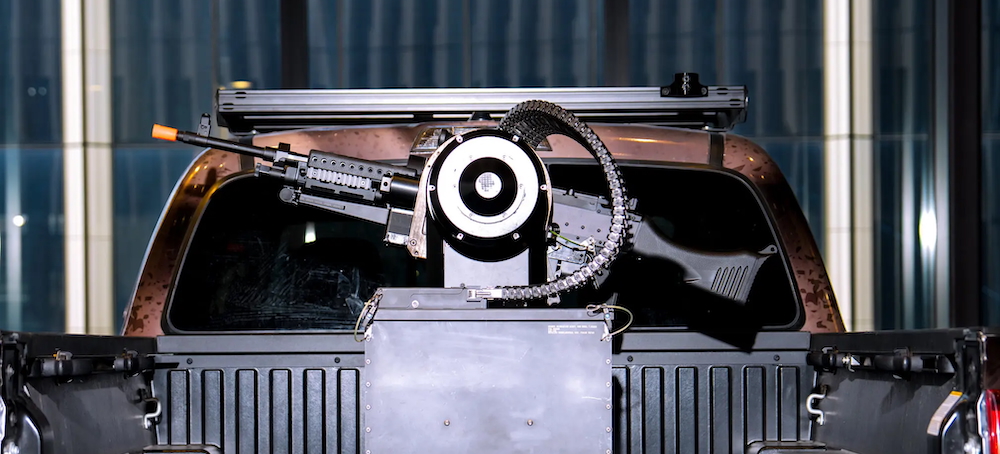 The Bullfrog, an autonomous gun turret developed by Allen Control Systems, on display at Reindustrialize 2025 in Detroit. (photo: NYT)
 Two Days Inside the Movement to ‘Reindustrialize,’ and Rearm, America
Farah Stockman The New York Times
Trump cabinet officials mingled with tech investors and manufacturers in an effort to supercharge factories.
In some ways, it looked like a normal convention. The makers of everything from carbon brushes to boat propellers milled around a large hall, looking at a flying boat, a customizable electric truck, an air taxi and a humanoid robot. But at times, it turned into an urgent and literal call to arms as discussions moved from manufacturing to national security.
“You will help us forge a future where we can build and sustain an industrial base that can deliver the critical weapons we need, fast and at scale,” Defense Secretary Pete Hegseth told the participants in a video message. “Time is short.”
The two-day summit, Reindustrialize 2025, was put on by an ad hoc group that met through Atomic Industries, a manufacturing firm in Warren, Mich. The convention’s founders include Atomic’s chief executive, Aaron Slodov, who last year penned “A Techno-Industrialist Manifesto,” which called on investors and the tech community to focus on manufacturing physical goods.
About 1,200 people attended the conference, about twice the number who attended the first gathering last year, said Falon Donohue, an Atomic board member who is also a founder of the conference. Thousands were on the waiting list, she said. More than 16,000 watched the speeches, round tables and fireside chats online.
Titans of industry have been pledging to reindustrialize the United States for decades, but the idea is particularly potent at this moment, when more Americans recognize the nation’s dependence on other countries for everything from electronics to batteries to medicines.
The goal of reviving American manufacturing has been a rare point of agreement between President Trump and former President Joseph R. Biden Jr., although they differed strongly on the strategy to bring it about. Mr. Biden successfully pushed for laws that gave subsidies and tax credits to companies that were building factories to make semiconductors, batteries and electric vehicles in the United States, whereas Mr. Trump has threatened to impose large tariffs on foreign nations to boost domestic production.
The conference attracted a large cohort of like-minded tech enthusiasts who spoke of boosting American manufacturing as a solemn patriotic duty, even if they had British or Australian accents. It also managed to make factories glamorous to a jet-setting crowd that to many might seem more at home in Davos than in Detroit.
“It has become high status to invest in manufacturing,” Christian Garrett, a partner on the investment team at 137 Ventures, noted at a fried-chicken-filled after-party downtown. Mr. Garrett said the factories that deals coming out of the conference would build would also create high-tech, “high status” jobs for blue-collar workers.
Speaker after speaker emphasized that military power flows from industrial power, which they said had been eroded by the offshoring of factories and an overemphasis on software, apps and financial products.
From the welcome by Chris Power, chief executive of Hadrian, a defense manufacturing start-up, to remarks by senior administration officials, the speeches drove home a single theme: Maintaining the country’s superpower status requires regaining the ability to produce physical goods at scale.
Nearly every session waxed nostalgic for World War II, when Detroit’s car plants were quickly converted into munitions factories that helped achieve victory. But today, Americans have fallen behind China in the mass-production of things that would matter in a war, senior administration officials warned.
“In a world where Russia has raw materials, and China dominates manufacturing, an economy centered around McKinsey and DoorDash will not cut it,” Mike Needham, counselor and chief of staff to Secretary of State Marco Rubio, told the crowd from the main stage. “We turn to China, the rival that too often no one wants to name, even as they surpass us in industry after industry: shipbuilding, steel, electric vehicles, critical metals.”
Mr. Needham urged his audience of venture capitalists, angel investors and inventors to rekindle “that swashbuckling American spirit that does what must be done and will not take no for an answer” in the race to secure the resources to rebuild the country’s industrial base.
Other Trump administration officials who attended included Kelly Loeffler, administrator of the Small Business Administration; Jamieson Greer, the U.S. trade representative; John Phelan, the Navy secretary; and unnamed representatives of the Central Intelligence Agency, who held a private round table with industry people.
In his speech, Mr. Phelan spoke bluntly about the dire state of affairs and proposed combining commercial and military shipbuilding abilities to address the shortfall of shipbuilders.
Our shipbuilding industry has eroded, hollowing out the very capacity we need to maintain credible naval deterrence,” he said.
Conference participants from Silicon Valley included Shyam Sankar, the chief technology officer of Palantir, the data analysis and technology firm, who said the United States was “actually the underdog” when competing with China.
Palmer Luckey, the founder of Anduril, a defense contractor, spoke to the crowd remotely through a stiff, humanoid robot dressed in a Hawaiian shirt and mullet wig.
The idea for a Reindustrialize conference sprang from a factory tour of Atomic in March 2024, said Ms. Donohue, the board member. In addition to the tour, Atomic held a discussion with policymakers and investors about how to revitalize manufacturing with tech and new government policies. Ms. Donohue is also a partner at Narya, an investment firm that Vice President JD Vance co-founded in 2019.
“We walked out so energized,” she said. “We said, ’Let’s keep this going,’ and it just grew organically from there.”
Another founder of the conference, Gregory Bernstein, who was a board observer at Atomic in 2024, said some embraced the idea of reindustrialization because of national security, while others saw it as a way to address economic inequality or the climate crisis.
Mr. Bernstein, the chief executive of the New Industrial Corporation, an investment company, said he found the idea of an economy based on building things more compelling than one based on intangible products.
“You can’t really offer your citizens much,” he said, “if all you’re asking them to do is sit around, trade crypto, watch Netflix and order Uber Eats.”
Despite the large presence of Trump administration officials, the conference founders said the event was staunchly nonpartisan. Mr. Biden’s former national security adviser, Jake Sullivan, and one of Mr. Biden’s former deputy national security advisers, Daleep Singh, spoke onstage.
But not everyone was impressed with the conference. A group called Engineers Against Apartheid protested with megaphones against Palantir, whose software has been used by Israel to pick targets in Gaza.
And Robert Rose, chief executive of Reliable Robotics, who stumbled across a mention of the conference on LinkedIn, said it did not reflect his own experience.
Having worked at companies building real hardware in America, “I scratch my head whenever I hear ’re’industrialize or ’re’shoring,” he wrote on LinkedIn. “Hello! We’re right here guys! We never left!”