
IDF Brass Fears Netanyahu May Launch Iran Offensive Before Tuesday’s Election
Amos Harel Haaretz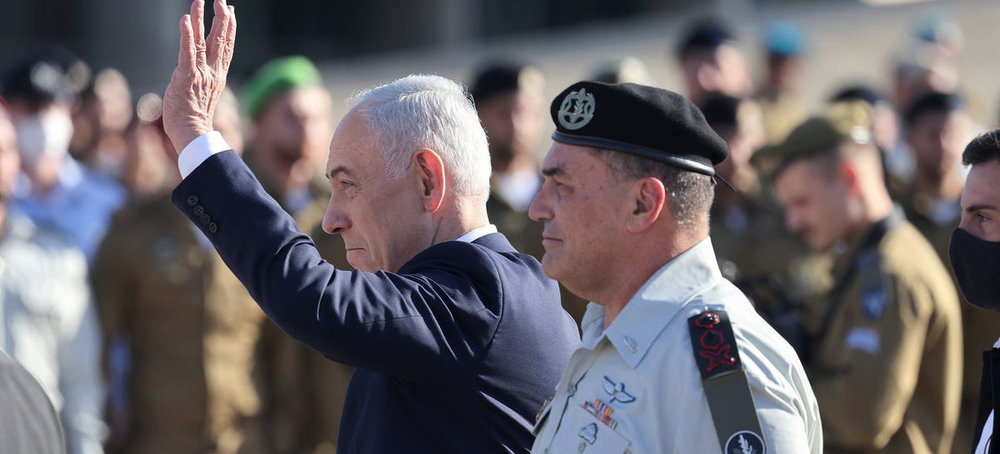 Prime Minister Benjamin Netanyahu and IDF Chief of Staff Eyal Zamir last week. (photo: Ilan Assayag)
IDF Brass Fears Netanyahu May Launch Iran Offensive Before Tuesday’s Election
Amos Harel Haaretz
The IDF's leadership, which disagrees with the prime minister over the urgency of an offensive against Iran, believes he is using footage of his tours of military bases as a deliberate to provoke Iran and its proxies
The IDF's brass disagree with the prime minister over the urgent necessity of an offensive and fear it may delay the election.
U.S. President Donald Trump was forced to issue a statement on Sunday night saying there would be no attack on Iran overnight, and the administration expressed surprise at Netanyahu's recent remarks.
On Sunday night, Israel's Channel 12 News reported on another spat between Netanyahu and IDF Chief of Staff Eyal Zamir, which occurred during Netanyahu's visit to Palmachim Air Force base Sunday. Netanyahu visited the base and was photographed against the backdrop of an Arrow interception missile battery, threatening Israel's enemies: "You will suffer disproportionate blows, stronger than you can imagine."
This was the prime minister's third visit to the Air Force base within about a week. The military believes he is using the tours for political campaigning (Netanyahu indeed films videos there that are integrated into the Likud campaign), and that there is a deliberate attempt to provoke Iran and its proxies.
Last week, Haaretz reported on concerns within the IDF that Netanyahu was seeking to attack Iran before the elections. The military brass fears that Netanyahu would alternatively try to provoke Tehran to attack Israel first. In the background is the prime minister's fear of losing the elections, given polls that do not bode well for Likud and its coalition partners.
British newspaper The Financial Times reported that the U.S. and Israel prepared for a massive airstrike in Iran on the weekend of October 10, but the plan was postponed by U.S. President Donald Trump.
One possibility raised was that the president would authorize a joint attack for Netanyahu after November 3, the date of the U.S. congressional midterm elections. Such an attack, and the renewal of widespread war with Iran, could still affect coalition talks after the Israeli elections, if a clear decision is not reached.
Netanyahu's leading rival, Gadi Eisenkot of the Yashar party, addressed Netanyahu on Sunday night and warned him from attacking Iran for political gain. "Netanyahu, I have my eyes on you," he wrote on X.
"The man under whose watch the greatest disaster in [Israel's] history occurred refuses to understand that Israel's security is not a political plaything. The lives of Israel's citizens and IDF soldiers will not be abandoned, and the State of Israel is not his private property. ... I warn Netanyahu: Do not dare to place your political interests above the state's security. Holding the elections on schedule and completing the democratic process are a central component of Israel's national resilience."
The report on the renewed confrontation between Netanyahu and Zamir was preceded by two unusual, even puzzling, statements from Netanyahu. First, on Friday, the prime minister said in an interview that Israel should prepare to bypass international sanctions by adopting cryptocurrencies.
The announcement caused deep concern in the Israeli business sector and a sharp statement of reservation from the Bank of Israel.
On Sunday, the prime minister published an illustration on his social media accounts showing Tel Aviv engulfed in flames, ostensibly as a result of Iranian atomic bomb strikes, and warned that "Israel is in real existential danger."
Both Israel's defense establishment and its political leadership believe that Netanyahu is very concerned about the possible election results and that this is influencing his extreme statements and his willingness to take unusual steps, even in the final stretch before the elections.