
Trump’s Words Don’t Predict War. His Deployments Do
Prof Robert Pape Substack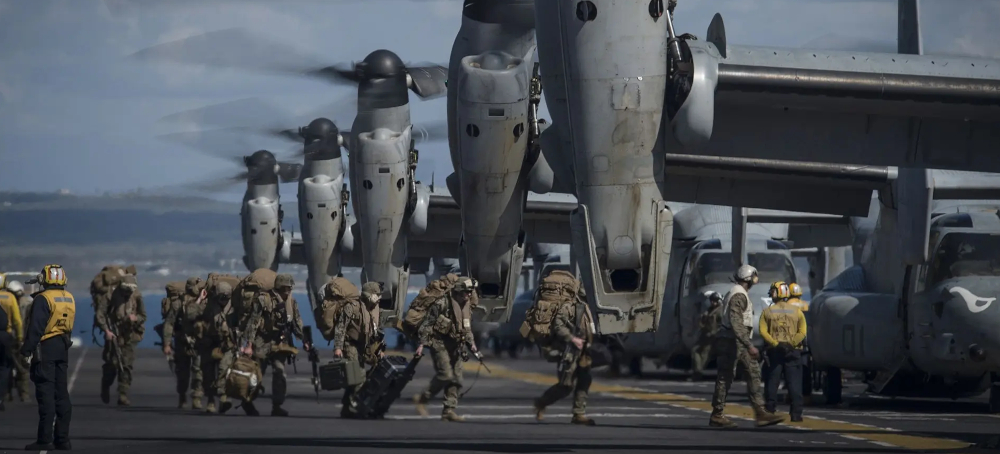 Marines from the 11th Marine Expeditionary Unit (11th MEU) board MV-22 Ospreys attached to Marine Medium Tiltrotor Squadron 163 as they prepare to launch from the flight deck of the amphibious assault ship USS Makin Island during an off-load of personnel and equipment on Feb. 23, 2015. (photo: Ronald Gutridge/AP)
 Trump’s Words Don’t Predict War. His Deployments Do
Prof Robert Pape SubstackALSO SEE: Escalation Trap, Prof Robert Pape on Substack
Breaking: 1,000 82nd Airborne troops ordered to the Gulf—another signal that movement, not rhetoric, is driving escalation
Is Donald Trump bluffing—or preparing for escalation with Iran?
That question dominates headlines because Trump’s rhetoric is easy to see and easy to debate. One day, he signals negotiations. The next, he signals resolve. Analysts toggle between interpretations: brinkmanship or breakdown, diplomacy or war. Tonight’s breaking news—that 1,000 troops from the 82nd Airborne are being sent to the Gulf—will only intensify that debate.
But this is the wrong way to read what is happening.
The problem is not Trump’s rhetoric. It is that we are watching the wrong signals.
Trump’s words are not confusing. They are doing exactly what presidential rhetoric is designed to do: manage multiple audiences at once—domestic voters, financial markets, allies, and adversaries. Ambiguity is not a flaw. It is the strategy. The mistake is treating rhetoric as a guide to action rather than as a tool of political management.
If you want to understand where this war is going, ignore what is said. Watch what moves.
The pattern becomes clear across three recent cases.
Case 1: Venezuela — The Build-Up Precedes the Signal
In late 2025, the administration’s rhetoric toward Venezuela oscillated sharply. At times, Trump emphasized restraint and the possibility of negotiated outcomes. At other moments, he invoked regime change and warned of decisive action. Media coverage followed every shift, parsing tone as if it revealed intent.
But beneath the rhetoric, a different signal was emerging.
Beginning in September, U.S. forces were quietly repositioned across the Caribbean. Within weeks, the buildup expanded to roughly 12,000–15,000 personnel, an aircraft carrier strike group, multiple destroyers, and forward basing across key regional nodes. Logistics chains were activated. Air and naval assets were synchronized. These were not symbolic moves; they required planning, coordination, and political commitment, creating options that did not previously exist.
The rhetoric suggested uncertainty. The deployments revealed direction.
This is the pattern:
Rhetoric moves perception. Deployments move reality.
Case 2: Iran — The Pattern Repeats
The same structure is now visible in the current crisis with Iran.
Publicly, Trump alternates between signaling openness to talks and warning of severe consequences. Each statement is treated as a clue—de-escalation, coercion, or preparation for war. The latest deployment of 1,000 troops from the 82nd Airborne will be read the same way: as another rhetorical signal to interpret.
It is not.
It is a deployment.
Since February, the United States has surged more than 150 aircraft, two carrier strike groups, over a dozen warships, and tens of thousands of personnel into the region. Airbases have expanded. Missile defense systems have been reinforced. Command integration under United States Central Command has tightened. Now, airborne infantry—forces designed for rapid insertion and early-stage ground operations—are being added to that structure.
This is not a signaling exercise. It is a structural shift in military posture.
Air campaigns can escalate quickly. Sustained presence cannot. It requires fuel, maintenance, logistics, and time. It creates commitment even before a formal decision is made. Each additional deployment narrows the gap between capability and action.
The rhetoric remains ambiguous. The deployments do not.
And that is the signal analysts keep missing.
Case 3: Greenland — Rhetoric Without Movement
Now consider Trump’s repeated statements about Greenland.
At various points, his rhetoric suggested serious intent—framed in strategic and security terms, delivered with unusual directness. The tone was assertive, even provocative. Media coverage reacted accordingly, treating the statements as potential indicators of policy.
But beneath the rhetoric, nothing moved.
There were no carrier deployments. No logistics buildup. No forward positioning of forces. No preparation consistent with coercion or seizure. The underlying infrastructure of action never materialized.
The rhetoric was vivid. The signal was absent. And nothing happened.
This contrast clarifies everything:
When deployments follow rhetoric, escalation becomes possible. When they do not, rhetoric fades.
The Pattern the Media Is Missing
Across all three cases, the same structure holds: rhetoric fluctuates, media reacts, and outcomes follow deployments. This is not unique to Trump. It is a recurring feature of crisis behavior.
Words are reversible. Deployments are not. Statements can be reframed in hours; force movements take weeks and shape what leaders can do next. The more attention we pay to rhetoric, the more we risk missing commitment.
The United States is not escalating because of what Trump says. It is escalating because of what it is building.
What to Watch Now: The Marines—and Beyond
If rhetoric is not the guide, what is?
The answer is simple: watch the most costly, least reversible moves.
Right now, that means Marines—and now also airborne forces.
The United States is deploying 2,500–5,000 Marines aboard amphibious ready groups, alongside more than 50,000 personnel already in the region. These forces are moving from Japan-based units and the U.S. West Coast, while the addition of 82nd Airborne troops introduces rapid-response ground capability that can be inserted ahead of heavier forces. Together, these deployments expand the range of immediate operational options.
This is not symbolic.
Marines and airborne forces are not sent for messaging. They are sent for options.
They are structured for entry, seizure, and sustained operations. Their presence changes the menu of choices available to decision-makers. Air power can pressure. Ground forces make entry possible.
If these deployments expand—if they are paired with logistics, engineering, and medical infrastructure—then the nature of the conflict changes. At that point, this is no longer a pressure campaign.
It is preparation.
If these movements continue, the question will not be whether the United States enters the war.
It will be when.
Conclusion
The next phase of this crisis will not be decided by what Trump says.
It will be decided by what moves.
Negotiations may continue. Rhetoric may soften or harden. Statements will shift, as they always do. But those are not the indicators that determine outcomes. The real signal is whether the physical infrastructure of escalation—forces, logistics, command—continues to expand.
That is what locks in pathways. That is what narrows choices. That is what turns possibility into probability.
And it is already happening.
The most important question is no longer what Trump says next. It is whether the build-up we are now seeing continues.
Because if it does, the trajectory of this war is no longer uncertain. It is accelerating.