
Trump’s Tough Talk Leaves Him Trapped
Bobby Ghosh Substack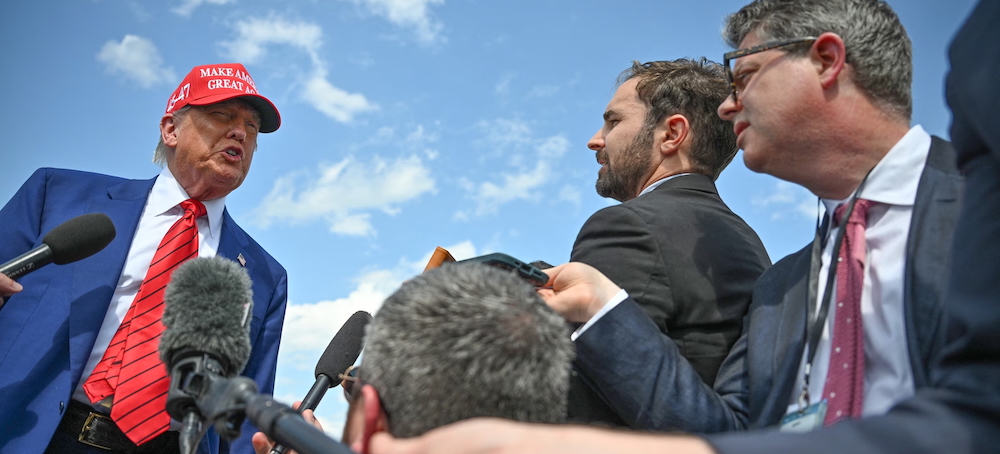 President Donald Trump speaks to the press. (photo: Mandel Ngan/AFP)
 Trump’s Tough Talk Leaves Him Trapped
Bobby Ghosh Substack
The president keeps setting deadlines for Iran, then backing away from them. That’s because he’s painted himself into a corner and has no clean way out.
It wasn’t opened. The 48 hours came and went. So did all the deadlines that followed.
On Easter Sunday morning, Trump marked the holiday with a Truth Social post that was, by any measure, memorable. “Tuesday will be Power Plant Day, and Bridge Day, all wrapped up in one, in Iran,” he wrote. “Open the F****** Strait, you crazy bastards, or you’ll be living in Hell — JUST WATCH! Praise be to Allah.”
A few hours later, he posted again: “Tuesday, 8:00 P.M. Eastern Time!” — apparently pushing the deadline back 24 hours, as AFP noted, without explanation.
Iran’s response, delivered through a senior official, was characteristically blunt: the strait would not reopen until the country was fully compensated for war damages. Its military command called Trump’s threat “a helpless, nervous, unbalanced and stupid action.” Tehran has said some version of this after every ultimatum. The cycle is now so well-established that it barely registers as news.
What looks like a failure of presidential nerve is in fact something more structural — and more dangerous. Trump is backing away because, when he looks at his options, each one leads somewhere he doesn’t want to go. The ultimatum framework he has adopted — set a deadline, threaten overwhelming force, wait for capitulation — was always going to produce this result. It assumes a counterparty that will fold under sufficient pressure. Iran has not folded. It has instead reached for the one lever that imposes costs not just on itself, but on the entire world.
Americans have learned more about the Strait of Hormuz in the past few weeks than at any other point in history. They’ve learned that it is 21 miles wide at its narrowest point; that through it, in ordinary times, flows roughly 20 percent of the world’s seaborne oil and a significant share of its liquefied natural gas. The Stimson Center has described it plainly: the strait is “not merely a tactical lever Iran can threaten or the United States can defend — it is a transmission belt between regional war and the global economy.”
Since Iran effectively closed it on March 4, Brent crude has surged past $120 a barrel, the International Energy Agency has described the disruption as the largest in the history of the global oil market, and the Dallas Federal Reserve has estimated that the closure could reduce global GDP growth by nearly three percentage points, annualized, in a single quarter. Bloomberg analysts are now gaming out scenarios in which oil reaches $200 a barrel if the closure persists.
Iran’s leaders have scenarios. Since the war began, any number of commentators have paraphrased Henry Kissinger’s formulation from a 1969 essay on Vietnam to describe the essential asymmetry: Iran wins if it doesn’t lose; the US loses if it doesn’t win.” The U.S. and Israel have launched more than 16,000 airstrikes. Iran’s navy has been largely sunk, its missile production substantially degraded, its supreme leader killed. And yet, as Time magazine has reported, “the fulcrum of the war is not Iran’s battered military but, rather, the fate of the world economy.” Tehran, the same report noted, regards the impact on global oil prices as validation of its doctrine of asymmetric warfare — relying not on conventional military strength but “on pinprick attacks on the fragile infrastructure of the petroleum industry,” and on the economic havoc that even a partial, selective closure of a narrow waterway can inflict on the world.
This is the trap the ultimatum framework built. By threatening overwhelming force without accounting for what leverage Iran retains if it doesn’t capitulate, Trump narrowed his own choices to three exits — and none of them is good.
The first is to follow through on tonight’s deadline and strike power plants and bridges. The military case is straightforward; the strategic one is not. Striking civilian infrastructure does not reopen the strait. It may harden Iranian public sentiment, complicate already-stalled ceasefire diplomacy, and add to what the Atlantic Council’s Daniel Shapiro has described as Trump’s central dilemma: he “can no longer single-handedly define victory when the paralysis of global energy markets will prevent the president from credibly declaring mission accomplished as long as the strait remains closed.”
Escalating the bombing campaign expands the military operation while leaving the strategic problem untouched.
The second exit is to declare the mission accomplished and stand down — to claim that Iran’s military has been “decimated,” as Trump told the American people last week, and quietly accept a strait that remains closed or selectively permeable on Iranian terms. Senior administration officials have already begun laying the groundwork for this. The Wall Street Journal has reported that Trump told aides he was willing to end the war even if the strait remained mostly closed. The White House press secretary declined to confirm that reopening the strait is a “core” objective.
This exit effectively hands Tehran a victory that no chorus of Washington spin doctors can explain away.
The third exit is the one Trump has been taking repeatedly for six weeks: delay, announce progress, extend the deadline, repeat. It has a certain tactical logic — it buys time, keeps oil markets from spiking on a confirmed breakdown, and allows intermediaries space to work. But each repetition costs something that cannot be recovered. Every deadline extended, every claimed breakthrough immediately denied by Tehran, every expletive-laden social media post that expires without consequence, chips away at the credibility of the next threat. Iran’s deputy communications chief dismissed Sunday’s ultimatum as evidence that the U.S. has “resorted to obscenities and nonsense out of sheer desperation and anger.”
That is propaganda, of course. But propaganda works best when it has something real to point to.
Iran’s terms, meanwhile, have not moved. They were the same six weeks ago as they are today: an end to hostilities, security guarantees against future attacks, compensation for war damages, and a formalized role for Iran in the governance of the strait it currently controls. These are not terms any American president can accept, which means there is no deal available on the horizon — not this week, and not under current conditions. Pakistan, Turkey, and Egypt have been working as intermediaries, but their efforts have produced indirect exchanges rather than substantive negotiations.
At 8 p.m. Eastern tonight, something will happen — or it won’t. Trump may strike the power plants and bridges he has been promising. He may announce, as he has done before, that productive talks are underway and that he has decided to give diplomacy more time. He may, as he told Fox News on Sunday, find that there is a “good chance” of a deal by Monday — a claim that, by Tuesday evening, will either have aged well or joined the lengthening list of predictions that didn’t.
What will not happen, absent a fundamental shift in the strategic equation, is a resolution that leaves the US with its leverage intact, the strait open, and Iran without a story of resilience to tell. The ultimatum framework was always going to lead here. It assumed that enough pressure would produce capitulation. Instead, it produced the Strait of Hormuz crisis — the largest energy shock since the 1970s, a war with no clean exit, and a pattern of deadlines that the world has learned, with each passing Tuesday, not to take too seriously.