
Trump’s Irritation, Netanyahu’s Desperation: Oval Office Smiles Mask Rifts
Ben Samuels Haaretz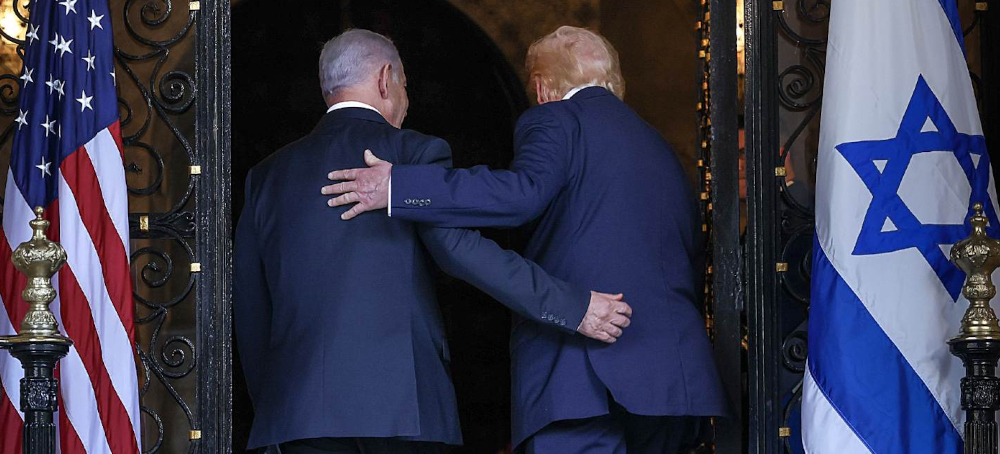 President Trump and Prime Minister Benjamin Netanyahu of Israel are both facing electoral challenges in the months ahead. (photo: Joe Raedle/Getty)
 Trump’s Irritation, Netanyahu’s Desperation: Oval Office Smiles Mask Rifts
Ben Samuels Haaretz
At yet another meeting, Trump and Netanyahu – both facing critical elections – found themselves indispensable to each other, even as their visions for the Middle East increasingly diverge
His Oval Office ring-kissing appearance before his senior partner, as Trump casts himself, had few publicly stated objectives and produced even fewer deliverables. Yet it should not be dismissed as a meeting that might as well have been an email: Netanyahu's most consequential visit occurred several months ago with the least pomp or circumstance, when he successfully pitched Trump on launching a joint U.S.-Israeli, generation-defining war against Iran.
This time, the political purpose was clearer than the policy one – preserving the appearance of coordination and keeping an exasperating but indispensable counterpart close.
Trump may be growing increasingly irritated with Netanyahu, while the prime minister's influence over him may be waning. But it would be a mistake to dismiss Netanyahu as anything less than a central figure in Trump's ambitions – both at home and abroad.
Both leaders know that neither is going anywhere ahead of their respective elections. Trump needs Netanyahu not to distract from his agenda; Netanyahu desperately needs Trump in his corner.
Netanyahu's handling of the visit showed unusual contempt for transparency, even by his shifting standards. His plane left Israel in secrecy before the public was informed, no journalists were allowed to accompany him, and no public schedule was released on the day of his White House meeting.
Netanyahu's despotic aspirations notwithstanding, it should never be accepted that a public servant can swat away transparency like a mosquito. But did Trump ultimately do him a favor by forcing him to slip into the West Wing through a side entrance?
The two leaders find themselves divided over the most pressing Middle East issues: Iran, Lebanon and Trump's efforts to deepen cooperation with Turkey and Saudi Arabia – moves that threaten Netanyahu's vision of Israel's regional primacy.
Never mind, though, that Trump is not holding Netanyahu's feet to the fire on the issues that actually threaten Middle East stability and the prospects for further Israeli normalization – above all, Jewish settler violence in the West Bank and a Gaza peace process that, even by the most generous interpretation, is barely moving.
'I don't need Bibi'
Landing in Washington, Netanyahu was met by anti-war protesters lining the streets, hoping to give his passing motorcade a cold welcome.
Netanyahu and his wife then attended a dinner honoring the late Sen. Lindsey Graham, hosted by former Trump Lebanon envoy Morgan Ortagus. The gathering might as well have doubled as a wake for Israel's fading bipartisan support – and for Netanyahu's closest ally in Congress.
Netanyahu's trip was publicly centered on attending Graham's funeral, though he effectively willed a meeting with Trump into existence through spin, leaks and good old-fashioned chutzpah.
Trump made it abundantly clear how unenthused he was about meeting Netanyahu, with U.S. officials engaging in the usual strategic background leaks in the hours before the meeting.
Speaking with Fox News shortly after the New York Post published a report on Netanyahu's plans to present Trump with intelligence related to Iran's Pickaxe Mountain, a heavily fortified, deep-underground Iranian facility linked to the country's nuclear program, Trump explicitly dismissed the plan as a stunt and a ploy.
"I don't need Bibi to tell me that. Bibi is telling me that because he wants me to stay involved," he said. "We know exactly what's going on. I heard Bibi announce that, I said, 'Why didn't you just tell it to me? Why did you have to announce it to the world?' I know exactly what's going on at Pickaxe. It's not a big problem."
Trump's irritation was similarly evident aboard Air Force One 24 hours before the meeting, when he was asked about Israel's vocal opposition to planned U.S. sales of F-35 fighter jets to Turkey.
"Nobody tells me what we should be selling," he told reporters. "Turkey's not a big fan of Israel, not a great fan of Bibi. But they've been great for me."
Trump is now publicly acknowledging that Netanyahu tries to manipulate him through flattery and appeals to his ego to achieve his desired outcomes.
A dangerous game
Polling released Tuesday showed how far Netanyahu's standing has fallen across the U.S. political spectrum.
Forty-nine percent of Americans – including 74 percent of Kamala Harris voters and 23 percent of Trump voters – believe he should be arrested while on U.S. soil, according to an Economist/YouGov poll. Nearly half say he has damaged U.S.-Israel relations or committed war crimes, while 54 percent view him unfavorably.
Netanyahu considers these trends a future prime minister's problem, not his own. For a prime minister making his post-October 7 pitch to Israeli voters, only the next 90 days matter – until Israelis head to the polls, any other consideration be damned.
He is playing a dangerous game: exploiting Trump's support for his political ambitions without overly alienating the president by dragging him deeper into a renewed war for which Trump appears to have little appetite.
Meanwhile, American Jews remain a discarded afterthought at a time when concerns about communal safety and the future of their relationship with Israel have rarely felt more urgent. Liberal Jewish protesters, long critical of Netanyahu and increasingly reflective of broader communal unease, demonstrated outside the White House during the meeting.
Netanyahu arrived in Washington with few allies and fewer good options. He will leave with none of his underlying problems meaningfully resolved. But he got the photo-op he craved.