
Trump’s Iran War Price Tag Just Keeps Rising
Garrett Owen Salon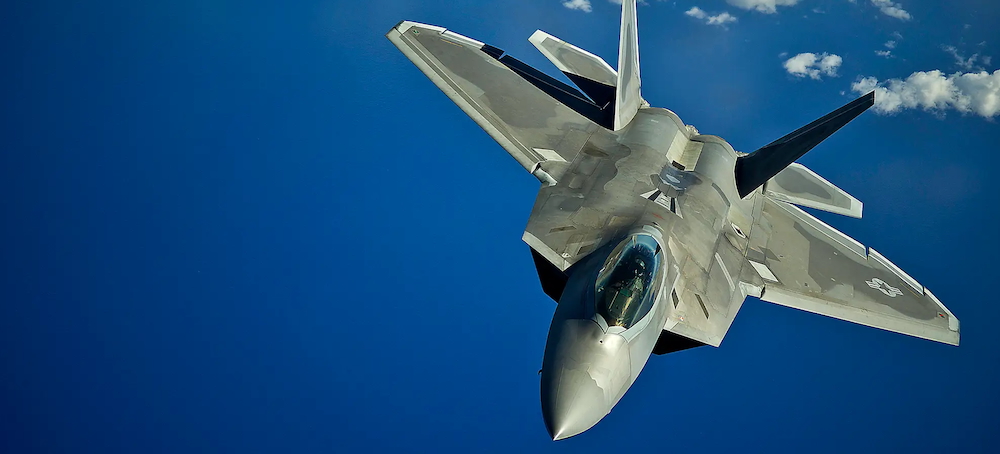 An F-22 Raptor from the Air National Guard’s 199th Fighter Squadron. (photo: US Air Force Photo)
 Trump’s Iran War Price Tag Just Keeps Rising
Garrett Owen Salon
The Pentagon requests more than $200 billion for the war while the White House hasn't articulated a clear objective
“You can say four weeks, but it could be six, it could be eight, it could be three,” he said. “Ultimately, we set the pace and the tempo.”
The same day, President Donald Trump gave a more straightforward answer, positing that the war would last “four to six weeks,” saying that the campaign was “substantially ahead” of schedule.
Trump said the goal of the strikes against the Islamic Republic was to destroy Iran’s nuclear and military capabilities. As the war enters its fourth week, his administration see these aims as having been at least partially successful. Iran’s navy appears to be in tatters, their nuclear program suffered more damage, along with their supply of long-range missiles.
Still, threats of escalation are omnipresent in the Persian Gulf, including speculation of a land invasion by U.S. forces. On Friday, 2,500 more Marines were sent to the area, along with three more U.S. warships.
The war is averaging an $11-billion-a-week price tag, but last Thursday, Hegseth requested even more, to the tune of $200 billion. This is on top of the Pentagon’s annual budget of almost $1 trillion. He also revised the war’s timeline to an additional two months.
“It takes money to kill bad guys,” Hegseth said. “We’re going back to Congress and our folks there to ensure that we’re properly funded.” The secretary said that increased funding would go toward replenishing munitions stocks used in Iran.
Heidi Peltier, director of programs at Brown University’s Costs of War project, is highly skeptical of the $200 billion request.
“What we’ve seen come out of this administration is numbers that do not correspond to specific strategies or specific plans,” Peltier told Salon, noting a $50 billion emergency budget request just the week prior.
Peltier also warned that spending could quickly balloon into “hundreds of billions of dollars,” with costs for everything from munitions to additional veterans’ benefits falling back on Americans.
“So, whether it’s $50 billion or $200 billion, that’s only going to cover a fraction of whatever the total bill is going to be to the American public,” Peltier said. Spending at this rate, Peltier said, is “definitely not” sustainable, to say nothing of the ever-rising death toll, many of which are children.
“We didn’t budget for this war, and we’re not raising taxes to pay for this war. We’re not selling war bonds to pay for this war. There’s nothing that we’re doing to raise revenues to pay for the war. So, the way we’re paying for the war is through debt,” she said.
Even with the additional $200 billion requested, the endgame is still unclear. The Strait of Hormuz is almost completely closed, raising gas prices worldwide, which has rattled global markets. Iran’s new supreme leader Ayatollah Mojtaba Khamenei wants to fight on and force the U.S. into negotiations. Trump said that the purpose of the war isn’t to enact regime change, yet has said that prospective leaders he would have wanted “are dead” as a result of U.S. and Israeli airstrikes.
Trump has stated publicly that he doesn’t want a land war, though hasn’t entirely ruled out the possibility as troop levels surge. What’s more, his administration is reportedly mulling the idea of taking Kharg Island in the Strait of Hormuz to put pressure on Iran, while having considered “winding down” the war without forcing the strait open.
Brian Finucane, senior adviser at the International Crisis Group, called the Trump administration’s approach to Iran a “misadventure” and noted the lack of an overall strategy beyond “blowing things up.”
“Trump’s war aims are ill-defined, shifting, and highly unlikely to be realistic,” Finucane told Salon.
Finucane noted a number of issues with Trump’s expectations of the war running into the realities of the conflict. For one, Trump “invoked” the strategies and tactics used in Venezuela, expecting a relatively quick operation based on shock and awe, followed by a transfer of power to someone conceivably more pliable to the Trump administration.
Also complicating the matter were the aims of Israel, which Finucane pointed out were different from those of the U.S., which sought to destroy Iran’s nuclear and military capabilities. “Israel wants to destabilize or destroy the Iranian state,” he said.
When asked what the Trump administration’s overall strategy in Iran, Finucane stated that “it doesn’t have one.”
“I think they’re very much improvising,” Finucane stated, pointing to the example of Israeli strikes on Iranian oilfields, followed by retaliatory strikes from Iran on Qatari oilfields, saying that the “conflict has gotten out of the hands of Donald Trump.”
Finucane noted instances of the Trump administration seeking an “off-ramp” from the conflict, such as negotiating with Iran to reopen the Strait of Hormuz or declaring some kind of political victory. Trump could point to the extensive destruction to Iran’s military and nuclear capabilities and “spin” a victory for his base, Finucane said.
Indeed, Trump has called for a halt to anticipated strikes on Iranian power stations for five days following “very good” talks with officials in Tehran. “We’re very intent on making a deal,” Trump said Monday. This comes just days after Trump issued a 48-hour ultimatum to Iran to reopen the Strait of Hormuz, vowing to “hit and obliterate” said power plants. Iran has denied any such talks have taken place.
A few days into the war, Hegseth stressed that it would not turn into a protracted conflict like previous “forever wars” in the Middle East. “This is not Iraq. This is not endless. I was there for both. Our generation knows better, and so does this president,” Hegseth, who is a military veteran, said on March 2.
Richard Caplan, a professor of International Relations at the University of Oxford, warns that such a war could be possible, as Trump’s strategy is not working in getting Iran to surrender unconditionally.
“There’s no evidence that the Iranian regime is prepared to do that,” Caplan told Salon. “They’ve been hardened, apparently, by this war, and they don’t show any signs of yielding.”
In his first address as supreme leader, Khamenei vowed that the Iranian nation would “not refrain from avenging the blood of your martyrs.” Kamal Kharazi, foreign policy adviser to Khamenei, said on March 12 that he doesn’t “see any room for diplomacy” with the U.S.
Caplan questioned the administration’s aims of crippling the Iranian regime via air war, coupled with the Israeli desire to “bring more destruction” in order to make Iran capitulate. He pointed out that even after Israel’s brutal war in leveling Gaza, killing tens of thousands of civilians, yet Hamas is still in power.
“Nothing to suggest to date, in terms of the behavior of the Iranians, that that is what they are inclined to do,” he said.
One aspect of the war that Caplan found “very worrying” was the abandonment of negotiations with Iran in favor of war and the “cost” the U.S. has paid for it on the world stage.
Caplain said that by launching preemptive strikes against Iran, despite official intelligence reports contradicting Iran’s would-be attack, the Trump administration contributed to a wider “loss of faith in the administration to be a trustworthy negotiating partner.”
“That’s hurt the credibility,” Caplan said. “It’s just, if you will, another nail in the coffin of U.S. standing in the world.”