
Trump Wants $200 Billion More For Iran War. Here's What Else That Could Fund.
Sara Dorn Forbes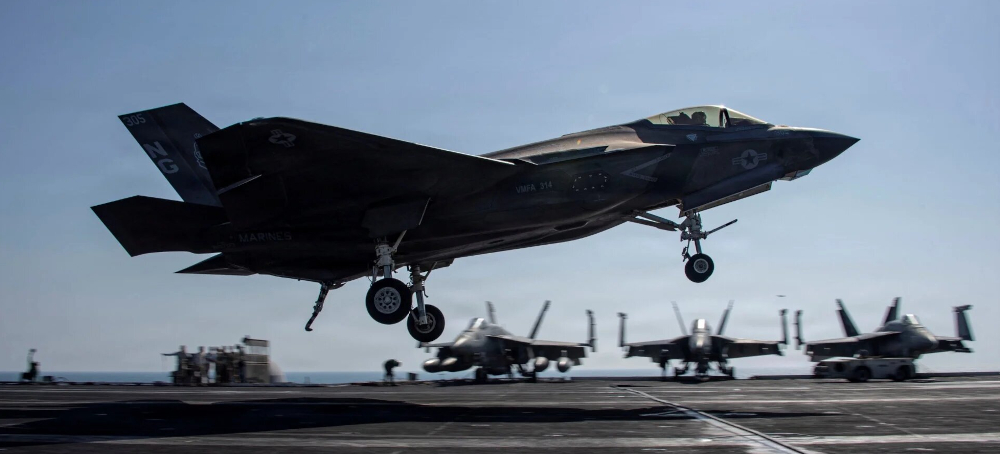 An F-35C Lightning II prepares to make an arrested landing on the flight deck of the USS Abraham Lincoln aircraft carrier, in support of the US-Israeli war on Iran, from an undisclosed location, on 7 March 2026. (photo: Reuters)
 Trump Wants $200 Billion More For Iran War. Here's What Else That Could Fund.
Sara Dorn Forbes
President Donald Trump is reportedly gearing up to ask Congress for a massive cash infusion for war in Iran at a time when his administration has made controversial cuts to other marquee government programs and left others unfunded and his tax cuts add to the federal deficit.
Healthcare: Republicans rejected Democrats’ push to extend enhanced premium tax credits for healthcare under the Affordable Care Act, which expired at the end of 2025, causing premiums to more than double on average for the 22 million recipients, according to KFF.
Expanding the subsidies would cost an estimated $60 billion over two years or $350 billion over the next decade, according to the Committee for a Responsible Federal Budget.
Clean energy tax credits: House Democrats want to restore Biden-era clean energy tax credits revoked by Republicans last year in Trump’s signature policy bill by passing the “Energy Bills Relief Act,” which would also expand the Low Income Home Energy Assistance Program and Weatherization Assistance Program that helps eligible Americans with their energy bills, and provide $2.1 billion for electricity transformers and grid technology, among other measures.
Low-income assistance on energy bills (LIHEAP): A bipartisan group of 40 senators called on the Trump administration to release the remaining $400 million of LIHEAP funding to states that was included in the fiscal year 2026 budget in a letter last week, citing an increase in heating bills from an unexpectedly cold winter—Sen. Kristen Gillibrand, D-N.Y., one of the signers, said in a statement the request comes as the “Trump administration pours hard-earned taxpayer dollars into endless wars abroad.”
Trump’s tax cuts: Congress approved $4.5 trillion in tax cuts over the next 10 years as part of his One Big Beautiful Bill, including an extension of tax cuts during Trump’s first term plus new policies such as no taxes on overtime and tips, partially paid for by controversial changes to the Supplemental Nutrition Assistance Program, student loans and Medicaid.
Ukraine war: The U.S. has allocated $180 billion total for Ukraine to help fund its war with Russia, but the International Monetary Fund estimates Ukraine will need a further $160 billion in foreign assistance over the next two years and is on the brink of bankruptcy.
Wildfire relief: Democrats in Congress have repeatedly called on the Trump administration to provide California with the $34 billion in Federal Emergency Management Agency money Gov. Gavin Newsom has requested to help the Palisades community rebuild from the January 2025 fires.
Farmer bailout: Farmers and some Republicans are calling for Iran war funding to be tied to additional financial assistance for farmers, with some Republicans eyeing a plan to attach a $15 billion farmer bailout to the war package.
Big Number
$1 trillion. That’s how much Congress has appropriated for defense funding in fiscal year 2026, a record high. Trump said in January he would seek a $500 billion increase in his 2027 budget request.
News Peg
The Washington Post reported Wednesday the White House is preparing to ask Congress for more than $200 billion to fund the war, citing unnamed sources. Trump and Defense Secretary Pete Hegseth both acknowledged the incoming funding request, with Trump telling reporters Thursday the White House is seeking the money “for a lot of reasons, beyond what we’re talking about in Iran,” adding, “it’s a small price to pay to make sure we stay tippy top.” Hegseth told reporters Thursday “that number could move, obviously,” adding, “it takes money to kill bad guys.” The Pentagon reportedly spent $11 billion on the war in the first six days alone.
What To Watch For
Whether Republicans will have the support to pass the $200 billion Iran war funding request. They can afford to lose no more than two votes in the House and need the support of seven Senate Democrats to overcome the filibuster without the support of any Democrats. Some Republicans are mulling a proposal to make the war funding conditional on aid for farmers, to make the package more attractive to Republicans, and wildfire relief, to appease Democrats, Politico reported. Sen. John Hoeven, R-N.D., was confident the move would secure “critical mass” for the war funds, “because I think [Democrats] want funding for the California fires, [Republicans] want funding for agriculture,” he told Politico. Others are calling for a way to offset the savings. Rep. Jodey Arrington, R-Texas, told CNN the Pentagon should be subject to an audit first. Rep. Chip Roy, Texas, Sen. Lisa Murkowski, Alaska, and Rep. Thomas Massie, R-Ky., have expressed broad hesitation, calling for more information about the goals, objectives and timeline of the war before approving any more funding. Sen. Susan Collins, R-Maine, who chairs the Senate Appropriations Committee, told reporters Wednesday she hasn’t received any formal request from the White House, but the reported $200 billion figure is “considerably higher than I would have guessed,” adding “I don’t know how it’s broken down.” Sen. Roger Marshall, R-Kansas, also told Fox Business on Thursday, the figure “sounds like a high number to me.”
Chief Critics
At least one Republican, Rep. Lauren Boebert, R-Colo., has said she won’t support additional funding for the Iran war, telling CNN, “I am so tired of spending money over there . . . I have folks in Colorado who can’t afford to live. We need America first policies right now.” Boebert’s stance reflects a break in Trump’s base over the war, with prominent right-wing figures, including Megyn Kelly, Tucker Carlson and former Rep. Marjorie Taylor Greene, R-Ga., expressing stiff opposition to the war, arguing it goes against Trump’s “America first” philosophy and his campaign promise not to enter into any new wars.