
Trump Is Dismantling US Guardrails, Warn Former Security Officials
Amy Mackinnon Financial Times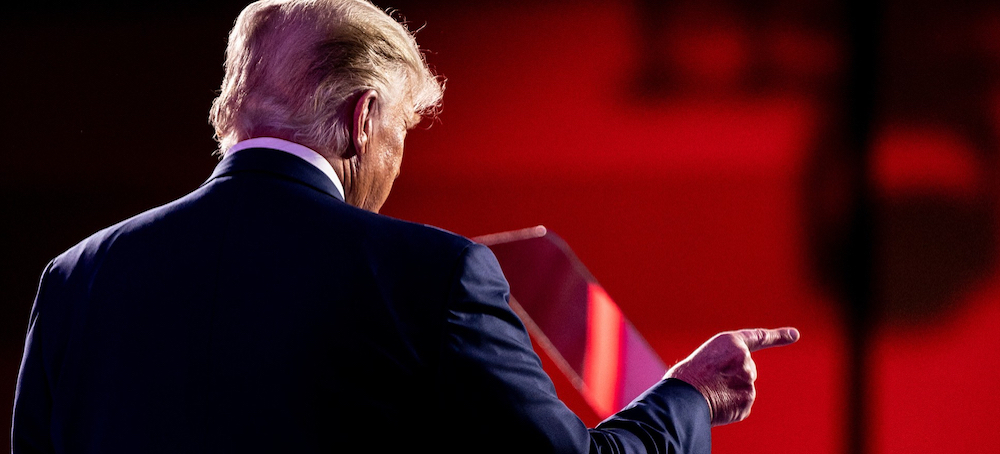 President Donald Trump. (photo: Intercept)
 Trump Is Dismantling US Guardrails, Warn Former Security Officials
Amy Mackinnon Financial TimesTrump returned to office pledging war against the so-called deep state that he blamed for constraining his power during his first term. Since then, he has sought to silence critics and demanded loyalty from those around him.
Autocrats “have relatively common playbooks in terms of how they capture and wield power”, said Paul Kolbe, a former CIA station chief who served across the former Soviet Union and Balkans. “These are all things that rhyme right now for me with what we see happening in the United States.”
Mark Zaid, a national security lawyer who is fighting a legal battle with Trump after the White House revoked his security clearance last year, warned that the president would continue his effort to consolidate power.
“The guardrails were all taken down,” Zaid said. “I don’t think we’re even close to the worst of where we’re going to go.”
Kolbe is among more than 400 former US intelligence and national security officials in The Steady State, a network formed in 2016 in response to members’ alarm at rising authoritarianism in the US. Zaid also works with the organisation.
The group warns that Trump’s erosion of institutions and checks on executive power threatens US democracy and its business environment.
The public intervention from former officials more used to a life in the shadows points to deepening alarm in the US intelligence community.
The Steady State’s membership has swelled during Trump’s second term, but many remain anonymous for fear of retaliation. “Half of our members do not want to be public, and these are people who have served in war zones,” said founder Steven Cash.
“There’s a lot of good reasons not to say anything,” said Julia Curlee, former CIA analyst who is a member of the group. “The problem is if everybody says nothing then we’re in the situation we’re in now.” She said people did not grasp “the degree to which these institutions which are so important have been hollowed out and weakened”.
Gail Helt, another former agency analyst focused on China and Taiwan, expressed alarm at a “cult of personality” around Trump. “He wants his face on our passports. He wants his face on our money. Even Mao didn’t put his face on money,” she said, referring to the former chair of the Chinese Communist Party.
Another group formed by intelligence veterans, the non-partisan Institute for the Study of States of Exception, is compiling a report on how US officials could use emergency powers to disrupt a US election.
“We want to look at what exactly we think the risks are or aren’t,” said Ed Bogan, a former CIA station chief who founded the institute.
Those concerns sharpened last month when Trump used a primetime television address to claim that China had meddled in the 2020 election, despite a 2021 report by the National Intelligence Council concluding that Beijing “did not deploy interference efforts” in the vote.
Trump’s claim was based on intelligence declassified by his administration but was seen as an attempt to cast doubt on the integrity of US elections just months ahead of November’s midterms.
Previous US presidents used declassified intelligence to support their policies, including George W Bush’s effort to justify the US invasion of Iraq. But former intelligence officials say Trump has gone further by using it for personal political gain.
Curlee accused Trump of “using the CIA” to reinforce his message “in defiance of what the institution itself actually believes”. She could think of “few worse abuses of the intelligence community’s capabilities and authorities in the last few decades”.
The CIA said it “closely collaborated with President Trump’s Government Transparency Task Force” to release the intelligence while protecting sources and methods, adding that senior intelligence officials were involved in “every step of this process”.
Former officials also say Trump has used his power over security clearances, which enable those in the private sector to work closely with US national security agencies, to punish critics.
On his first day back in office, Trump revoked the clearances of 50 former intelligence officials who had signed a 2020 letter saying the release of emails from a laptop belonging to Joe Biden’s son Hunter bore the hallmarks of a Russian intelligence operation. He later stripped clearances from top Biden administration officials and other prominent critics.
Liz Lyons, the CIA’s director of public affairs, dismissed the criticism. “Former officials without security clearances because of their roles in the Russia collusion hoax and Hunter Biden laptop fiasco are not serious sources with opinions worth reporting.”
Davis Ingle, a White House spokesperson, said Trump had been elected with a mandate “to root out the Biden-era weaponisation of government against Americans, drain the swamp, and put American citizens first — which is exactly what he is doing”. The president was “restoring democracy by putting power back into the hands of the American people and out of the hands of unelected bureaucrats”, Ingle said.
Zaid, the national security lawyer, said Trump’s use of clearances against perceived enemies had not been seen on this scale since the “Red Scare” of the 1950s, when people suspected of communist sympathies were targeted.
For all their alarm, some former officials believe US institutions will withstand Trump’s pressure.
“The list of things to be concerned about is long,” Helt said. But Americans had a “history of democracy and freedom” running through them. “I don’t think we’re going to go silently into that cold night.”