
Trump Is Claiming a Major International Victory. I Come to You With Less Than Shocking News.
Nitish Pahwa Slate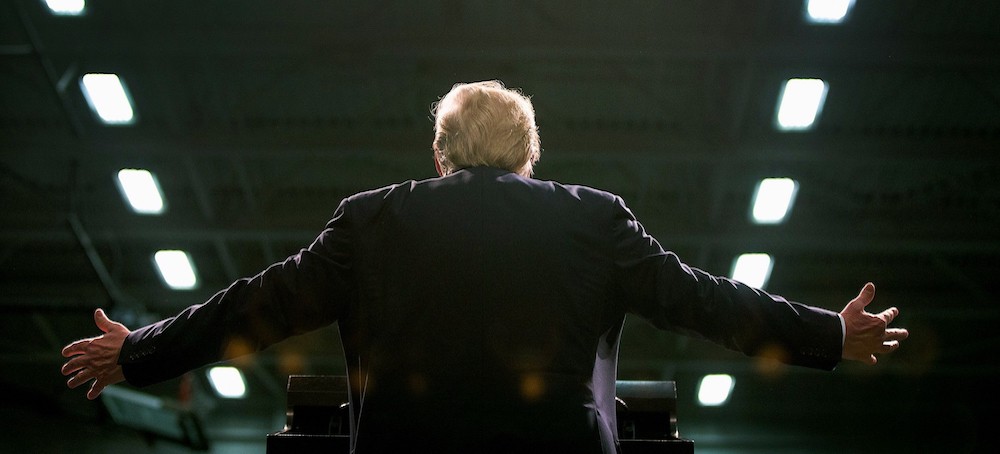 President Donald Trump. (photo: Intercept)
 Trump Is Claiming a Major International Victory. I Come to You With Less Than Shocking News.
Nitish Pahwa Slate
I regret to inform you that the president of the United States may not be totally on the level this time.
Update, April 18, 2026, at 10:36 a.m.: Iran announced on Saturday morning that it was once again closing access to the Strait of Hormuz, in response to the U.S. blockade of its ports. Our piece reads below as originally published.
On Friday morning, Iran declared that the strait was finally reopened for all commercial, nonmilitary ships hoping to traverse the essential waterway, provided that all entrants follow a “coordinated route” determined by Iranian authorities. It should, in theory, be a massive burden lifted from the global economy, which has suffered from the closure of a passage that’s supremely important for the global oil trade. But in practice, besides American oil traders, no one appears to be celebrating or taking this too seriously just yet. Per the BBC, oil and gas tanker companies aren’t rushing to run through the strait, telling the broadcaster that the news “doesn’t change anything.” The Iranian Revolutionary Guard Corps has claimed that only it will determine who gets to go through the sea lane, and the terms are still being “verified” by the International Maritime Organization. Iranian media outlets are questioning their own government’s messaging around the strait.
And the United States, for its part, is still keeping up its naval blockade across Iranian ports, a move it had purportedly intended as retaliation for Iran’s refusal to fully reopen the strait during the two nations’ ceasefire. Saudi Arabia has been itching for Trump to end that blockade, and his simple “thank-you” message to the Gulf royals isn’t likely to satisfy them. Iran itself has stated that it considers a blockade to be a violation of its peace deal with the U.S.—a stance it still holds as of Friday, threatening to once again close the strait should the American naval offensive continue.
It turns out there’s still a lot that’s up in the air. And until and unless Trump formally ends the destructive, useless, counterproductive war with Iran he started for no real reason, hardly anyone is going to feel any relief for a while yet. To actually keep the Strait of Hormuz open for the long haul, a lot of uneasy conditions will have to be met to the satisfaction of a slew of global stakeholders. And if even one of those delicate matters falls through, the catastrophic disruption promulgated by the strait’s closure is likely to last indefinitely.
For one, the truce that enabled this reopening remains fragile. Last week’s announcement of a two-week ceasefire between the United States and Iran was conditioned upon the regime’s willingness to open the strait for passage—which it did at first, allowing a few dozen ships to sail through before re-gating the waterway in response to Israel’s persistent attacks on Lebanon. Trump then imposed the blockade, which multiple Iranian boats reportedly managed to supersede, as the Iranian regime threatened to set up its own barriers over the Red Sea and gulf coast. The only reason that didn’t come to pass is that Israel finally declared a 10-day ceasefire with Lebanon on Thursday evening.
That raises two big questions: Will that truce actually last? And how would Iran respond if it doesn’t? Trump is still attempting to decouple the Israel-Lebanon deal from the one he reached with Iran. He has posted repeatedly that “this deal is in no way subject to Lebanon,” while emphasizing that Israel is “PROHIBITED” from bombing its neighbor. That puts Israeli Prime Minister Benjamin Netanyahu in a shaky spot: It was Bibi who persuaded the U.S. to join Israel in bombing Iran in the first place, who told Trump last week to exclude Lebanon from any ceasefire agreement, and who vowed not to cede any defenses. Plus, Israeli troops remain in Lebanon, and there is no formal ceasefire declared with Hezbollah, the militant Lebanese group that’s allied with Iran and carrying out most of the fighting with Israeli soldiers. (The paramilitary organization has offered a “cautious commitment” to the ceasefire with Israel, albeit with plenty of critiques of the Lebanese government.) A stray shot from either side could reignite the conflict and cause Iran to shut off the strait again.
Another factor: the mines. To enforce its control over the Strait of Hormuz, Iranian forces placed myriad mines throughout the waters, ready to blow at a moment’s notice and snarl any unlucky trespassers. While Trump has posted that Iran is working on removing said mines (something the regime has not confirmed), any such effort is likely to take a while: Iran told the U.S. just a week ago that it was unable to recover all the explosives it’d placed, and the U.S. Navy released an advisory Friday adding that the munitions situation is “not fully understood,” meaning that boats should “consider avoidance of that area” for now. BIMCO, the world’s largest shipping association, is also asking the companies it represents to continue avoiding the strait thanks to those mines. Not exactly a “complete” opening, then.
And then there’s Trump’s blasé approach (“well, [gas prices] are not very high”) to the lingering effects of the strait’s obstruction. Since the U.S.-Iran war kicked off on Feb. 28, the transmission of essential materials even beyond fossil fuels—sulfur, helium, urea, ammonia, steel, feedstock—has been restricted to devastating effect, constricting global supply and production of everything from agricultural goods to fertilizer to semiconductors to passenger vehicles, both electric and gas-powered. The self-imposed economic damage at home is ramping up; Trump’s own voters are not buying his dismissal of heightened gas and food and car costs. Desperate people across both hemispheres are begging Trump to end the carnage he wantonly started, and for now, even this ostensible strait reopening will only permit a fraction of its usual shipping traffic as the U.S. and Iran hammer out a deal. Yet by all accounts, the two parties remain far apart, the clock is ticking on the current cessation of hostilities, Trump has demurred on a potential ceasefire extension, and Iran is probably not going to like his Truth Social post claiming that the regime “has agreed to never close the Strait of Hormuz again.”
So, despite Trump’s Truth Social celebrations and the stock market’s bizarre rally, the situation abroad remains extremely uncertain—and no matter what happens next, the consequences will be felt worldwide through the rest of the year. It’s good we’ve gotten to a place where the U.S. and Iran can jointly allow some commercial ships with essential goods to travel the Strait of Hormuz. But it doesn’t mean any of the peril is over just yet.