
Trump Faces Midterm Verdict With Control of Congress at Stake
Joseph Ax Reuters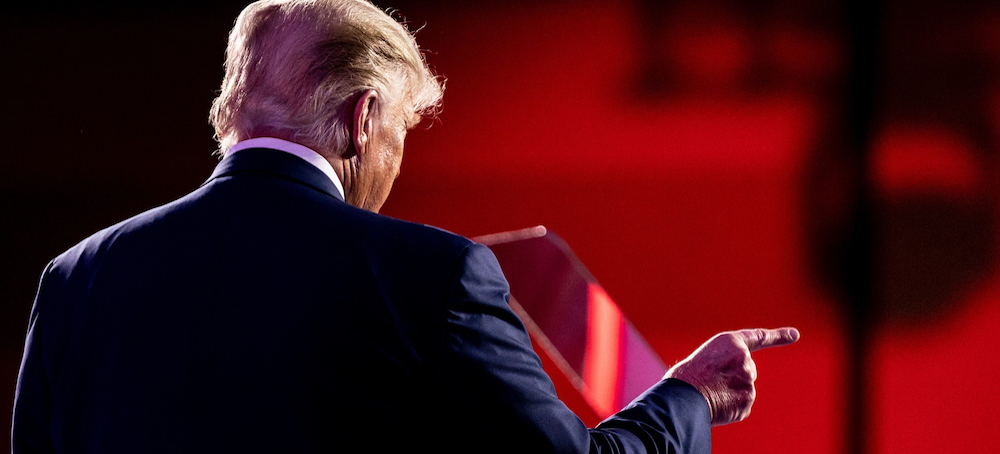 President Donald Trump. (photo: Erin Schaff/NYT/Redux)
Trump Faces Midterm Verdict With Control of Congress at Stake
Joseph Ax ReutersThe battle for the Senate is unfolding across nearly 10 closely contested statewide races, most in Republican strongholds.
History is against Trump's Republicans: the sitting president's party has lost ground in Congress in all but two midterm elections since World War Two. Trump's approval rating is hovering near his all-time lows, dragged down by deep voter frustration over the war with Iran and the resulting rise in fuel prices.
There is little doubt this year's election is all about Trump, who is nearly two years into his second term. Trump himself has told his supporters repeatedly to "pretend I'm on the ballot," a message Democratic leaders have happily echoed.
Trump touted in a television interview on Tuesday morning what he billed as his achievements in Venezuela and Iran and declared optimism for fellow Republicans.
In remarks that appeared aimed at swaying voters unhappy with US support for Israel, Trump said that he intended to stop $3.8 billion in promised annual funding to Israel after the end of this year, but it was unclear how he would do so, given a 2020 law mandating the funding levels in the agreement with Israel.
US policy toward Israel has been a particular focus in Michigan, where progressive Democrat Abdul El-Sayed is running a closely watched campaign for Senate.
The president has sought to energize his base with more than two dozen campaign rallies since the start of October, most in states he easily won in 2024.
Led by Trump, Republicans have portrayed Democratic candidates as radical, un-American and even communist.
But opinion polls show voters are most concerned about affordability, and disapprove of Trump's handling of the issue after his sweeping tariffs on imports, many of which were thrown out as illegal by the courts, and his decision to attack Iran in February increased domestic costs. Republican candidates, meanwhile, have struggled to distance themselves from a president who demands fealty and rarely acknowledges mistakes.
At a voting center in a predominantly Black neighborhood in northwest Detroit, Natalia Towns, 34, said she did not find efforts by Mike Rogers, the Republican Senate candidate, to court Black voters sincere, and felt El-Sayed would do more to bring down costs.
"I do feel like health matters, gas prices are high, food is too high," she said.
DOJ DEPLOYS ELECTION MONITORS
Democrats have warned that Trump, who has long falsely claimed that US elections are rigged, may attempt to challenge Tuesday's results if Republicans lose.
The US Justice Department said on Tuesday it was deploying 1,000 election monitors and observers to all 50 states in what it called the largest Election Day monitoring effort in history.
Democrats have criticized the plan as potential voter intimidation. Roughly two-thirds of the jurisdictions the department listed are in places where voters supported Democrat Kamala Harris over Trump in the 2024 presidential election, a Reuters analysis found.
All 435 seats in the US House of Representatives are up for election, along with 35 of the Senate's 100 seats, though most contests are not considered competitive. Democrats must flip at least three House seats and four Senate seats to win a majority in each chamber.
Democrats have little margin for error. The party must defend all of its current seats while winning at least two states that voted for Trump by a double-digit margin two years ago: Alaska, Iowa, Kansas, Nebraska, Ohio, South Carolina and Texas.
Opinion polls show Democrats either narrowly leading or within striking distance in all of those states.
ELECTION DRAMA IN MICHIGAN, ALASKA, TEXAS
The Michigan Senate contest between El-Sayed, 42, and Rogers, 63, represents a high-profile test of whether Republicans' identity-based attacks – El-Sayed would be the nation's first Muslim senator — prove effective in a battleground state.
A win for El-Sayed, who has criticized Israel and supports policies such as universal healthcare, would also be seen as a boost for the Democratic Party's left wing ahead of the 2028 presidential election.
The Alaska Senate race has been thrown into turmoil after the New York Times reported that the campaign of Democratic candidate Mary Peltola, 53, helped recruit a third candidate who shares the first and last name of her Republican opponent, Dan Sullivan, 61.
Peltola has denied involvement. Trump's Justice Department has launched a criminal probe into the allegations and filed a lawsuit to block certification of the election results, though a judge dismissed the latter effort.
In addition to its actions in Alaska, Trump's Justice Department also filed a lawsuit in California to block ballots it says may be invalid, a break from decades of practice meant to insulate elections from political interference. The US Supreme Court on Monday rejected the administration's request for an emergency order in the case.
In Texas, Democratic Senate candidate James Talarico, 37, has his party once again dreaming of winning the biggest Republican state after decades of heartbreak. His scandal-plagued opponent, Republican Attorney General Ken Paxton, 63, has benefited from a nine-figure investment from the world's richest man, Elon Musk, who has spent hundreds of millions of dollars boosting Republicans.
In Kansas, Democrat Adam Hamilton, 62, a megachurch pastor, holds a narrow polling lead over Republican US Senator Roger Marshall, 66. The state voted for Trump by more than 16 percentage points in 2024 and has not elected a Democratic senator in nearly a century.
And in Maine, Republican US Senator Susan Collins, 73, is once again seeking to defy the Democratic leanings of her home state and win a sixth term. She faces Democrat Troy Jackson, 58, a former state senate president who unexpectedly became the nominee after Democratic oyster farmer Graham Platner dropped out amid accusations of misconduct, which he denied.
There are 47 US House races widely seen as competitive, according to a Reuters analysis of the leading election forecasters. If the other contests all proceed as predicted, Democrats would need to win only 13 of those races to secure a majority.
The fight for the House has been waged largely on Republican turf, including some districts Trump carried by double digits in 2024. A Trump-backed Republican effort to redraw districts in several states to make them safer for the party appears not to have yielded the gains the president expected.