
Trump Doesn’t Realize the Risk Settler Violence Poses to His Plans. He Soon Will
Ben Samuels Haaretz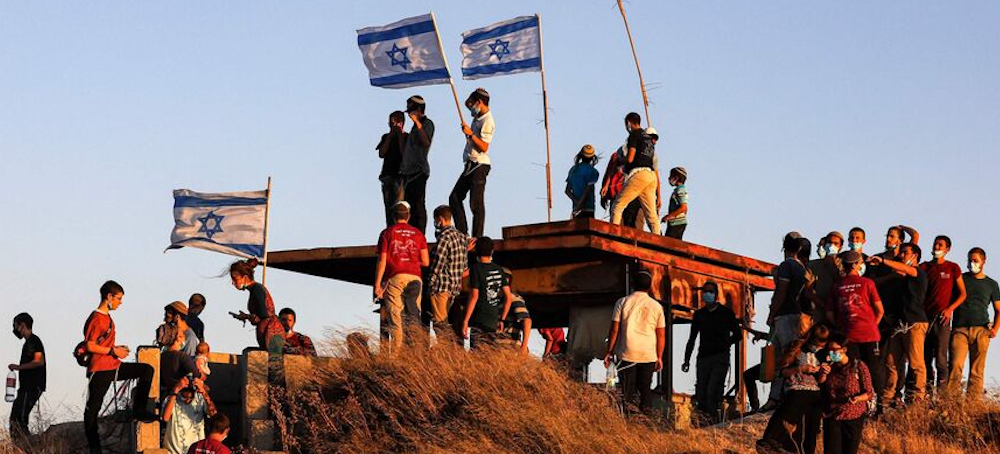 Israeli settlers gather on a hill next to the Palestinian town of Halhul, north of Hebron in the occupied West Bank. (photo: Menahem Kahana/AFP)
 Trump Doesn’t Realize the Risk Settler Violence Poses to His Plans. He Soon Will
Ben Samuels Haaretz
Haaretz Today Trump Doesn't Realize the Risk Settler Violence Poses to His Plans. He Will Soon Enough
Neither leader, however, is likely to dedicate much time or proactive thinking toward an issue that could very well spark the next regional conflagration: dramatically escalating Israeli settler violence in the West Bank.
Netanyahu, for his part, has taken pains to disregard such issues on the rare occasion that he is explicitly confronted with the problem (at least publicly), waving it away as several dozen bad apples, approaching the level of dismissiveness of "boys will be boys." Trump, for his part, has only raised the issue when it becomes a direct matter of concern to him – specifically when his Arab allies flag Israel's creeping annexation of the West Bank as a dealbreaker-level concern.
For all of Trump's bluster and for his open acknowledgement of Israel and Netanyahu serving as the junior partners in the U.S. bilateral relationship, he has only used his influence on several occasions to effect change in Israeli policy.
All of these instances – forcing Israel to abide by cease-fires relating to Gaza, Iran and Lebanon – came at the behest of Arab allies close to Trump's special envoys, Steve Witkoff and Jared Kushner, who explicitly stated Netanyahu was taking things too far.
For all the talk of America First, it is abundantly clear that the Middle East plays a significant role in Trump's vision of America's place in the world – even if you don't factor in that Iran now plays a significant role in whether Republicans keep control of Congress in the midterms.
Many of his aspirations in the Middle East hinge on Israel not being a headache or distraction. He has made no secret of wanting to link the Abraham Accords with the various investment opportunities he is attempting to cultivate, most recently with Saudi Arabia and civil nuclear cooperation. So there is no reason for Trump – whether morally, ethically, politically, geostrategically – to not explicitly prioritize calming tensions in the West Bank.
Trump, however, is apparently the last person to acknowledge that worsening tensions in the West Bank not only entrench Israel's regional alienation, but also stand to dramatically worsen facts on the ground. His administration's approach to the Palestinians has been overwhelmingly limited to a Gaza peace plan that has advanced piecemeal at best, while failing to empower Palestinian self-determination and shielding Israel from accountability on the international stage.
The West Bank is one of many factors informing Israel's rapid decline in the court of U.S. public opinion. Jewish-Americans find the conduct of settlers (and Israel's empowerment of them) largely detestable, young Americans are cutting bait with Israel at an overwhelming level, the majority of Democratic lawmakers and candidates alike have made it clear that this is unacceptable and even Republicans (save for the Netanyahu True Believers who will be the last to go down with the ship) are beginning to roll their eyes at Israel's destabilizing behavior.
The question now is whether Trump will continue treating the West Bank as a secondary concern that does not impact his calculus. He may be the last person to not realize that it already does, and unless he pushes Netanyahu to immediately stem the bleeding, he will find out soon enough.