
Trump Administration Is Deporting Parents Without Their Children in Violation of Its Own Policies, Report Finds
Maanvi Singh Guardian UK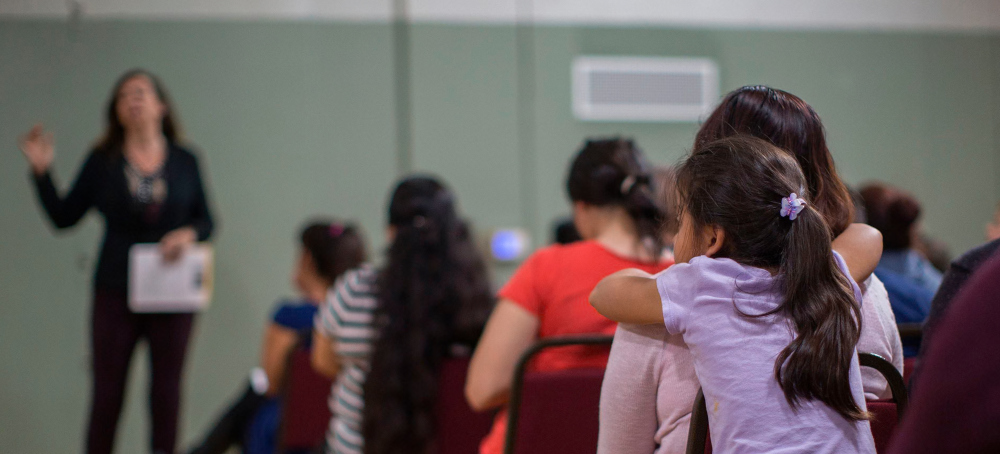 A child watches during a workshop for immigrants to make a preparedness plan, in case they are confronted by immigration officials, in Los Angeles, California. (photo: David Mcnew/Getty)
 Trump Administration Is Deporting Parents Without Their Children in Violation of Its Own Policies, Report Finds
Maanvi Singh Guardian UK
Dozens said they weren’t given chance to arrange care for their kids after being deported at short notice, study shows
In interviews with dozens of parents deported to Honduras, as well as physicians and psychologists, government officials and staff at reception centers for deportees, researchers found that many parents were deported quickly after they were detained, without a chance to arrange for the care of their children.
According to the report by the Women’s Refugee Commission (WRC) and Physicians for Human Rights (PHR), parents were forced to leave their children under the informal care of friends or family members who were also vulnerable to deportation. Others were separated from young children and toddlers – including a mother who was deported without her two-month-old baby.
Immigration officials “didn’t ask me anything”, one 22-year-old mother told researchers in Honduras, where she was sent without her two-year-old child. “They never said: ‘You have a daughter, you can bring her,’ because I would have brought [my daughter], she is very attached to me.”
Some pregnant and postpartum women, meanwhile, had arrived at reception centers in Honduras displaying “extremely high levels of emotional distress” including symptoms of anxiety and panic, according to staff at the centers.
“What we’ve found is fairly significant evidence that [Immigration and Customs Enforcement officers] are not asking about people’s children at the time of arrest. They are not ensuring that those children have safe care, and they are not allowing parents an opportunity to decide what happens to their children if they are deported,” said Zain Lakhani, director of migrant rights and justice at WRC.
The researchers said they chose to interview parents in Honduras, after they were deported, because the administration has made it increasingly difficult for lawmakers and lawyers to visit immigrants in US detention centers. The researchers stationed at three reception centers for deportees in San Pedro Sula, Honduras, over the course of five days. They encountered 163 women – three of whom were visibly pregnant – and 1,094 men.
Michele Heisler, a physician with PHR who interviewed parents in Honduras, said that several reported trying to explain to immigration officers that they had children, but were ignored. “We talked to parents who were detained one day, and they were literally deported a couple of days later,” said Heisler. Some had no opportunity to speak to a lawyer or coordinate with co-parents or other family members to reunite with their children before their deportations.
“This type of sudden, traumatic separation for both parents and the children – I think it’s fair to say that this is going to create a really high burden of mental health distress,” Heisler said.
The impact can be especially acute for tender-aged children and babies who are too young to understand why their parent is gone. “For a toddler, they are left with a sense of abandonment that’s kind of imprinted,” she said. Studies show that early traumas can have lasting psychological and physiological consequences.
“It’s hard for all of us to understand why there is this gratuitous level of cruelty happening,” she added.
Some of the parents interviewed were separated from children with disabilities and neurodivergence. One mother who was interviewed by researchers said she was detained while dropping off her son, who has autism, at school. “I left him and when I came back, I saw that some men were coming. They didn’t ask me anything, they just put me in handcuffs, and I couldn’t say even a word.”
The US Department of Homeland Security (DHS) did not immediately respond to a request for comment about the report’s findings.
The agency has told the Guardian on several occasions that it does not separate families, and that it allows parents the option to take their children without them. Previous reporting from the Guardian, as well as findings in the report, suggests that is not always the case.
Although the report was conducted in Honduras, Lakhani noted, she suspects that deportees to other countries likely face similar obstacles to reunification.
In July 2025, the administration changed its “Detained Parents Directive”, weakening protections for noncitizen parents and stepped back its commitments to keep families unified. For example, the 2022 version of the directive stipulated that ICE had to take into consideration whether or not an individual was a parent or legal guardian of a child in its decisions on whether to detain or deport them. The 2025 version of the directive no longer includes that guidance.
But interviews with deportees arriving in Honduras show that the administration is not even abiding by its current policies on family separation. “We’ve found fairly significant evidence that ICE [officials] are not asking about people’s children at the time of arrest. They are not ensuring that those children have safe care, and they are not allowing parents an opportunity to decide what happens to their children if they are deported,” Lakhani said.
Once parents are deported away from their children, it can be incredibly difficult, expensive and logistically complicated to reunite with their children. Although the Honduran government has some capacity to assist parents in reunifications, it lacks a formal process to receive and process parents’ claims.
If deportees’ children are US citizens, the process of acquiring proper paperwork for the children to live in Honduras can also be complicated, because it requires the consent of both parents. “What if the child’s father isn’t known to a mother or is not in contact with her? What if the child’s other parent is in detention in the US and cannot be contacted? What if they are a Mexican national, and they’ve been deported to Mexico?” Lakhani said.
Often, parents who are deported are forced to leave their children with co-parents, family or friends who may also be undocumented, and vulnerable to arrest and deportation. Those adults may also be fearful of contacting the US government to coordinate the reunification of a child with parents, or lack the funds or travel documents required to chaperone the child to Honduras.
The report makes recommendations including that the Honduran government invest more in helping deportees reintegrate, and prioritize assisting deported parents. It also calls on international organizations including the United Nations to coordinate and consult with the Honduran government to provide sexual and reproductive healthcare, and mental healthcare for deportees.
The report also calls on the US congress to codify policies to protect families and pregnant women in the immigration system, and asks DHS to “identify, document and protect medically vulnerable individuals in ICE custody” and create a “national coordinator” of child welfare to family reunification.