
Trump Administration Diverts Human Rights Funds to Push Far-Right Agenda Abroad
Andrew Roth and Joseph Gedeon Guardian UK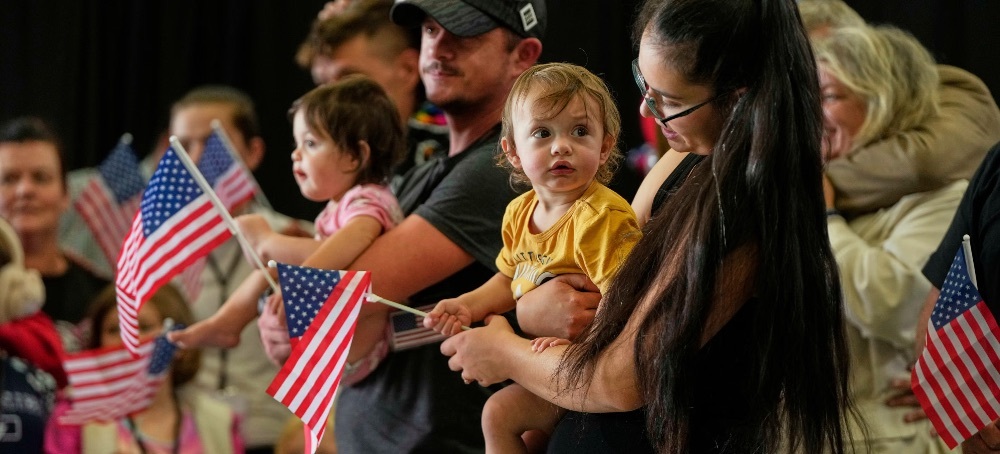 Afrikaner refugees from South Africa hold American flags as they arrive at Dulles airport in Washington last May. (photo: Julia Demaree Nikhinson/AP)
 Trump Administration Diverts Human Rights Funds to Push Far-Right Agenda Abroad
Andrew Roth and Joseph Gedeon Guardian UK
Support for white Afrikaners, anti-communism and others reveals how US redefining what qualifies as human rights
On Wednesday, the state department obligated the funds to the grantees hours before the deadline despite congressional concerns and requests not to do so, according to a source familiar with the negotiations. The Guardian has reached out to the state department for comment on whether it had “blown” holds from Congress on releasing the funds due to concerns about their use.
Critics have focused on 43 awards of a combined $176.9m that will bolster rightwing and conservative causes around the world while probably angering US allies over interference in internal politics. The Guardian has seen a sample of the controversial grants, which make up most of the $205m in funding that Congress has appropriated for the entire Human Rights and Democracy Fund (HRDF).
Sources with knowledge of the grant process have told the Guardian that the awards were personally lobbied for by members of the Trump administration, and reflect interests that include JD Vance’s warnings of the collapse of traditional western values in Europe and Stephen Miller’s push against immigration and to support white minorities in countries like South Africa.
“The story for me is the high-level – including White House-directed – attention on these programs,” said a person familiar with the discussions over the democracy awards. “These awards have been briefed at the highest levels of the department and have buy-in from the White House.”
The proposed awards represent a significant shift in US support for dissidents, human rights defenders and civil society groups under authoritarian governments. The new slate includes projects in wealthy nations, and those focused on opposition to regulation, Brexit, migration, anti-communism, Christian protection and opposition to “gender ideology”, offering a window into how the Trump administration is redefining what qualifies as human rights and merits tens of millions of dollars in US foreign assistance.
“Congress appropriated money for the democracy fund on a bipartisan basis to support defenders of human rights, to assist victims of human rights violations and to instead promote the growth of democracy abroad,” said Jeanne Shaheen, the top Democrat on the US Senate committee on foreign relations.
“The Trump administration’s proposals would use taxpayer funds to promote far-right organizations and programs in established democracies. This is a waste of resources and undermines United States values and relations with democratic partners, including allies in Europe.”
The largest award, of $40m, was directed to a consortium led by the Victims of Communism Memorial Foundation (VOC), an anti-communist non-profit that has received far smaller grants in the past. A state department vetting document seen by the Guardian records $96,997 in previous contracts in the last five years between the foundation and the department, all in the 2022 fiscal year, and notes that it had been vetted in 2019 in connection with tickets to the foundation’s gala. The vetting document also identifies Andrew Bremberg, a former Trump White House domestic policy adviser and US ambassador to the UN European office, as a “senior leader” of the foundation.
In July, ProPublica reported that Samuel Samson, a 27-year-old deputy assistant secretary overseeing the new grants, was linked to senior members of VOC through his studies at the Christian conservative Hillsdale College graduate program. (A state department official then told the outlet that the relationship had nothing to do with the grant).
Samson has described the US and Europe as partners in a shared civilizational struggle. Samson toured Austria, the Czech Republic, Hungary and Slovakia last December – all countries that were floated to receive a $2m grant to counter migration weaponized by Russia and Belarus – and criticized NGOs that previous administrations had worked with for promoting what he called radical concepts, including gender theory and DEI.
The state department did not comment on individual grants but said the programs were still in “active deliberation”, that awardees would meet guidelines for federal grants, and that all programming would undergo a “standard and rigorous vetting process by grant professionals”.
“Our programming in Europe aims to support our European allies in defending those rights and principles, along with their civilizational self-confidence and sovereignty from those who seek to undermine them,” a state department official said. “The national security strategy highlights our priorities in Europe which includes advancing political liberty, promoting free speech, and collaborating with European partners to jointly support European revitalization and civilizational self-confidence.”
Under the legislation authorizing the fund, the money must be assigned by 30 September, the end of the fiscal year, when unobligated funds typically lapse. Shaheen, the ranking member of the Senate foreign relations committee, has put a partial “hold” on giving the grants to some of the controversial awardees – setting up a showdown with the state department with just hours left for the money to be obligated.
ProPublica first reported that Trump officials had drawn up at least a dozen no-bid grants aimed at rightwing and anti-immigration causes in Europe and advocates for white South Africans.
The document now shows how much of the fund the plan takes up, and which awards have since been dropped.
A $1m award titled “Countering Lawfare and Censorship in Brazil” would fund civil society groups opposing what it calls judicial overreach and censorship by Brazil’s supreme court. The Trump administration sanctioned the Brazilian justice Alexandre de Moraes last year after lobbying by Eduardo Bolsonaro, son of the former president.
A program titled “Promoting Western Civilization Allies” would be limited to implementers who do not subscribe to “ideologically weaponized accounts of human rights, such as gender ideology”, according to the document, and will receive $2m. It names possible recipients in Poland, Slovakia, the Czech Republic, Hungary, and the Balkans with “anti-communist” and “natural rights” approaches.
One award was allocated to document “democratic backsliding” in Europe tied to “mass and illegal migration” and legislation by “supra-national entities”, while a $1m journalism consortium would push back against designations of “trusted” media outlets. The list also includes $2m for early-warning networks protecting Christians in Nigeria.
And a $3m no-bid award would go to the Jobs Foundation, a UK group run by Matthew Elliott, who led the Vote Leave campaign. The grant, titled “Countering Overregulation to Advance American Investment”, would promote a “common good capitalism index” and pro-business policy, including how the foundation promoted Brexit as a chance to cut the UK’s climate regulations.
The document also shows that a proposed $5m no-bid grant to the Free Speech Union, the British group founded by Toby Young, has been marked “withdrawn”. When the award was first reported in July, Young said the group had never applied for or received US government money (though Trump officials had reportedly met with the group during a European tour late last year).
The grant would have paid the group to campaign against online safety and hate speech laws, including Britain’s Online Safety Act, a law passed under the Conservatives in 2023. Meant to protect children from harmful content and is enforced by Ofcom, its age-verification rules – which took effect last year – have drawn constant criticism from the Trump administration, which cast them as censorship.
The Free Speech Union is the second British group to drop off the list. A $7m no-bid award to 878, a thinktank whose stated missions include restoring Judeo-Christian culture and “ending mass migration and deporting illegal immigrants”, was abandoned in July after pushback from Congress. It was founded by Jacob Rees-Mogg, who served as Brexit opportunities minister and business secretary before losing his seat at the 2024 election, and now presents on GB News.
The British awards would have sent $15m in US taxpayer money to groups run by two sitting Conservative peers and a former cabinet minister, regarding issues including online safety law to migration.